

The Forests of India do not reveal their big cats easily. As the minutes stretch into hours, the silence itself becomes part of the experience, interrupted only by birdsong, rustling leaves, and the calls of unseen creatures. Then suddenly, in a fleeting moment, leopard appears, almost like a phantom, moving or prowling with effortless grace before melting back into the wilderness as though it had never been there. The encounter may last only a few seconds, but the surge of excitement and awe lingers long after. It is a rare privilege to catch a glimpse of a tiger or leopard, while one is surrounded by silence, which suddenly breaks and that makes the whole experience, so unforgettable.
One such surreal experience was captured by Dr. Prasad J Kamath, which we are are sharing with our readers.
– CLN Newsdesk
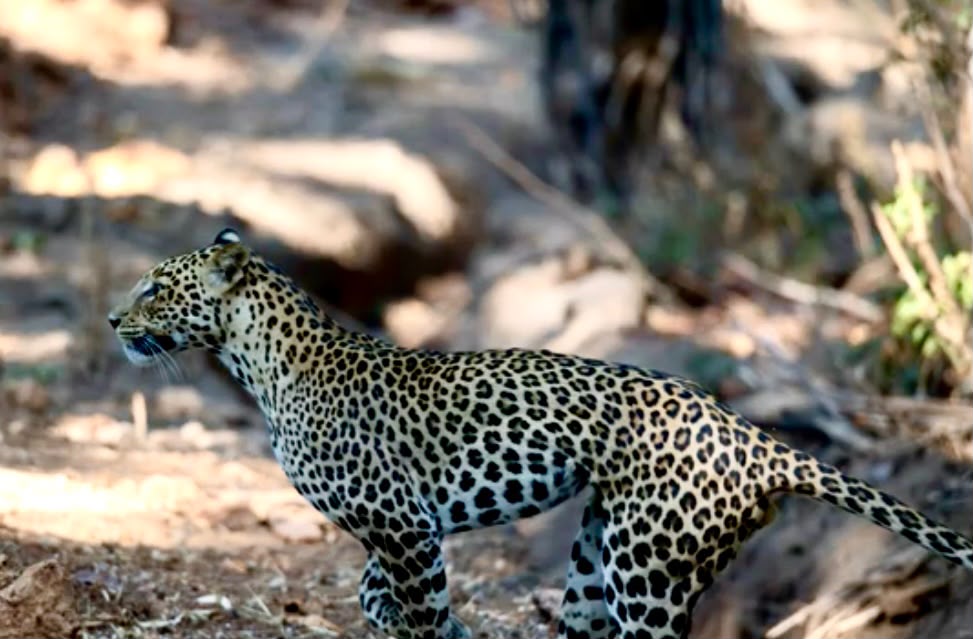
For just 13 seconds, Kanha’s forest revealed one of its best-kept secrets—a leopard sprinting across the road before disappearing into the Sal forest.
Some moments in the wild last only a few heartbeats, but stay with us forever.
Watch this rare encounter from the Kisli Zone of Kanha National Park.
© Dr Prasad J. Kamath, Gynaecologist; Endoscopic Surgeon. A Nature Enthusiast by passion.
The Silent Earth Stories attempts to capture such unique experiences which can seldom be anticipated. The series will cover many such events, which I hope to share in the future.
Join our WhatsApp Group for News and Article Alerts



What Dr. Prasad mentions is spot on. His vision takes me straight to The Silent Valley National Park, a rich biodiversity of Nilgiri Biosphere Reserve. This is one of the last undisturbed tracts of Western Ghats rain forests and tropical moist evergreen forest in the country.
In my article Preserving the Quintessential Forests and Lofty Trees of Coorg, I had referred to this quote –
Tipu Sultan, recalling his military campaign against Coorgs(Kodavas) in 1784, notes in his Memoir:
The Valley was surrounded by thick jungles of very lofty trees around it, so that even at mid-day the valley was so dark that one could hardly see the earth under one’s feet.
I have experienced some of this “silence” during my treks to the forests beyond Mandalpatti, the Biddanda Jamma Malai beyond ChomaKund and the forests behind Talekaveri. All close to two decades ago. The forest consumes the visitor. During my journeys through the myriad forests of Kodagu, the Kodava, Kudiya, Jenu Kuruba and Kapala guides who accompanied us invariably showed profound respect for the forest spirits. Before entering, they would quietly seek permission and pray for safe passage, reflecting an enduring bond with the forest.
Kodagu still possesses such precious patches of tree canopies (best left unspoken). For those in the know, we have to ensure that these sacred forests are preserved, nurtured, expanded and left as reminders of what a large part of Kodagu once was – before the rampant onslaught by the British planters, later emulated by the locals and the relentless extraction of timber Post 1956.
We asked Dr Prasad about the thought process behind
𝙎𝙞𝙡𝙚𝙣𝙩 𝙀𝙖𝙧𝙩𝙝 𝙎𝙩𝙤𝙧𝙞𝙚𝙨…. and this is his reply:
Silent Earth Stories is built on a simple belief that the natural world is always telling stories. To listen, one needs to willingly slow down and immerse oneself in nature, to let the stories unravel themselves.
Beyond dramatic wildlife encounters lies a quieter world of hidden lives of birds, insects, reptiles, forests, rivers, and the intricate relationships that have evolved over millions of years. Every creature, no matter how small or overlooked, has a story worth telling.
Through immersive storytelling, natural history, and thoughtful observation, Silent Earth Stories, seeks to inspire curiosity, deepen our connection with nature, and remind us that conservation begins with patient observation and understanding.
In a world growing louder each day, Silent Earth Stories invites you to hear the whispers of the wild.
Nice article about big cats and appreciate the efforts of Dr Prasad J. Kamath for sharing it in CLN for wildlife enthusiasts.
We are really proud to have these big cats in our neighbourhood forests in good numbers as compared to 18 other states.
India holds just over 66% of the world’s estimated population of 5,574 adult wild tigers (ref. IUCN). Karnataka’s forests are among India’s most important habitats for big cats, supported by strong protection, wildlife corridors, and sustained conservation efforts.
According to the latest tiger and leopards estimated count carried out by the National Tiger Conservation Authority (NTCA) and released by the Government of India on 29th July 2023, the current tiger population especially in our Karnataka forests are encouraging.
A beautifully written peice that captures the magic of India’s forests with remarkable elegance. The description of silence, anticipation and the fleeting appearance of the leopard transports the reader straight into the wilderness. It reminds us that the greatest wildlife encounters are not measured by how long we see an Animal, but how deeply the moment stays with us. Congratulations to CoffeeLand News and Dr. Prasad J. Kamath for sharing such a captivating experience that inspires admiration for our forests and the need to protect them .
Beautifully written. It brought back one of the most unforgettable moments of my childhood.
I was about 11 years old, travelling through the forests of Mudumalai with my father and a Forest Ranger in an open jeep. For what seemed like hours, there was only silence—the kind of silence that belongs only to an ancient forest. Then, without warning, a leopard emerged from the shadows on our right, crossed the road in a single effortless leap, and disappeared into the jungle on the other side.
It lasted no more than two or three seconds, but I can still see it vividly more than fifty years later—a flash of gold, yellow and black, pure muscle and grace. It wasn’t merely a sighting; it was a privilege. Some moments in nature become permanent memories, and that magical encounter has stayed with me all my life.
Thank you, Dr. Prasad J. Kamath, for bringing those memories rushing back.