

“What humans do over the next 50 years will determine the fate of all life on the planet.” – Sir David Attenborough.
Conservation of forests has been an integral part of Kodava culture. Before the advent of coffee plantations, Kodagu (Coorg) was covered with massive trees, many of them hundreds, if not thousands, of years old. Sacred spaces within the forest – known as Devarakads‘ (Gods own forests) were preserved and venerated primarily for the diety Botekara Aiyappa (The God of Hunt), by the Kodavas.
Dr. George Bidie in his 1869 report on destruction of forests in Coorg, due to coffee cultivation by the European planters, noted that:
Only a very few clearings have been made in this tract, and the land, as a rule, is in the hands of the Coorgs, who seem anxious that the standing forest, of which there is a great deal, should be left untouched, and the district kept sacred to them and their descendants.
Times change, and so does people’s mentality. The natives also took up Coffee Cultivation and Coorg started to witness wide scale clearing of forests.
While some Devarkadus were indeed in the forest – many were in the “cleared” coffee plantations; which were sadly encroached by planters. It has had serious environmental implications, besides furthering human-animal conflict, the consequences of which are now being witnessed in the form of the man-elephant conflict in Coorg.
In 1871, worried about the encroachment of forests and Devarakadus in Coorg, the Officiating Superintendent of Coorg noted in his letter to the Secretary of the Chief Commissioner {Emphasis mine}:
In Coorg there are forests called Devaroo-kadoo, or sacred woods, which, until late years, have never been touched by man; but now the villagers have made a theory that there is no sin in planting coffee in them so long as a portion of the produce is devoted to the deity. The result is that several of these forests have been invaded; and though a small portion of the produce of the coffee planted is given to the deity, that is to say, to the Poojaree, or Takka, the bulk of the crop is carried off by the villagers, or by the more influential persons among them.
It is a widespread belief that those who are “merchants” of timber exploiting Nature – have faced terrible consequences of family trouble and lineage. Many elderly Kodavas told me that the curse of the forest spirits is real and does take effect.
To make matters worse, following the loss of statehood, forestry management underwent a significant change after 1956. Corruption, which had been virtually absent under the Coorg administration, increased considerably, along with illegal activities involving timber merchants primarily from Kerala. In late 50s and early 60s in Pattighat Reserve Forest thousands of Trees were cut for Southern Railways which was used for Railway Bogies and Railway tracks.
According to Thamoo Poovaiah, a committed environmentalist and member of the NGO – Kodagu Ekikarana Ranga, as per the Government report of 1900, Kodagu had nearly 15,000 acres of Devarakadu forests, much of which was gradually lost due to encroachment by local villagers for coffee cultivation. He noted that during the late 70s and early 80s, certain politicians distributed portions of the Devarakadus to migrants from neighbouring districts to create their new vote banks.
Further stating that – In 1991, Kodagu Ekikarana Ranga launched a strong movement against the Government of Karnataka on the issue. Subsequently, in 1994, then Chief Minister S. Bangarappa convened a meeting with representatives of the Kodagu Ekikarana Ranga and Kodagu MLAs, following which an order was passed declaring all Devarakadus as Protected Forests. Until then, these lands had been classified as Revenue land. At present, a mere 5,000 acres of Devarakadu forests remain protected in Kodagu.
It is the sacred duty of the present and future generations to mitigate the damage already done and preserve whatever precious forests remain and restore the same to its former glory.
Tipu Sultan, recalling his military campaign against Coorgs(Kodavas) in 1784, notes in his Memoir{Emphasis mine}:
The Valley was surrounded by thick jungles of very lofty trees around it, so that even at mid-day the valley was so dark that one could hardly see the earth under one’s feet.
What happened to the Thick Jungles and the Lofty Trees?
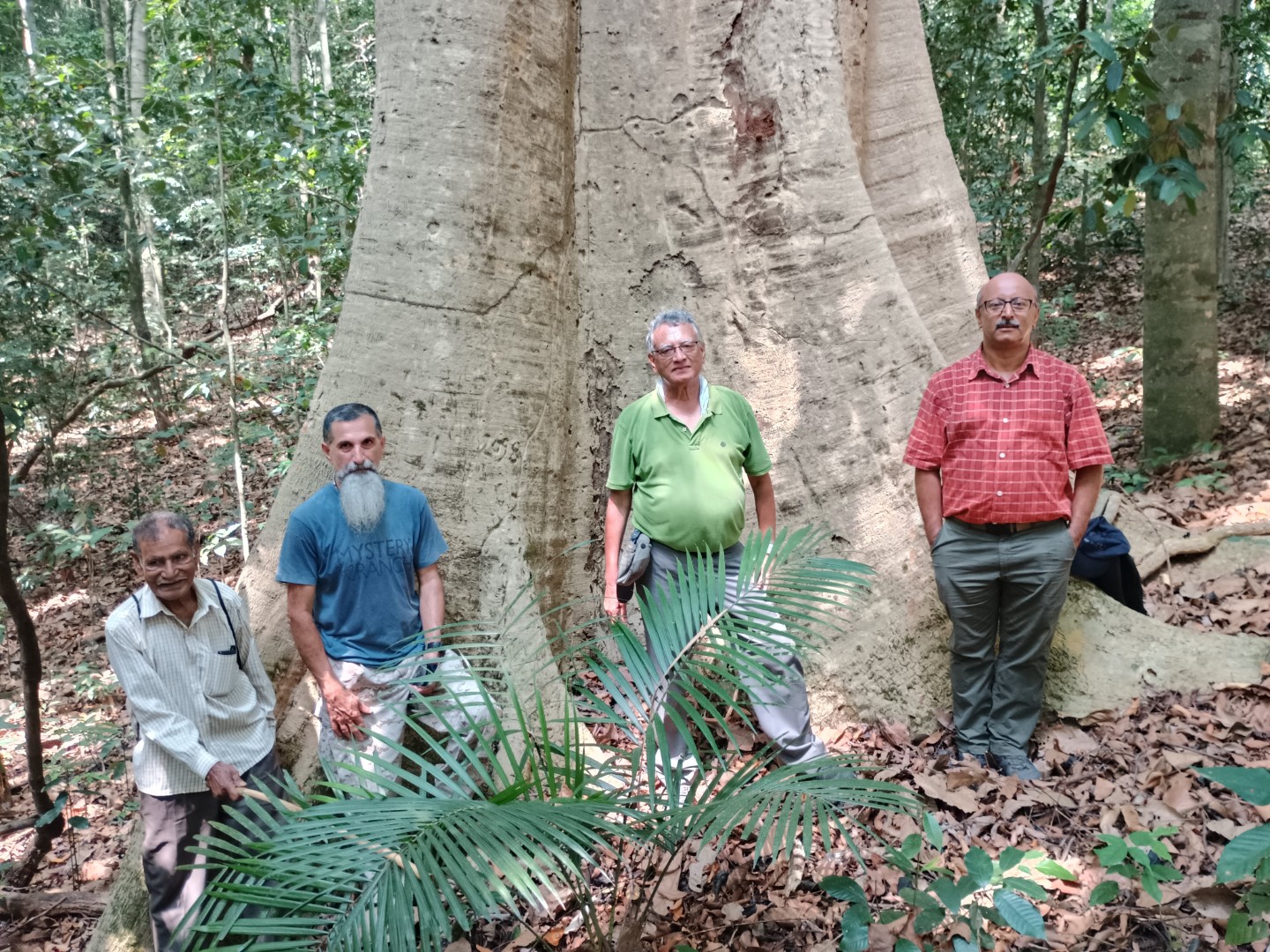
During the course of my conversation with Poovaiah, I asked him whether any such forests and “lofty trees” still existed in Coorg. He smiled and showed me an image of a massive tree, with four men standing beside its enormous trunk.
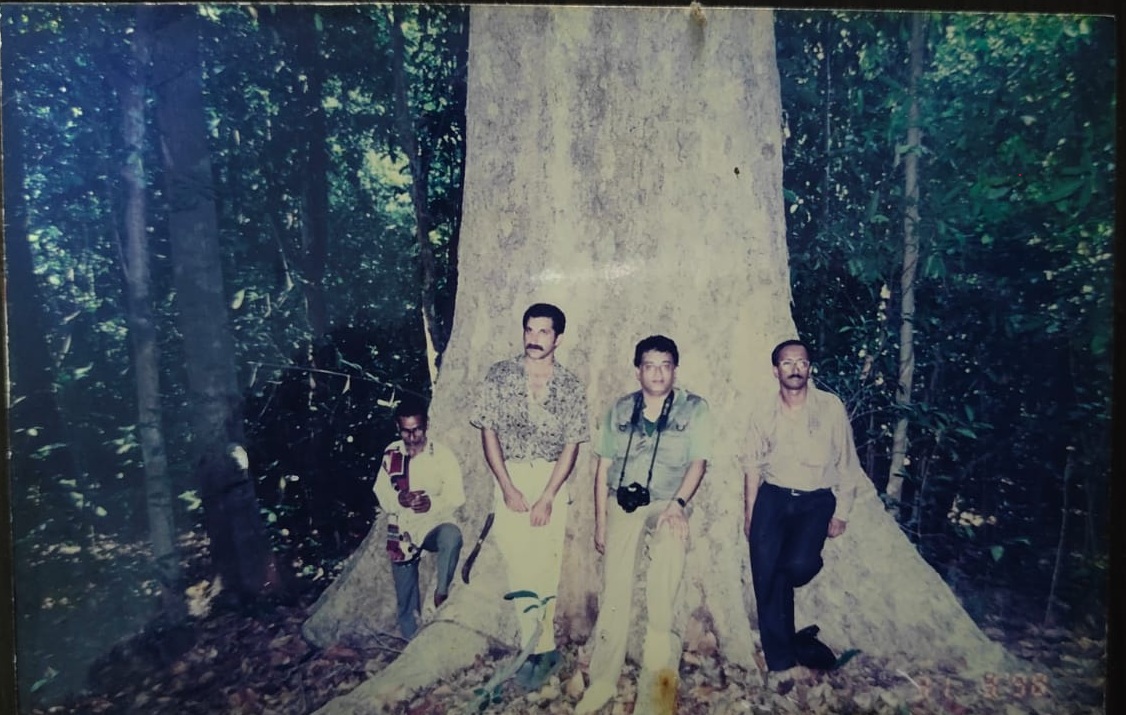
This huge Cedar tree and others in the forest was saved by the timely intervention of Poovaiah in 1994. Its Girth was 18 feet, Stump was 23 feet, and Height was 130 feet, when it was measured in 1994.
The story behind saving the Indian Cedar Trees and its home
In 1994, Poovaiah, took his newly purchased Yamaha RX 100 for a ride across Coorg. He came across a Senior Forest Officer of Madikeri Forest Division and a Senior Surveyor along with their staff, measuring the land inside Pattighat Reserve Forest with their land survey chains. Sensing something amiss, Poovaiah conforted them, asking why are they measuring land inside a protected reserve forest. They told him that there is a “Contempt of Court” order and he should mind his business, if he does not want to get in trouble.
Growing up in Coorg, Poovaiah had noticed how thousands of acres of forests had been leased to timber merchants and they had stripped the virgin forests bare of all the magnificent native trees. To provide an example – they would take a contract for an area inside forest, which would be limited to felling 100 trees, but then in connivance with corrupt in the department, they cut down thousands of trees. There still exist Rubber Plantations on a 999 year lease in Kodagu forests. However, it is a sham contract, as illegal felling of trees has taken place on such leased lands. I have seen it all. – said Poovaiah.
The Contempt of Court Puzzle
Poovaiah contacted Chowrira Devaraj, who was posted as Deputy Conservator of Forests (DCF), Forest Squad, in 1994. Devaraj was a upright officer and he himself was flummoxed, when he heard that the survey is being carried as their is a “Contempt of Court” order against the Govt Department. Devaraj looked into the matter, and then handed over certain documents to Poovaiah. When Poovaiah went through the documents, the pieces of the puzzle fell into place.
The Scam, to Scam the Government
The documents that Poovaiah accessed, laid bare an elaborate plan to change the land survey map and allow an individual, who was a planter and timber merchant, to illegally claim ownership of a part of reserve forest land.
The Backstory
In 1980’s, a timber merchant cum planter bought a cardamom plantation at Betathur village, which borders the Pattighat Reserve Forest. Unable to extract a proper yeild from the plantation, he abandoned the plantation. And later, devised a plan, in connivance with the Senior Forest Official of Madikeri Forest Division, to get the survey maps altered so that his land will appear as if it was located inside Pattighat Reserve Forest, instead of the village where it was actually located. He could have made a killing, by claiming the forest land as his private property and felling illegally – hundreds of years old Indian White Cedar(Dysoxylum malabaricum) and other native trees, such as ebony and other speices from the reserve forest.
The Assistant Director of Land Records (ADLR), was also roped in and the fraudster submitted an application to the ADLR stating that he had lost the records of his land being located in the area where he had originally bought it and wanted a new survey done by the survey department to identify the land and provide him new records for the same. The ADRL, as planned, was not to respond to this application. And he did not. Again a second reminder application was submitted to the ADLR. Again the ADLR did not respond, as planned.
Fraudster goes to Court
Now the fraudster moves High Court praying for relief, telling the Court that the ADLR is not reponding to his pleas. High Court issues summons for the concerned to respond, and this time also the ADLR does not respond. The game was to deliberately ignore the court orders so that the High Court would issue contempt proceedings and, in the process, become an unwilling participant in the entire scheme of things.
Contempt of Court Order issued
As the ADLR had not responded to the High Court’s summons, the Court issued a Contempt of Court order against the Department and ordered them to do a survey and issue new land records to the Petitioner, without any further delays.
Taking this Contempt of Court order as a shield, the Senior Forest Officer, Senior Surveyor and their staff, landed in Pattighat Reserve Forest to survey the land and change the land records map, to record that the land of the fraudster was not located in the village near the Reserve Forest, instead a part of Pattighat Reserve Forest was to be marked as his land in the survey maps and issue new records for the same.
Poovaiah filed a case in District Court, bringing it to the Court’s notice that the the forest department and the Land records department were surveying land in the reserved forest and were conspiring to fiddle with the demarcation of the forest land by shifting the survey marked stones and trying to alter the survey maps. The District Court served notices to the Forest Department and Land Records Department, to respond. Both the departments fienged ignorance of any such survey. The matter ended there.
They developed cold feet and ran away, said Poovaiah.
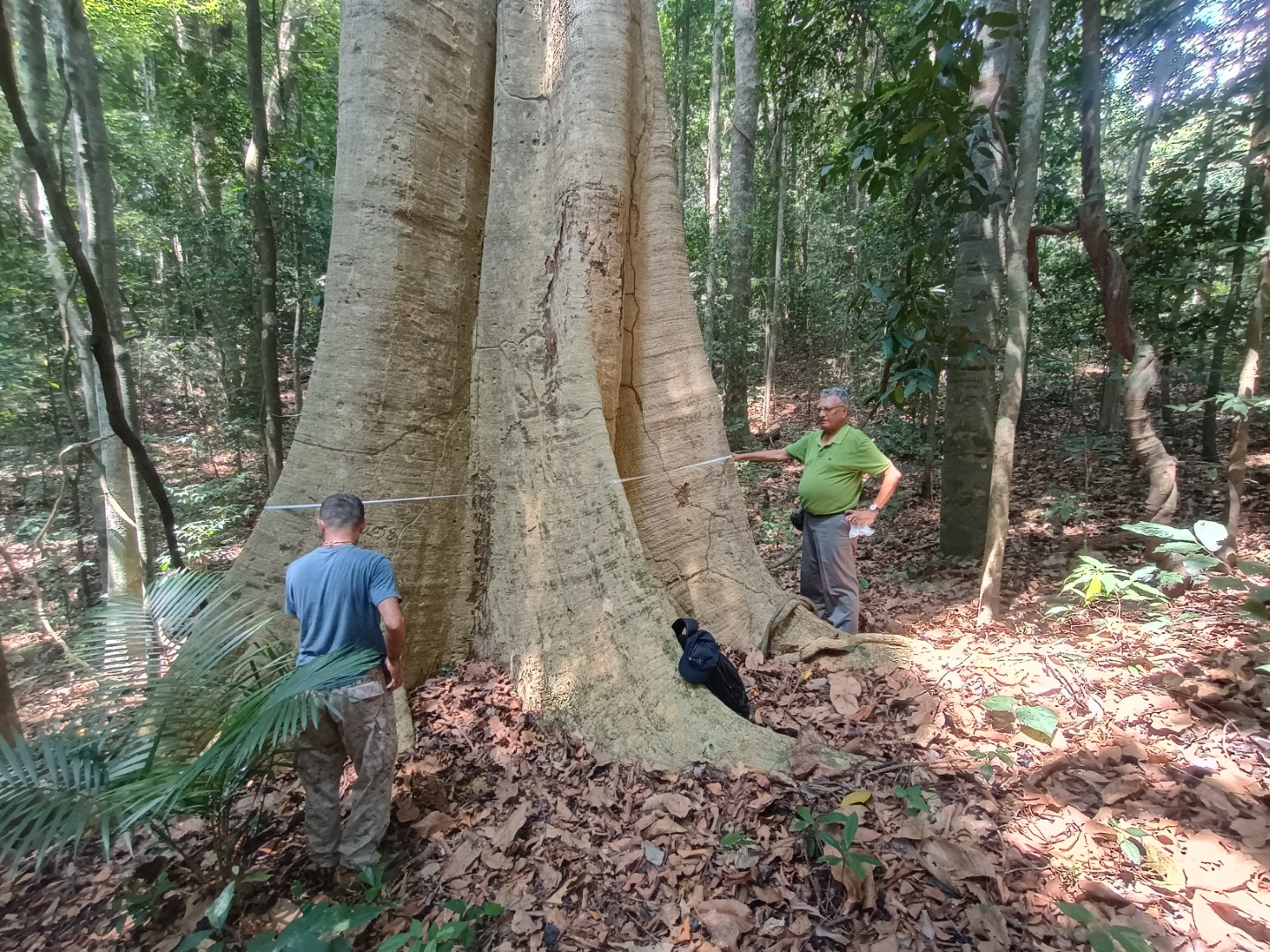
I along with my friends then visited the Reserve Forest and took a photo with a Indian Cedar Tree. We measured a tree at the time. Its Girth was 18 feet, Stump 23 feet, and height was 130 feet. Most of such majestic trees have been felled. The ranges of Brahmagiri, Pushpagiri and Talakaveri Reserve forest are the last refuge of such trees, and the threat of Timber Mafia still looms over them, Poovaiah lamented.
Is that lofty tree still alive?
I asked Poovaiah if that Indian Cedar Tree where he had clicked the photo in 1994, is still existing. Ofcourse, he said and stated that – I have friends in that area, who alert me if they see anyone trying to pull a fast one in the forests. And now with news and social media accessible to everyone at their fingertips, it is not easy to hoodwink so easily and get away with it.
Can we visit the tree again, I requested him. Poovaiah smiled and said – Sure, I will call my friends who came with me in 1994. Will keep you informed.
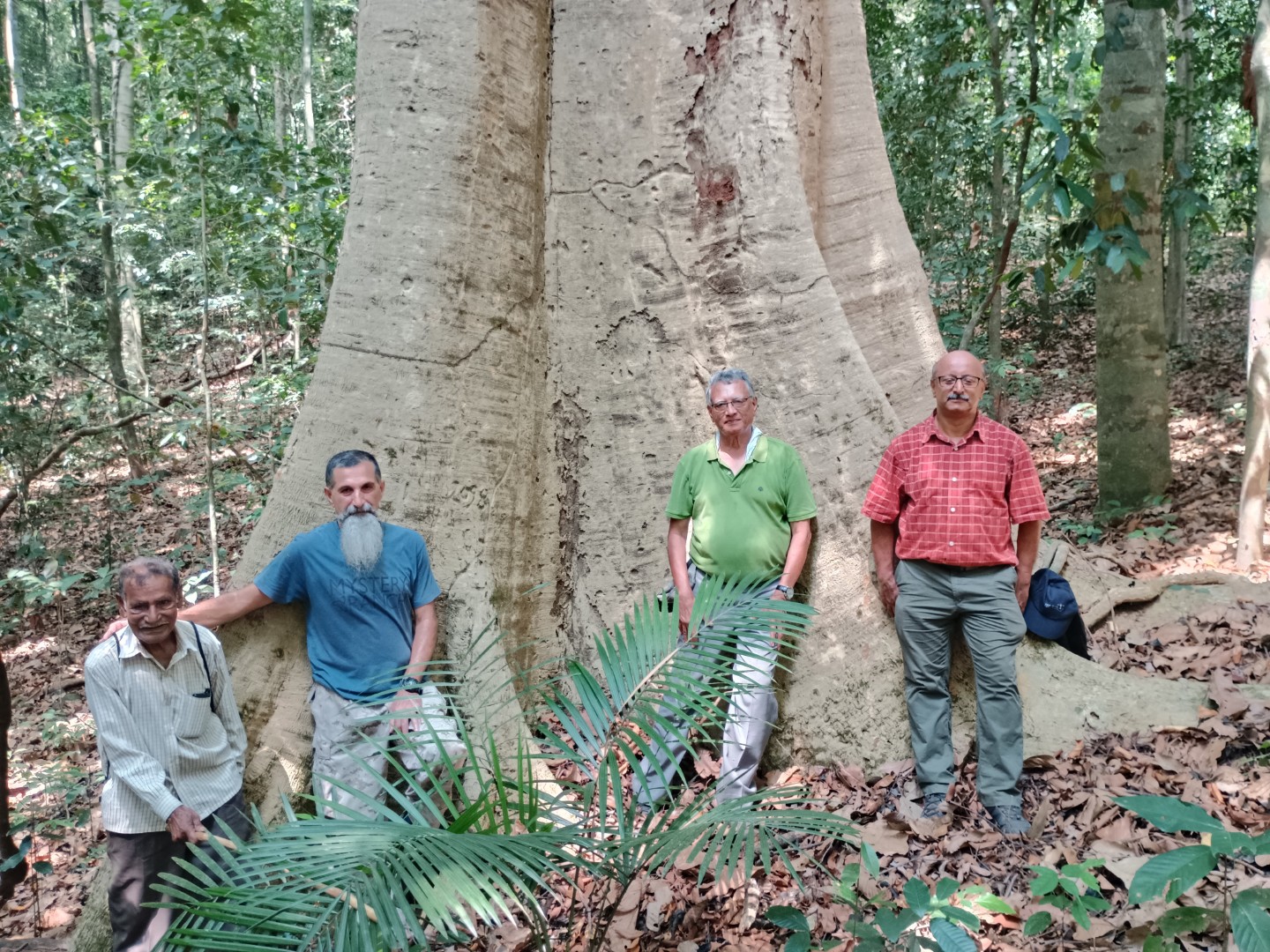
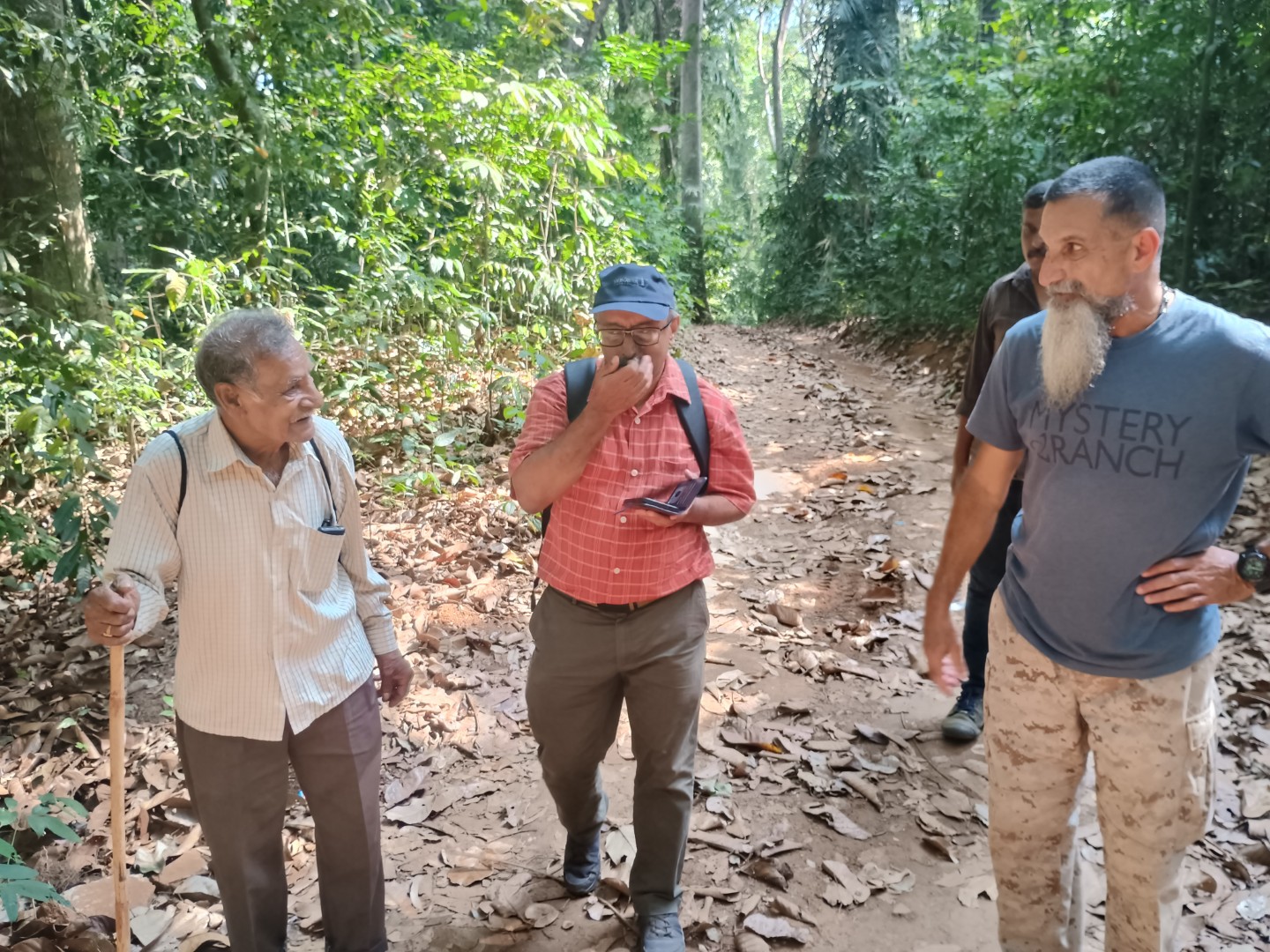
After a few weeks, Poovaiah arranged for me to visit the tree. I was delighted to meet the men who were with Poovaiah in the 1994 photo. Kudiyara Ponnappa, is now 84 years old and a treasure trove of knowledge, Kodandera Chinappa is 61 years and Pandira Muthanna is 55 years. Both also have vast knowledge of Coorg’s forests.
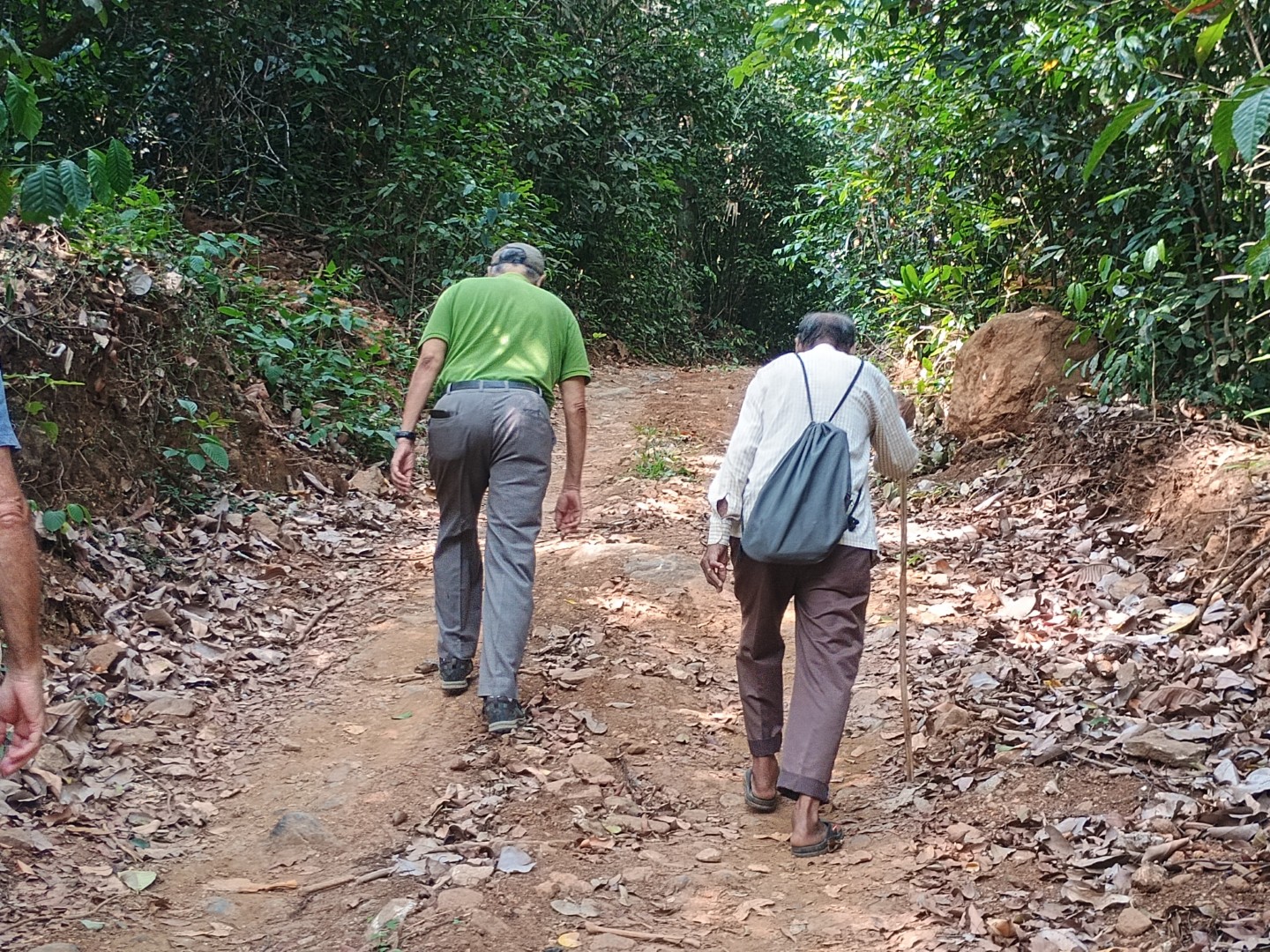
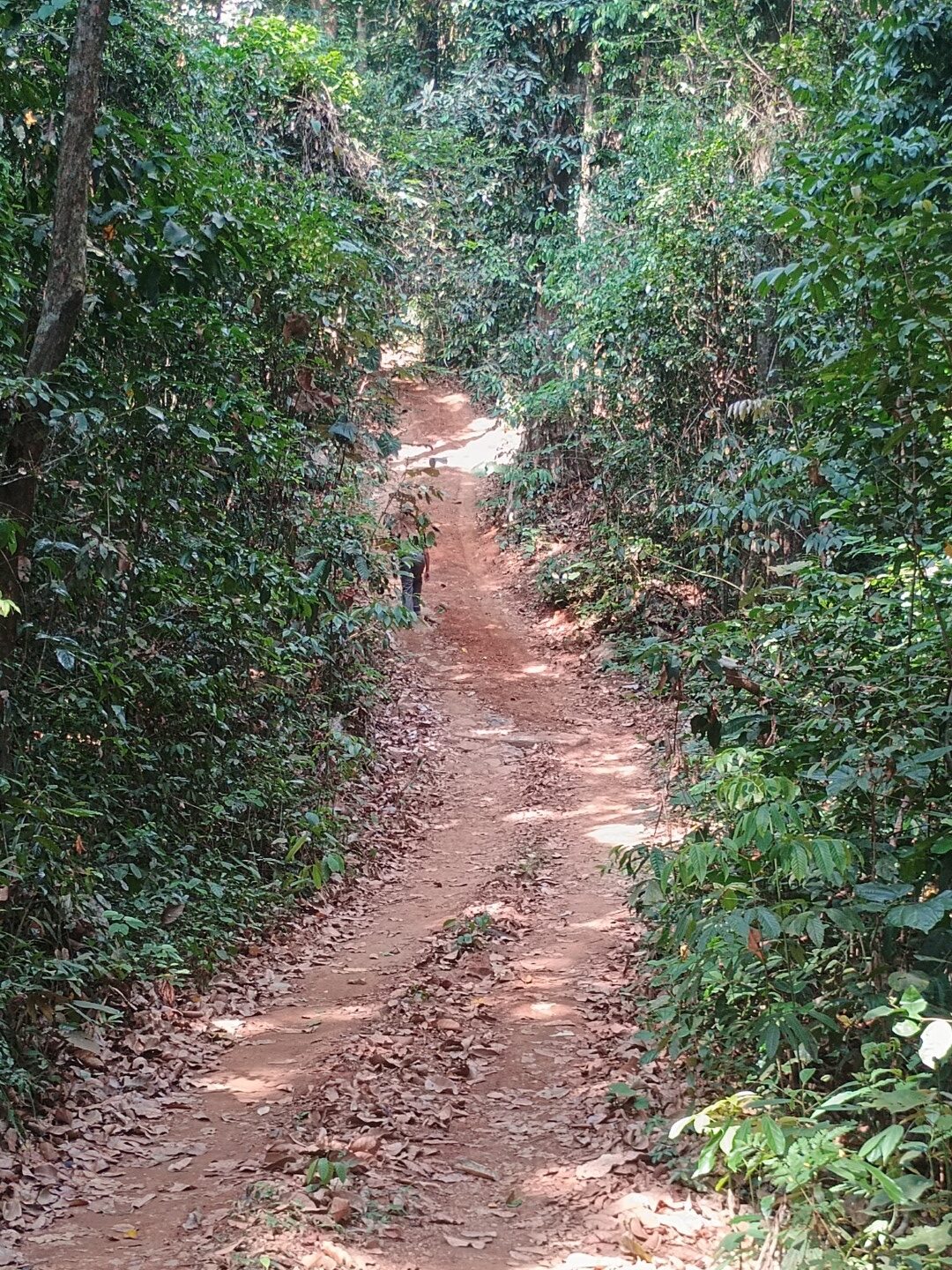
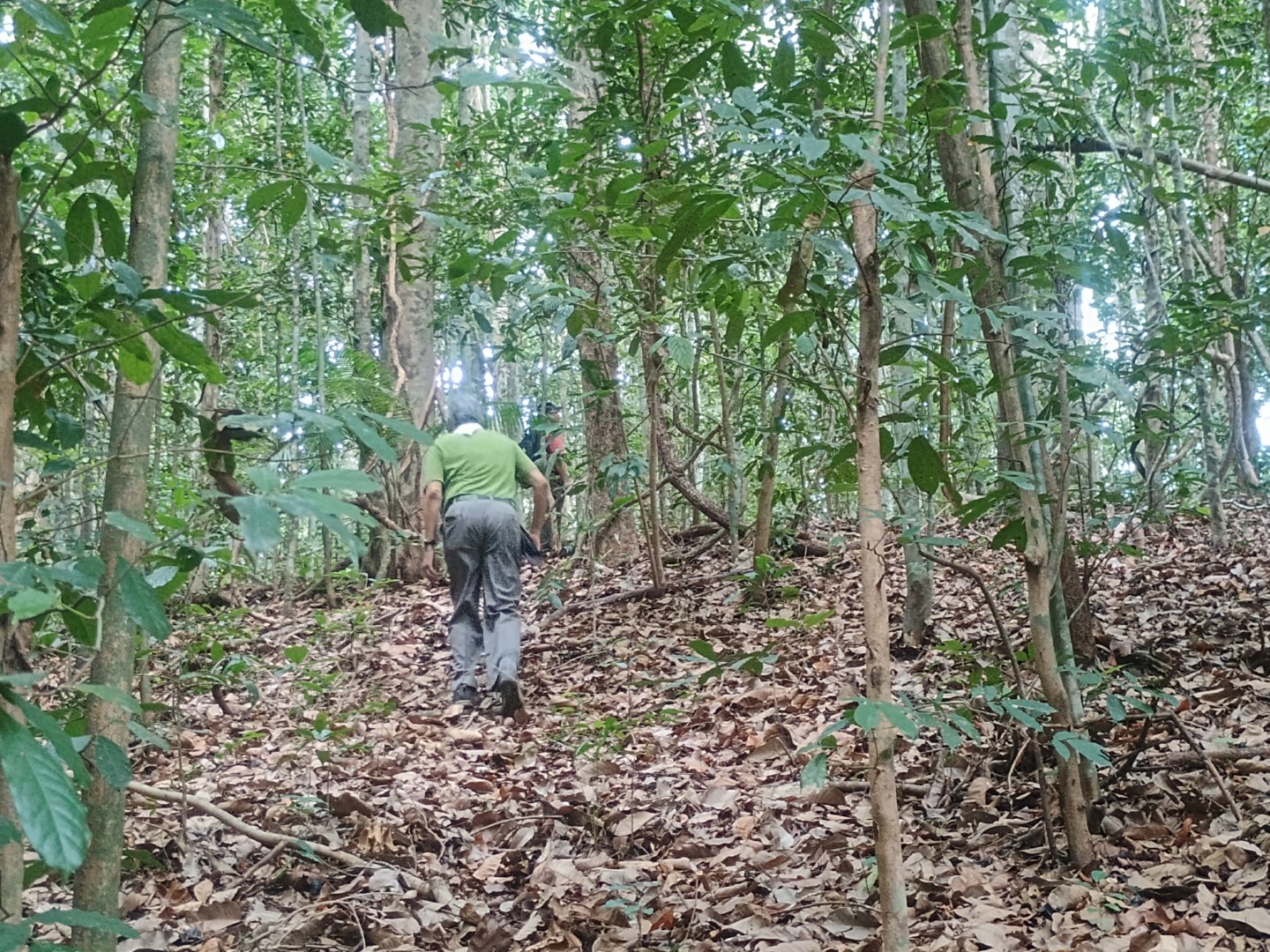
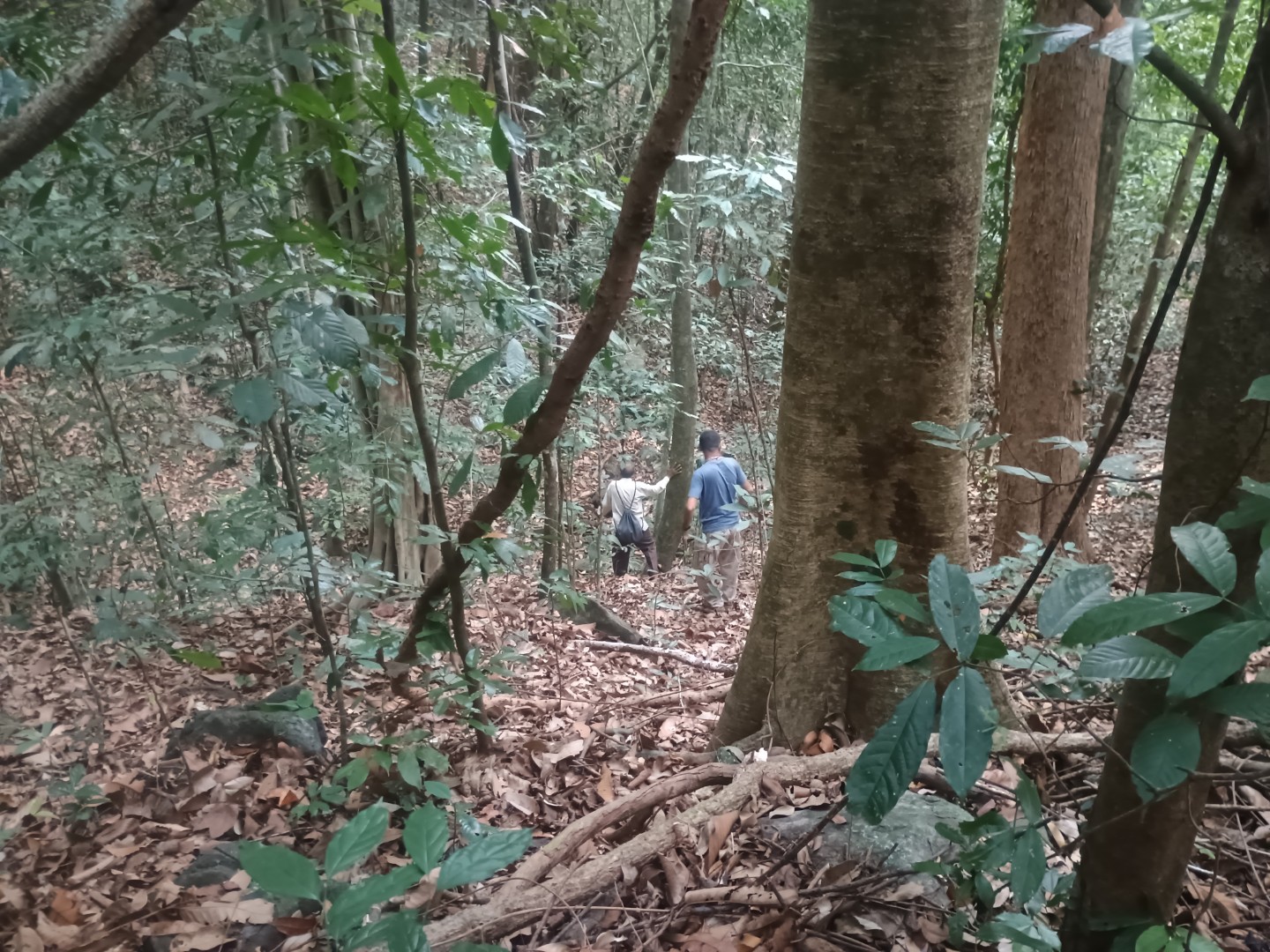
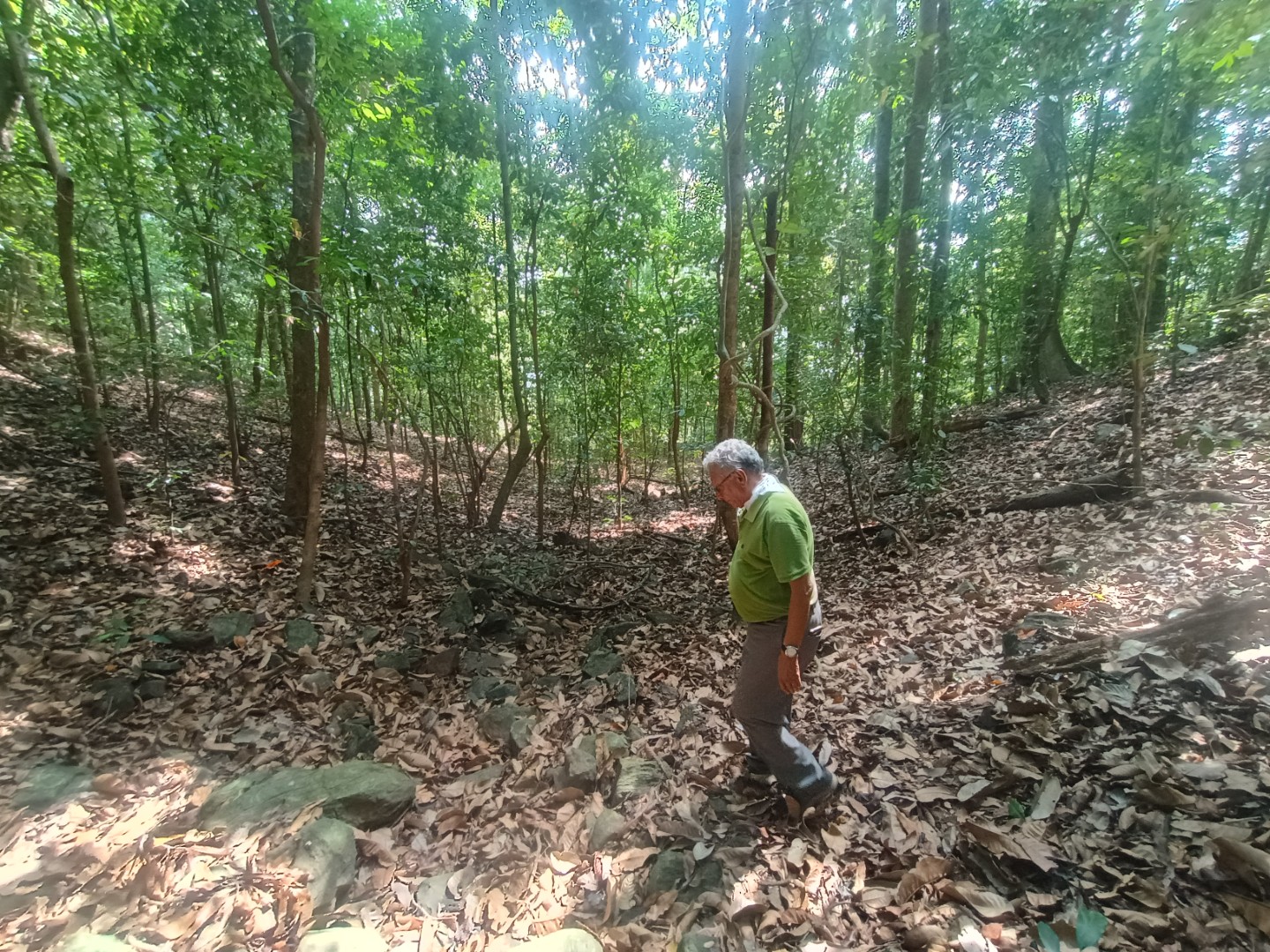
To visit the Cedar tree, we had to trek 2.5 kms inside the forest, uphill, a steep climb. I was wondering if Kudiyara Ponnappa who is 84 and Thamoo Poovaiah(75) can make it?
Was impressed to see that it was they who were climing up the steep pathway with ease, while I was lagging behind.
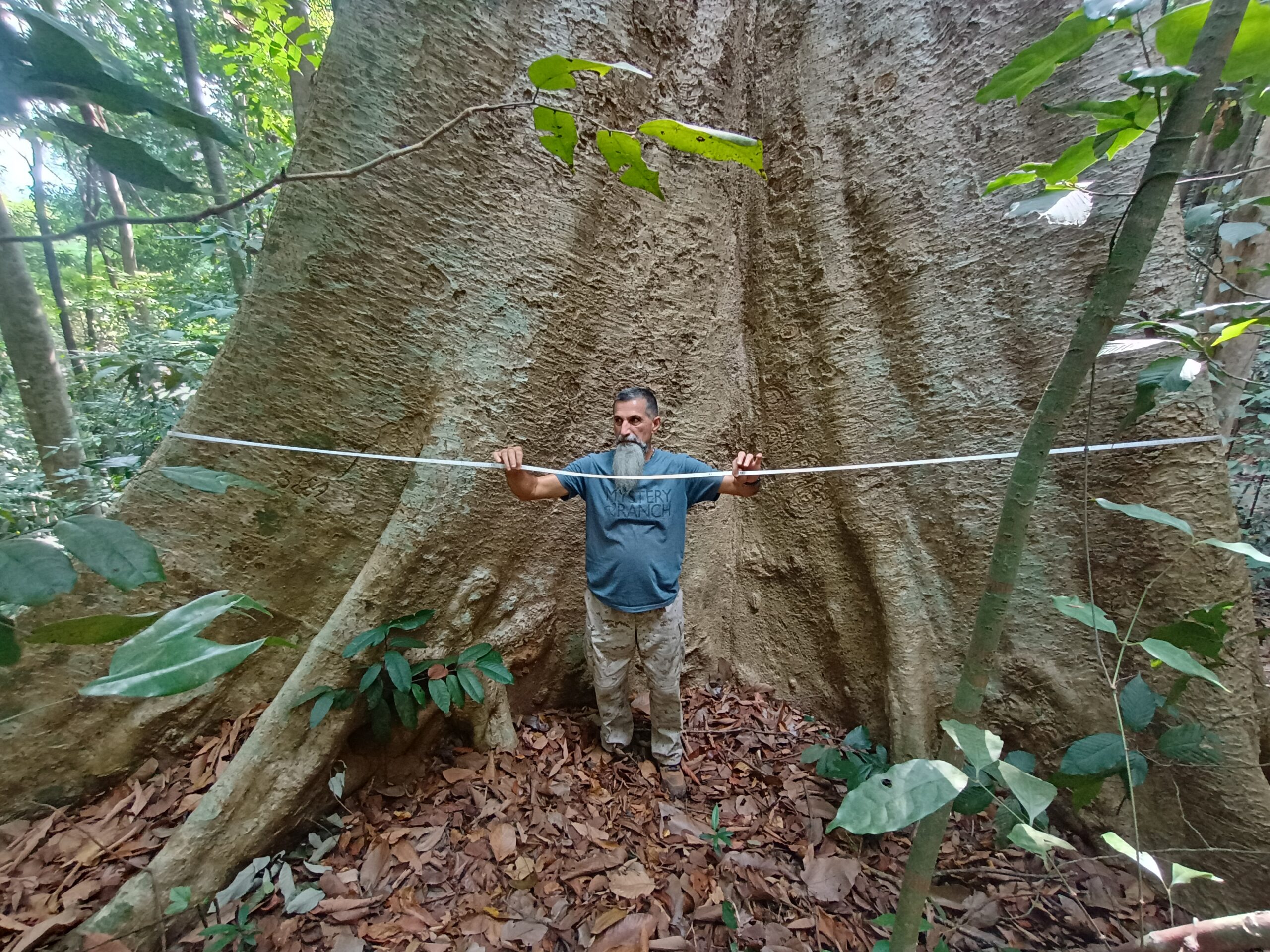
In our search for the Cedar Tree where they took the photo in 1994, we stumbled upon another huge Cedar tree, which had a nearly 50 feet Stump.
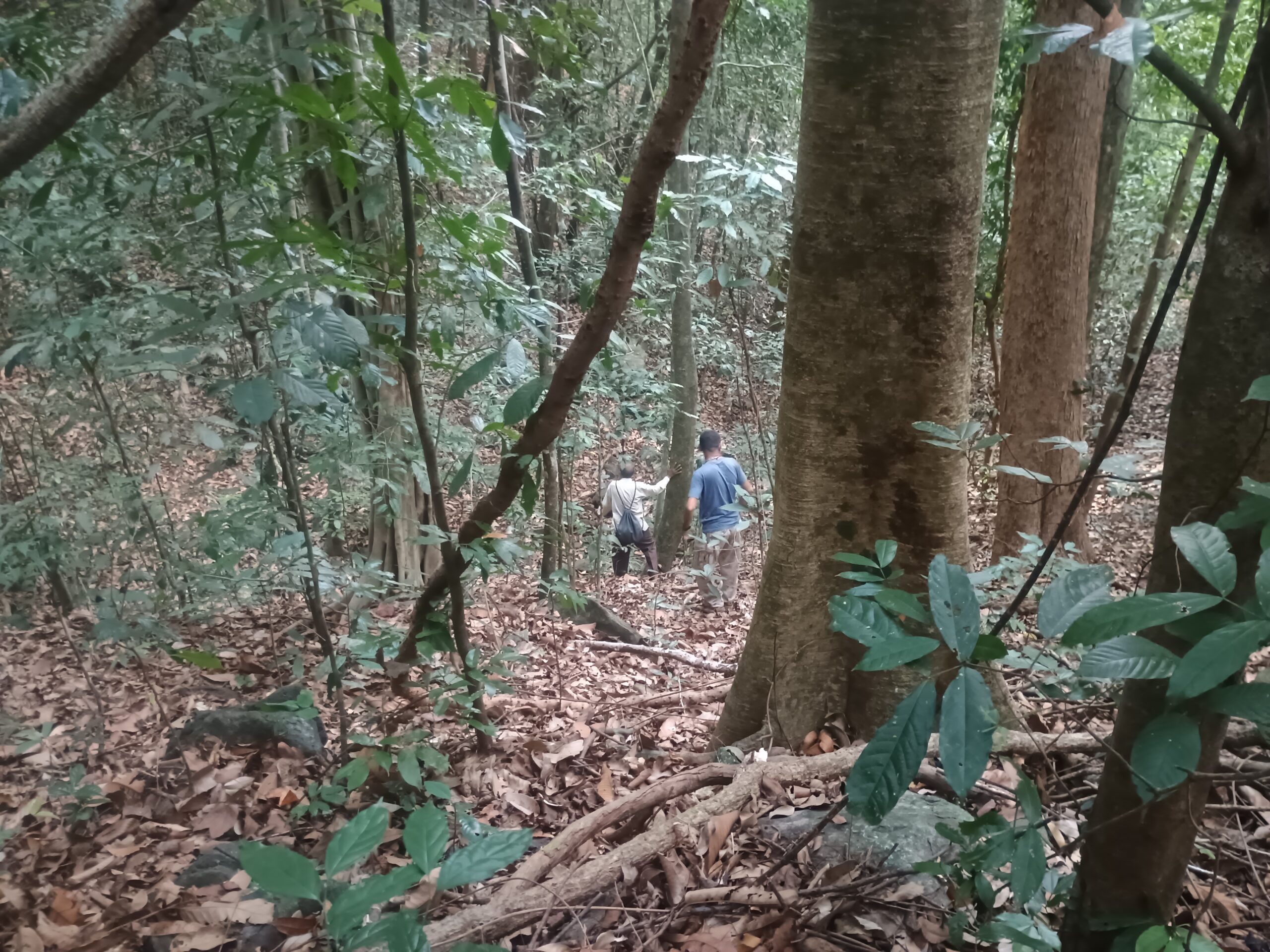
We encountered many rare species, such as ebony, endemic ones like Vateria indica and others. Ponnappa could identify all of them and knew their native names by heart.
Standing Taller and Bigger
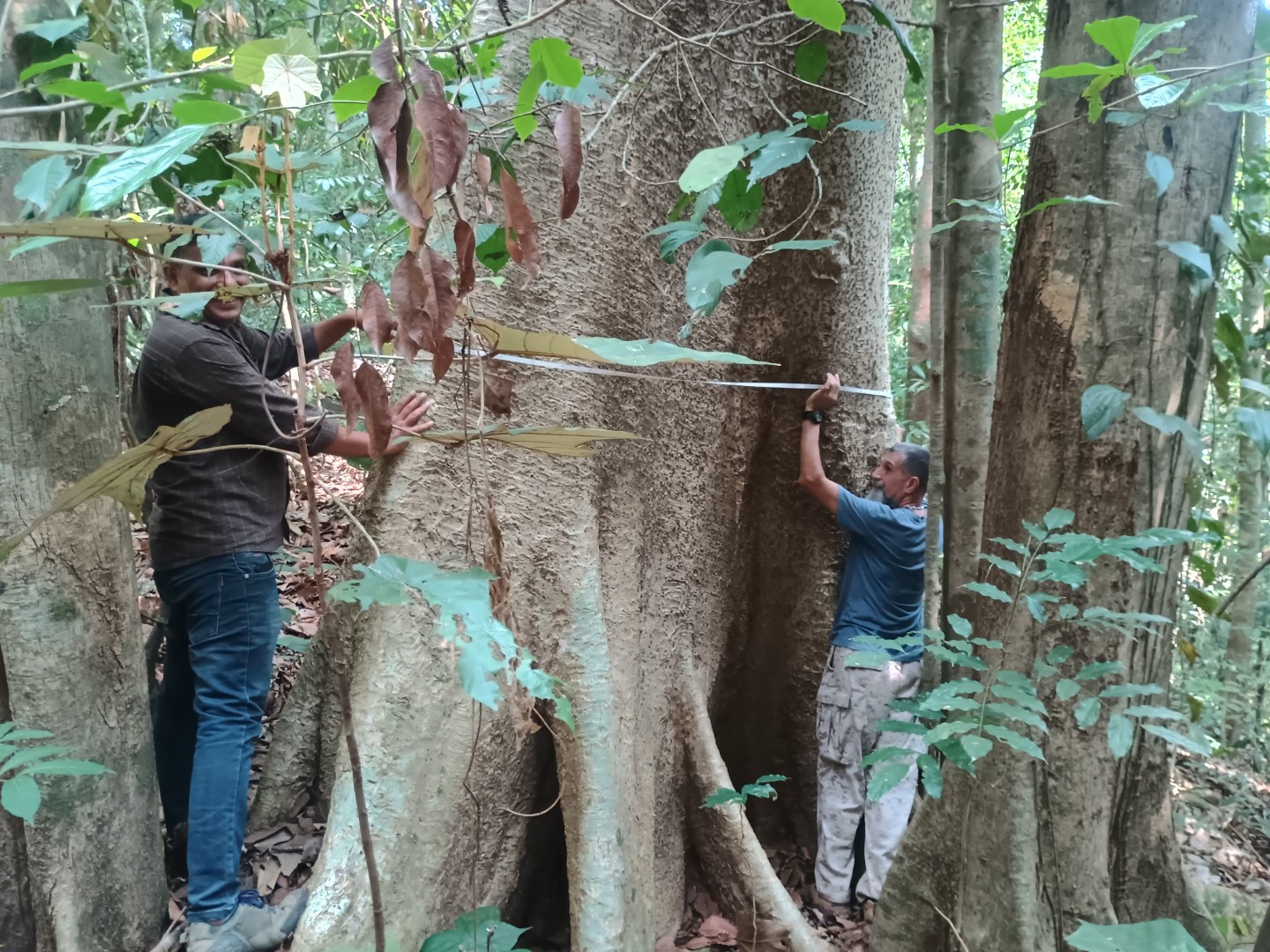
Finally the tree which was last clicked in 1994 was located.
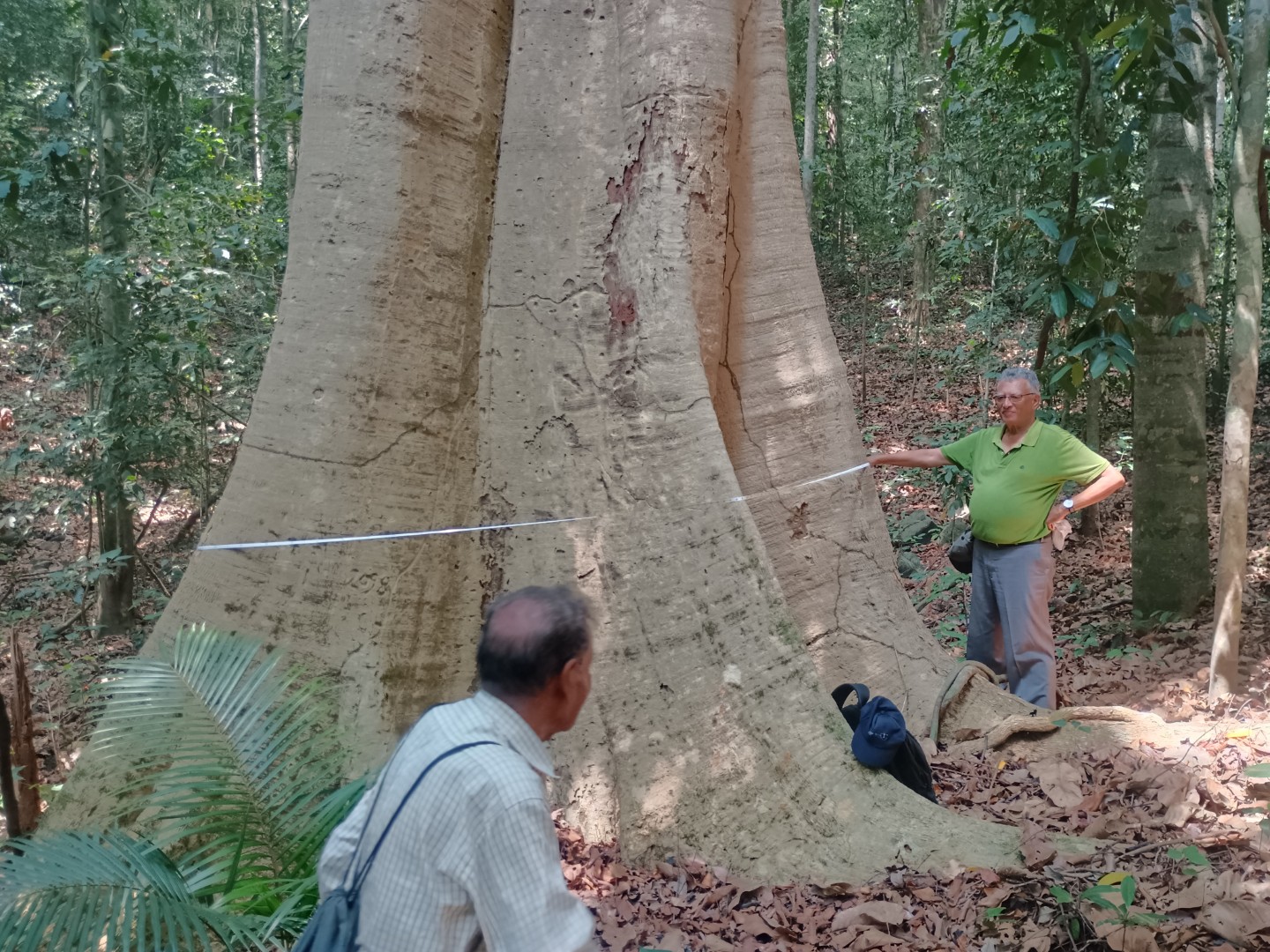
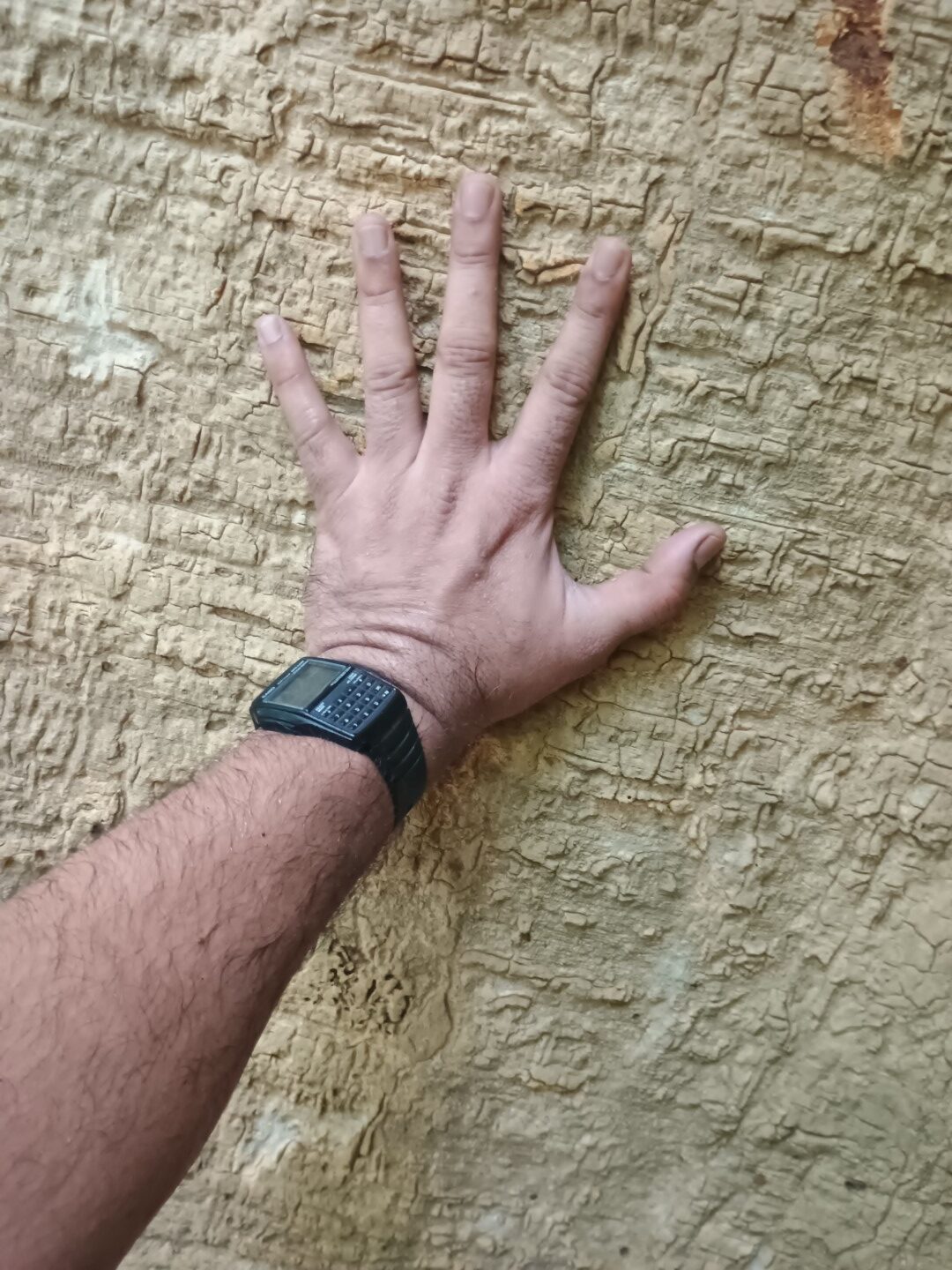
It has grown much taller and bigger. Compared to the measurements of 1994, now it stands at 150 feet height, the Girth was 27 feet and Stump – 40 feet.
The above story is illustrative of many such instances within the district.
Large companies have failed in their responsibility as corporate citizens to protect the environment, engaging instead in the large-scale felling of timber. The local population has, unfortunately, taken this as an example and followed suit.
The regreening of our forests with native trees should be a priority to manage climate change, restore the water table (including wetland cultivation) and mitigate man-elephant conflict.
Join our WhatsApp Group for News and Article Alerts



Read the Hidden Life of Trees by Peter Wohlleben where he makes the case that the forest is a social network. He draws on groundbreaking scientific discoveries to describe how trees are like human families: tree plants live together with their children, communicate with them, support them as they grow, share nutrients with those who are sick or struggling and even warn each other of impending dangers.
Therefore, it comes as no surprise to note the elation that Kudiyara Ponnappa, Kodandera Chinappa, Ajjinanda Thamoo Poovaiah and Pandira Muthanna felt while reconnecting with the Indian Cedar Tree. We need more such stories to raise the awareness of the wisdom that such “sentinel” trees possess – the guardians of the forest and the delicate balance that they provide to our planet.
I can relate to this from what happened at Kudremukh. Kudremukh, nestled in the Western Ghats, hosted one of India’s largest open cast iron mines causing extensive deforestation, soil erosion, landslides, and water pollution, damaging the ecosystem and local communities. Supreme Court halted mining operations in Kudremukh due to severe environmental concerns and violations.
In Kodagu, which I am familiar with, environmental damage has increased tremendously due to irresponsible tourism and construction of resorts on very fragile land slopes. If all the stakeholders do not act in a concerted manner, sooner rather than later, Kodagu will suffer severe drought, significant loss due to climate change consequences and primary crops like coffee will bear the brunt of the environmental impact. Such articles should be seen as a WAKE UP CALL.
It is hard to comprehend why humans cannot respect the need for forest/tree cover – human beings have possibly grown 5 to 6 times since the last World War, while forest cover has decreased by 50%. India is no exception to these numbers and dare I say, Kodagu is perhaps worse off.
It is common knowledge that Forest cover helps balance rising temperature – eastern part of the USA is a good example. It doesn’t require too much intelligence to see the consequences of loss of tree cover leading to drought like conditions in Kodagu.
When will better sense prevail and the Administration and Residents get together and draw up a sensible plan to Regreen and STOP the loss of tree cover. There must be a limit to human greed in setting up more resorts on an already devastated landscape. Granting permission and worse irresponsible construction must attract punitive action from the Supreme Court.
Development and conservation must go hand in hand. Articles like this are important to remind us why forests are worth fighting for; not just for wildlife, but for humanity itself.
The Coorgs who take their name from Kodagu or Kodamale are the principal tribe of the country and from time immemorial the lords of the soil. They worship sylvan deities whose temples are the natural forests, signs are not wanting however to shew that in modern days these sylvan gods are being neglected for their compeers of the Hindu pantheon. – Major A.W.S Lindsay said so, in the Report of Coorg General Census(1871).
Many Devarakadus rather than being left alone, now has a temple inside it. Some have only temple kind of structure and no forests around it. There was no requirement for a Poojari, Homa and Mantras. Just like we do not need any such in our Marraiges, Death and Naming ceremonies. Now it is a different scene. There is enough evidence on record to know where we went wrong. Lindsay was right.
The Kodavas once lived in perfect harmony with their natural surroundings, revered and prayed to the Forest Gods and Ancestor Spirits.
Come 21st Century, many complain when elephants and other wild animals enter their plantations. Joke is on us.
What our ancestors did belongs to their time. The responsibility now rests with the present and future generations to mitigate, correct, and undo the damage that has been caused.
We need more Thamoo Poovaiahs in Coorg.
Yes – the Supreme Court ruling is quite strict. The Court directed the Forest Department of the State of Karnataka to restore the forest on the land in question by planting indigenous trees and plants in consultation with experts and ordered that compliance be ensured within a period of twelve months.
Will it get done – the jury is out.
There has been a lot of material and talk circulating on social media, especially Instagram and WhatsApp Groups about Sacred Groves in Kodagu, their alleged Chief Custodian and so on. It is best to put this is perspective.
As per published reports – “In 1905, the ownership of the Kodagu devarakadus changed hands and went to the Revenue Department. This transfer of ownership came at a heavy price. According to anthropologist M A Kalam ( who has perhaps done the most authentic work in the field of Sacred Groves across the country and Kodagu in particular), between 1905 and 1985, the extent of sacred groves in Kodagu had shrunk to just 2406.768 ha. In other words, a whopping 42 per cent of sacred grove area was lost in just 80 years”.
For the record, the first ever survey of sacred groves in Kodagu was conducted in 1873, when 873 groves covering 4,398.79 ha were listed. Under the then The Indian Forests Act, 1875, these were declared as “protected forests”. An 1898 report compiled in the office of the Commissioner of Coorg (Kodagu) states that the sacred groves or devarakadu then comprised 6,275.081 ha out of 45,0118.3 ha of total forest land. (Kindly refer to the attached image)
So contrary to popular belief that Devarkadus are “safe and well-preserved” – it is far from the truth. There has been massive encroachment, aided by Brahminical advice that the first two bags of coffee be offered to the deity. That is ludicrous.
The most significant order/ directive by the Supreme Court has just been made – The Ministry of Environment, Forest and Climate Change has to identify, map and declare all such Sacred land as Forests – a big step to restore and protect our biodiversity, culture and climate.
For those interested Madhav Gadgil’s seminal work on this subject: Sacred Groves of India – A plea for continued preservation; Sacred Groves in Coorg, Karnataka M.A.Kalam are amongst the most relevant.
Indeed, it was truly heartwarming and inspiring go through this article.
Kodagu is blessed to have committed and passionate people like you who genuinely care for our forests, wildlife, and the priceless natural treasures gifted to our land.
The fact that you visited same cedar tree in 1994 and have returned once again in 2026 speaks volumes about your enduring love, emotional bond, and unwavering dedication towards this beautiful homeland. Very few people carry such deep affection and concern for nature across decades.
Your commitment to preserving the beauty and soul of Kodagu is deeply appreciated and will always be remembered with gratitude and respect. People like you give hope that our forests and environment will continue to survive for future generations.
May God Almighty bless you abundantly with good health, happiness, peace, and strength to continue your noble mission and your love for Kodagu.
Hats off to Mr. Thamoo Poovaiah & Team for their continued & relentless efforts to protect our ecosystem and environment. It is not an easy task. It should have been a collective effort by all local communities & the government. But it is not happening. Mainly because of the strong clout between timber lobby & political nexus which is really hard to break. Sorry to say that the leasing of forest land to rubber plantations in Sampaje area is still not received back to the forest department in spite of court orders. Left out Devarakadus in Kodagu is a blessing in disguise. A strong political will is the only way out to protect our ecosystem which is already in danger. We have to blame ourselves for this disaster.
It is indeed a significant achievement for you and your dedicated bunch of enthusiasts.
Look forward to more such crucial endeavors.
All the best and more muscle to your arms (and legs) for carrying out such activities.
Wish I was part of this adventure.
Saving Kodagu’s Forests and Devarakadus needs an ethical approach, with real commitment and consistency.
The years from 1994 to 2026 bring a deep sense of nostalgia when I look at Kodagu today.
Recently, during one of Bird survey sessions stood before a tree whose girth alone suggests it has lived for over 150 years. It made me wonder — how many such silent sentinels have we already lost?
What is truly destroying our forests and lands is not just external demand, but vested interests within Kodagu itself. Unscrupulous elements are actively inviting outside buyers, driving speculative land purchases. If this internal push stops, the artificial demand for land in Kodagu will naturally decline.
Ironically, some individuals who project themselves as environmentalists are also engaged in real estate dealings. This conflict of interest undermines genuine conservation efforts. It is a fact that many of the Real Estate Agents are Kodavas themselves.
Valid observation Naveen – how else are so many high end resorts coming up in Kodagu when it is common knowledge that the fragile landscape cannot support it? The most famous amongst the high end properties in Madikeri is built on a mud-compacted ridge – and many have followed suit. Over 20 such resorts have mushroomed in Coorg and without exception they are all (being) built by investors from outside of the district. Do they understand the topography, the unstable landslide prone slopes, desecration of tree cover … Many questions without answers.
Very interesting, eye-opening article about the history of our land/forests. Thanks for highlighting the greed and insensitivity of eco terrorists as a warning of what’s happening while telling us about eco champions Pooviah and his friends who are bravely keeping them in check on our behalf. Good luck for the ongoing success of your important work
Good article – it is very important that “influential voices” comment and raise all round awareness on such critical matters. The forest cover of Kodagu is one of our most valuable inheritance so painstakingly preserved by our ancestors.
To put the problem in perspective, India faces a critical loss of forest cover, losing 2.33 million hectares of tree cover since 2000, despite government reports indicating minor net increases in total green cover. Between 2015 and 2019, the country lost 18 times more forest than it gained. Primary causes include
– development projects,
– mining,
– natural forest degradation
Key Trends in Forest Cover Loss:
– Declining Natural Forests: While “tree cover” (including plantations) may show stability, natural forests are experiencing decline. Roughly 94% of tree cover loss from 2021-2023 occurred in natural forests.
– Major Losses: Between 2001-2023, 60% of all tree cover loss occurred in five states: Assam, Mizoram, Arunachal Pradesh, Nagaland, and Manipur.
– Industrial and Urban Pressure: Significant deforestation is driven by projects like mining and urbanization/infrastructure projects.
– Loss vs. Gain Ratio: Research indicates that for every 1 sq km of forest gained, India lost nearly 18 sq km between 2015 and 2019.
– Degradation: Over 46,000 sq km of dense forest have degraded into non-forest areas over the past decade, and 40,709 sq km of dense forest has downgraded to open forest, according to a report citing a 2025 assessment.
One could go on, but the reason for these details is to push awareness within our community to the devastating reduction of our green cover. Do we have a formal understanding of the extent of Forest Cover Loss in Kodagu? Is there public data available? Would this be something that The Forestry College in Ponnampet can undertake? Is this an area that CWS can collaborate proactively with the Forest Department; as also COHERA with the District Administration/Tourism Department?
So much can be done – including COMPLETE STOPPAGE OF PERMISSION FOR NEW RESORTS WITHOUT UNDERSTANDING THE ENVIRONMENTAL IMPLICATIONS.
Dear Sir,
Thank you for writing this piece. I genuinely liked the thought process behind it. It did not feel like just another environmental article. It felt rooted in memory, culture, responsibility and lived history together. I became a bit emotional while reading it.
From my perspective, forests are not destroyed in one day. It happens layer by layer through normalization, administrative adjustments, public silence, commercial pressure and gradual disconnect from cultural memory. Your article captured that very honestly.
One line that kept coming to my mind while reading was this: “When greed leads, entire forests are fed to it.” First the boundaries move on paper, then the roads arrive, then silence settles where life once stood.
I also feel older communities had a much deeper civilizational instinct toward ecology even without modern environmental terminology. Sacred groves and reverence toward forests acted like natural conservation systems long before policy frameworks existed. It was also heartening to see a few lone voices choosing to stand up instead of remaining silent spectators.
Thank you again for documenting this with sincerity and depth. Articles like this matter because they preserve not only forests, but also the memory and consciousness around them.
Warm regards,
Harish Kamath
A thought provoking and necessary piece that deserves to be widely read and discussed. Kodagu owes much to vigilant voices like Poovaiah and the team who refused to let greed destroy its native treasures. A powerful and inspiring account of how one individuals courage and awareness helped protect Kodagu’s priceless natural heritage. Stories like these remind us that forests are not just timber reserves , but living ecosystems tied to our identity, climate and future generations.
The article painfully exposes how corruption and unchecked exploitation devastated vast stretches of Virgin forests in the name of contracts and development. Conservation is not only about planting trees, it is about protecting what still survives.
Such a wonderful article.
It is dedicated people like Mr. Poovaiah and other who have managed to help preserve what little is left of our pristine forest in Coorg.