Action Plan of About Rs1,300 Crore Presented
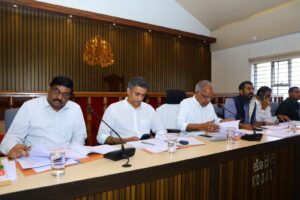
A preliminary meeting regarding the draft annual development plan for the year 2026-27 was held recently under the chairmanship of Kodagu District In-charge Minister N.S. Bhosaraju, in the presence of MLAs A.S. Ponnanna and Dr. Mantar Gowda.
The meeting was held at the Deputy Commissioner’s office hall, where detailed discussions took place on the proposed development action plans of various departments for the forthcoming financial year.
Addressing the meeting, Minister N.S. Bhosaraju stated that Chief Minister Siddaramaiah had directed that District Planning Committee meetings be conducted after detailed deliberations and with inputs from advisory committees. In line with this directive, departments were instructed to prepare comprehensive and realistic action plans for 2026-27.
The minister directed officials to provide accurate information on proposed works relating to roads, drinking water, construction of school and college buildings, government office complexes, public hospitals, veterinary hospitals, transport connectivity, student hostels, housing projects, and other development initiatives. Emphasising seriousness in planning, he said government funds would be released based on well-prepared action plans.
He stressed that departmental programmes should be prioritised, inclusive, and responsive to public needs. Highlighting infrastructure concerns, he instructed officials to expedite completion of power substations under construction and ensure quality road and electricity connectivity across the district.
Chief Minister’s Legal Advisor and MLA A.S. Ponnanna said there must be clarity and accuracy in planning for the next financial year. He stressed the importance of submitting precise statistics related to roads, bridges, hospitals, and educational infrastructure. On the issue of ration cards, he said eligible poor families shifted from BPL to APL categories should be reconsidered and relevant details furnished to the Deputy Commissioner.
Madikeri MLA Dr. Mantar Gowda suggested that taluk-level meetings should be conducted under the chairmanship of MLAs to discuss action plans and development works. He emphasised that government projects should be scientific, transparent, and accessible to all sections of society.
Deputy Commissioner S.J. Somashekar said taluk-wise data would be collected regarding revisions of ration cards shifted from BPL to APL, and corrective steps would be taken wherever required.
Z.P. CEO Anand Prakash Meena explained that the District Planning Committee had been constituted under the Karnataka Gram Swaraj and Panchayat Raj Act to consolidate draft plans from urban and rural local bodies.
District Planning Committee member Rajesh Yallappa requested that newly elected members be given at least one week to study the projects. He also stressed that this was a planning meeting and not a progress review.
Members raised various local issues, including the need for a health centre building and doctor appointment in Karike village, construction of Anganwadi buildings where they currently function in rented premises, establishment of new Anganwadis where required, and provision of dedicated hostel buildings. Additional demands included allocation of more funds for colony development, improved maintenance of the garden at Gaddige, parking facilities and toilets at Raja’s Seat Park, construction of a veterinary hospital at Kuttandi, utilisation of Barapole river water within Kodagu, and improved drainage systems along newly constructed roads.
Municipal Council President P. Kalavathi raised concerns regarding ration card issues. Superintendent of Police R.N. Bindumani highlighted traffic and parking problems at Raja’s Seat due to tourist influx.
Officials from various departments presented their respective action plans. It was informed that Taluk Planning and Development Committees have been formed under the chairmanship of MLAs, and meetings will be held shortly.
The District Planning Committee will consolidate taluk-level plans into a comprehensive district development plan based on grassroots inputs from Gram Panchayats and Urban Local Bodies.
Join our WhatsApp Group for News and Article Alerts