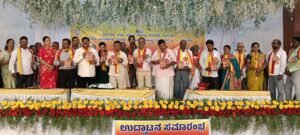
Renowned writer Abdul Rashid stated that Kodagu is often referred to as the “Kashmir of Karnataka,” but said that such a comparison is not appropriate. He was speaking after presiding over the forum programme of the 17th Kodagu District Kannada Literary Conference held at S.S. International Hall in Suntikoppa on Friday.
Abdul Rashid observed that those who are familiar with the hardships faced by Kashmir and those who truly understand the beauty and uniqueness of Kodagu recognise that the comparison is misplaced. He said visitors should instead be introduced to the rich cultural and spiritual heritage of Kodagu, including its land, forests, traditions, temples and deities such as Bhagavathi, Ishwara, Ayyappa, Korathi and Chamundi, as well as sacred groves and traditional places of worship. Highlighting Kodagu’s contribution to Kannada literature, he noted that several distinguished writers and scholars had close associations with the district. Panje Mangesh Rao served as a school inspector in Kodagu, Bharathisutha worked as a high school teacher in Madikeri, while G.T. Narayana Rao taught mathematics. Literary figures such as B.D. Ganapathy and I.M. Muthanna made significant contributions to Kannada literature. Jnanpith awardee Dr. K. Shivaram Karanth frequently visited Gundugutti and wrote several novels there. Likewise, literary giants such as Masti Venkatesha Iyengar and D.R. Bendre also visited Kodagu and produced notable literary works.
He further stated that the roots of many of Kuvempu’s literary inspirations could be traced to Kodagu and stressed the need to reprint valuable literary works and establish museums dedicated to the lives and contributions of prominent writers. He also suggested creating audio libraries for tribal music and utilising websites and digital platforms to promote Kannada literature. Emphasising the role of education, Abdul Rashid said school libraries are crucial in strengthening literary culture. Rather than locking books away in cupboards, efforts should be made to cultivate reading habits among children. He stressed the need for a long-term vision to instil a love for reading in younger generations.
He also called for a comprehensive cultural policy and educational language framework for Kodagu district. Languages such as Kodava, Arebhashe, Jenukuruba, Bettakuruba, Kadukuruba, Yerava, Meda, Adiya, Paniya, Devasoliga, Jenu Malekudiya and PoomaleKudiya are unique to the region and cannot be preserved elsewhere. While these languages may not become mediums of formal instruction, efforts must be made to create awareness, curiosity and pride among children belonging to these linguistic communities.
He suggested that local resource persons be engaged in schools, particularly residential schools attended by tribal children, to impart knowledge about these languages and cultures. He stressed that Kannada has flourished because of the contributions of these smaller linguistic streams and warned that Kannada itself would become poorer if these languages disappeared. According to him, preserving Kannada in Kodagu also means protecting the district’s smaller languages and safeguarding communities whose languages are facing extinction. He advocated digitisation and promotion of rare art forms and cultural traditions through modern technology and social media.
Abdul Rashid further observed that society should be based on equality and coexistence. He questioned why tribal communities living in the forests of Kodagu had remained deprived of educational opportunities and why so few writers, artists, lawyers or officers had emerged from these communities. He urged society to reflect seriously on these issues.
He also expressed concern over social challenges affecting tribal communities, including poverty, alcoholism and cultural alienation, and called for collective efforts to address these issues while preserving indigenous traditions and identities. Former conference president Dr. Teethira Rekha Vasanth said Kannada continues to occupy a place of prominence and there is no reason for concern regarding its future. She emphasised the need for everyone to respect and cherish their mother tongue.
Quoting the principles of Kavirajamarga, she said tolerance in society and religion is essential for progress and harmony.
Kannada Sahitya Parishat District President M.P. Keshava Kamath said several literary programmes, including book publications, poetry gatherings and literary discussions, would be undertaken across the district. He noted that 19 commemorative gateways had been erected in honour of local poets, writers and literary personalities as part of the conference celebrations. Former Kannada Sahitya Parishat President T.P. Ramesh said it was fitting that the conference was being held in Suntikoppa, a town known for its multilingual and multicultural population. He added that the event aimed to create awareness among youth about the importance of Kannada literature and called upon people to actively participate in literary activities.
Literary figure M.G. Nagaraju stressed the importance of giving priority to Kannada within the educational system and said protecting Kodagu’s groundwater resources was a collective responsibility.
Speaking on the occasion, B.S. Lokesh Sagar, former Taluk Unit President and former Kannada Sahitya Parishat office-bearer, recalled the contributions of writer Gouramma of Suntikoppa to Kannada literature.
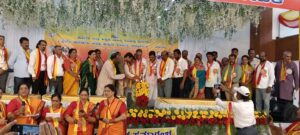
Several books were released during the conference, including RagavuttaPoetha by E. Suleman, Manushyatvada Sara by H. Manjunath, Personality Development Principles by Jayaprakash Puttur, Swatantra KrantiyaKidi by Dr. Besur Mohan Palegar, Children’s Stories by Ganesh Sharma and Swapnada Hakki by Hemant Parera. A number of distinguished personalities were also felicitated.
Prominent attendees included Vishal Shivappa, Sabhastin, Munir Ahmed, Revathi Ramesh, Jalajashekar, Vasurai, Kadlera Tulasi Mohan, Ambekallu Naveen, E.O. Paramesh, K.S. Nagesh, Dayachangappa, Nizamuddin, Nasir and others.
The conference was welcomed by Reception Committee Chairman A. Lokesh Kumar. The programme was compered by Sunita Girish, Anil Kumar and V.G. Lokesh. Teachers of St. Mary’s English Medium School rendered the invocation song. The conference president was taken in a grand procession from Suntikoppa Government Primary School near Sri Ayyappa Temple to Gundugutti Manjanathayya Hall.
The procession featured traditional Mangala Vadyas, Chande drummers, women carrying Kalashas, folk dolls, cultural dances, band performances, school and college students, members of Sanjeevini Women’s Association, Dharmasthala Rural Development Project, Anganwadi workers, Stree Shakti groups, ASHA workers, teachers, representatives of various organisations, auto and vehicle drivers’ associations, NCC cadets and Scouts and Guides. Tableaux presented by the CESC Department attracted considerable attention.
Join our WhatsApp Group for News and Article Alerts