

There has been a lot of messages on social media on the recent 7th Draft Notification on Eco Sensitive Areas (ESA) of Western Ghats. The article by Machaiah attempts to simplify the possible misconceptions with direct intent of setting at rest – unwanted fears. In essence, there are similarities between the earlier notifications of 2017 regarding Eco Sensitve Zones (ESZ), which was focused on areas around Wildlife Sanctuaries and National Parks. ESA on the other hand can cover and protect a much larger ecologically fragile and sensitive landscape. The intent remains the prevention on Environmental damage as listed in Machaiah’s article.
However, the ESA and ESZ Notifications do not address the impact of the massive increase in footfalls arising from tourism. Kodagu like many similar hill stations like Ooty/Coonoor/Mussoorie/Shimla/Nainital/Mahabaleshwar/Matheran/Chickmagalur/Yercaud/Wayanad,etc faces a severe impact on natural resources and its related degradation of the environment. This needs to be addressed with equal urgency. While homestays is a much needed supplement to agricultural income, both the supply and the operations to improve the overall experience and value realization needs immediate attention. This is where the homestay association, along with COHERA, should step in to ensure responsible tourism with support from the District Administration. Needless to state, large resorts beyond what already is, have no place in this fragile ecosystem.
– CLN Newsdesk
The publication of the Seventh Draft Notification on Eco-Sensitive Areas (ESA) for Western Ghats, issued on 27th July 2026, appears to have caused considerable apprehension among people in Kodagu, particularly coffee planters.
Apprehensions Driven by Fear and Misperception
Some people fear that they could lose their land, while others apprehend restrictions on their agricultural activities and livelihoods. However, much of this concern appears to stem from a lack of understanding about what an Eco-Sensitive Area (ESA) or an Eco-Sensitive Zone (ESZ) actually means.
Social media and WhatsApp groups are already buzzing with messages expressing concern and fear. While some people may be genuinely ignorant of the implications of the notification, there may also be vested interests seeking to create apprehension and oppose the inclusion of parts of Kodagu in the ESA.
It is therefore important that people understand the facts before forming an opinion.
ESA and ESZ Are Not the Same
First, it is important to understand the distinction between Eco-Sensitive Area (ESA) and Eco-Sensitive Zone (ESZ).
ESA and ESZ are two different concepts, although both are intended to protect ecologically important areas. The confusion often arises because the terminology is similar and the terms are sometimes used loosely in official communique, media and public discussions.
An ESZ is generally a buffer or transition area around a Protected Area, such as a National Park or Wildlife Sanctuary. Its purpose is to ban envirnomentally destructive actitives and regulate other activities in the surrounding area so that the ecological integrity of the Protected Area is not adversely affected.
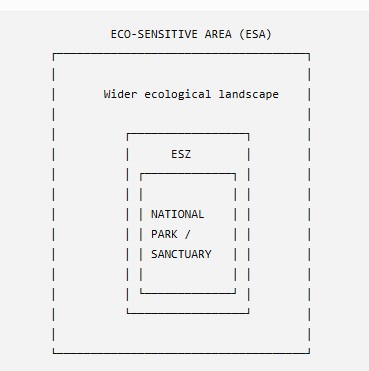
An ESA, on the other hand, can cover a much larger ecologically fragile or sensitive landscape. The proposed Western Ghats ESA is an example of such a landscape-level environmental protection measure.
ESZs Already Exist Around Three Wildlife Sanctuaries in Kodagu since 2017
It is also important to remember that ESZs have already been officially notified around the three major Wildlife Sanctuaries in Kodagu: Pushpagiri, Talacauvery (Talakaveri) and Brahmagiri Wildlife Sanctuaries.
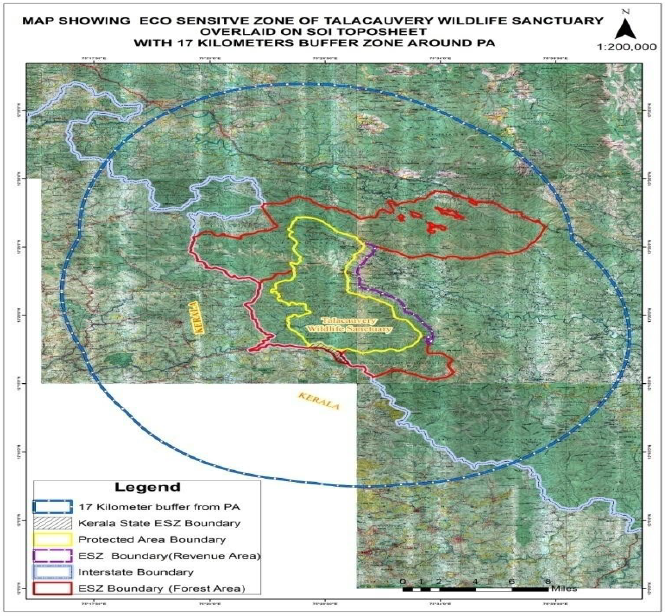
The ESZ around Talacauvery Wildlife Sanctuary was notified through a Gazette Notification dated 15 May 2017.
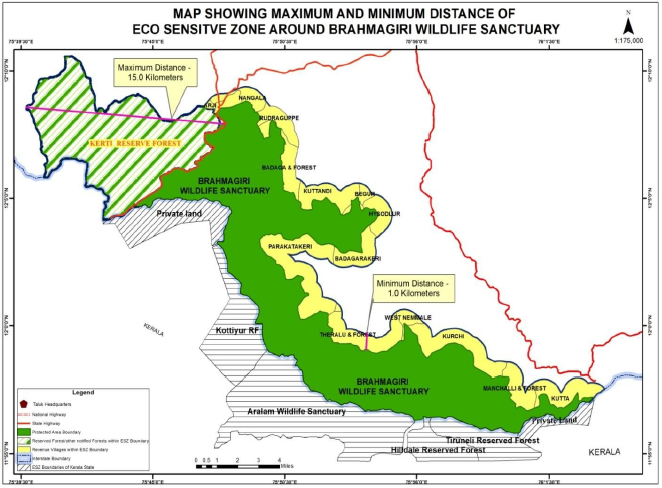
The ESZ around Brahmagiri Wildlife Sanctuary was notified on 26 May 2017.
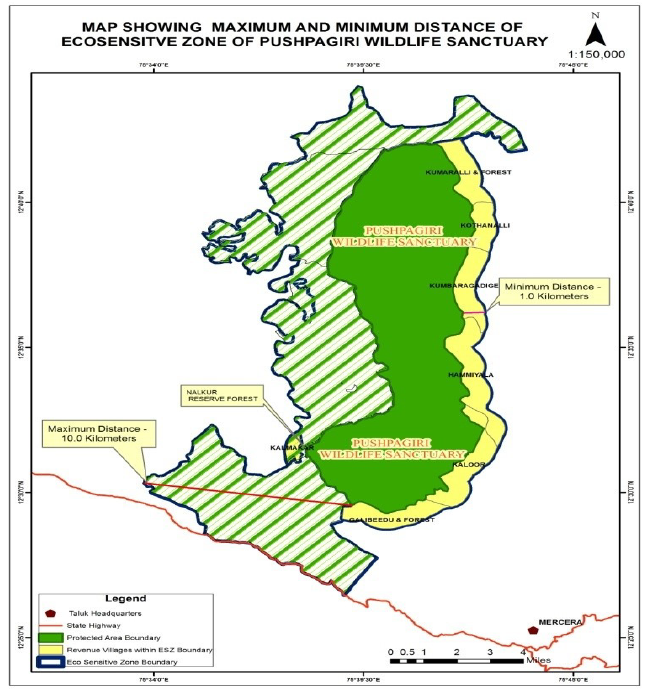
While the ESZ around Pushpagiri Wildlife Sanctuary was notified on 28 June 2017.
The proposed ESZ around Nagarhole National Park is yet to be finally notified. However, planters living around Nagarhole have little reason for concern. Their fellow planters around the Brahmagiri, Pushpagiri and Talakaveri Wildlife Sanctuaries have continued to tend their coffee plantations and carry on their agricultural activities without hindrance since these areas came under ESZ regulations in 2017.
What Has Happened to Planters Living Around Existing ESZs?
A useful way of understanding the implications of ESZ regulations is to look at the experience of people living around the three Wildlife Sanctuaries where ESZs have already been notified.
Since the notifications were issued in 2017, agriculture and coffee cultivation have continued in the surrounding areas. Numerous plantations and residential properties continue to exist within the notified ESZs. There has been no general acquisition of private agricultural land by forest department, merely because it falls within an ESZ.
The existence of an ESZ does not, by itself, mean that private land is taken over by the Government or that existing agricultural activity automatically comes to an end. There is no provision in the notification or law for the same.
No Ban on Normal Agricultural Activities or Homestays
The Supreme Court has also clarified the basic purpose of ESZ regulation. The objective is not to stop the normal day-to-day activities of people living around Protected Areas, but to prohibit or regulate activities that could adversely affect the Protected Area.
Normal agricultural and livelihood activities therefore should not be confused with activities that are specifically prohibited or regulated under the applicable notification.
The same principle is important when people consider the proposed ESA notification.
What About Roads, Electricity and Other Infrastructure?
The existence of an ESZ does not mean that roads, electricity, drinking-water infrastructure or other essential public infrastructure automatically come to a halt.
Activities that are specifically prohibited or regulated under the relevant notification may require restrictions, permissions or scrutiny. Environmentally destructive activities such as certain forms of mining and quarrying, highly polluting industries and large-scale construction may face prohibition or regulation.
This is fundamentally different from saying that all development or infrastructure activity is prohibited.
What If Areas of Kodagu Are Included in the ESA?
The Seventh Draft Notification proposes the inclusion of 54 areas in Kodagu within the proposed ESA.
Many of these areas are villages and human settlements located in landscapes surrounded by forests, plantations and other ecologically sensitive areas.
The inclusion of these areas in the ESA should therefore not automatically be interpreted as a threat to the ownership of private agricultural land or to the continuation of agriculture.
Similarities Between ESA and ESZ Regulations
There is considerable similarity in the broad environmental objectives of ESA and ESZ regulations.
Under the proposed ESA framework, activities that can cause significant environmental damage, such as mining and quarrying, highly polluting industries, major construction and development projects, certain large-scale tourism projects (Huge Resorts, Tourism Parks, etc), and activities that adversely affect water bodies and fragile ecosystems, can be prohibited or regulated.
This does not mean that ordinary agricultural activities, existing settlements or the day-to-day lives of residents will automatically be stopped.
The ESA Is Not Limited to Karnataka
The proposed ESA is not confined to Kodagu or even to Karnataka.
The Government has been considering the declaration of ecologically sensitive portions of the Western Ghats as an ESA across six States.
The latest republished Seventh Draft Notification proposes an ESA covering approximately 56,825.7 sq km across Gujarat, Maharashtra, Goa, Karnataka, Tamil Nadu and Kerala.
Therefore, the proposed notification needs to be viewed in the larger context of protecting the ecological integrity of the Western Ghats, rather than as a measure specifically directed at the people or agricultural communities of Kodagu.
People Should Understand the Notification Before Panicking
The debate over the Western Ghats ESA is important and people of Kodagu have every right to examine the proposed notification, raise legitimate concerns and seek clarification from the Government.
However, opposition based purely on the assumption that an ESA or ESZ will result in the automatic loss of private land, the closure of coffee plantations or the end of normal agricultural activities is not supported by the experience of the existing ESZs in Kodagu.
The people of Kodagu should therefore read the actual notification, understand what is prohibited, what is regulated and what is permitted, and distinguish between legitimate concerns and misinformation.
Environmental protection and the interests of local communities need not necessarily be contradictory. The objective should be to ensure that Kodagu’s forests, rivers and fragile ecosystems are protected while the legitimate rights, livelihoods and economic activities of its residents and agriculturists are safeguarded.
The facts, views and opinions expressed are solely those of the author and do not necessarily reflect the views of Coffeeland News.
Join our WhatsApp Group for News and Article Alerts



The draft places 53 Kodagu villages within the proposed Western Ghats Eco-Sensitive Area (ESA). It would mainly control environmentally damaging development, not automatically take away private land or stop coffee cultivation.
The draft proposes strong restrictions or prohibitions on:
– Mining, quarrying and sand mining.
– Thermal power plants.
– Red-category and highly polluting industries.
– Large construction and township projects.
– Major area-development projects.
– Conversion of forest land for non-forest purposes.
– Large tourism developments whose scale exceeds the area’s ecological carrying capacity.
This means new resorts, tourism parks, major commercial buildings and similar projects may face prohibition, environmental clearance or other approvals.
Coffee and agriculture
The draft does not automatically prohibit coffee cultivation, plantation management or ordinary agricultural work. Existing agricultural livelihoods and settlements should not be treated in the same way as mining, polluting industry or large construction.
However, the practical effect could be greater scrutiny of:
– New estate buildings and building expansions.
– Estate roads and other large infrastructure.
– Processing units and power installations.
– Borewells, water-storage structures and major irrigation works.
– Land conversion from plantation or agricultural use.
New homestays, resorts and other tourism facilities.
The draft itself should be checked for the exact rules applicable to each activity; public statements have raised concerns about possible effects on fertiliser use, pesticides, borewells, machinery and infrastructure, but those concerns should not be treated as confirmed provisions unless they appear in the notification.
Land ownership
Being inside the proposed ESA does not by itself transfer private land to the Government, cancel land titles or require coffee plantations to close. The key legal impact is regulation of future activities and environmentally harmful development, not automatic acquisition of existing private property.
The exact impact may differ within the same village because the notified boundary, land category, forest area and activity involved will matter. The village being listed does not necessarily mean that every parcel will face identical restrictions.
Infrastructure and public services
Roads, electricity, drinking water, schools, hospitals and other essential services are not automatically cancelled merely because a village is included. Nevertheless, new or expanded projects could require environmental scrutiny, particularly if they involve large construction, forest diversion or substantial ecological disturbance.
This is where local residents’ concerns are most significant: even if ordinary farming continues, slower approvals or additional conditions could affect future infrastructure and estate development. Local Malnad representatives have specifically warned about possible effects on roads, schools, hospitals and electrical connections.
Tourism and homestays
Small-scale homestays are not equivalent to large resorts or tourism parks. The more likely concern is uncontrolled tourism expansion, particularly projects that generate heavy traffic, waste, water consumption, sewage and construction pressure.
For Kodagu, the notification could therefore encourage a distinction between:
– Existing homes and modest livelihood-supporting homestays.
– Large resorts, tourism parks and intensive commercial developments.
Current status
The proposal remains a draft, so the 53 villages are not yet subject to the final ESA regime. The Centre has invited objections and suggestions, and the boundaries and final restrictions could change after consultation with Karnataka and affected communities.
For planters and residents, the most important documents to obtain are:
– The village-wise list and map.
– The precise ESA boundary for each village.
– The schedules of prohibited, regulated and permissible activities.
– The procedure for permissions and environmental clearances.
– The deadline and format for submitting objections.
In practical terms, the draft is most likely to constrain new mining, polluting industry, large construction, forest conversion and oversized tourism projects; it does not, on its face, impose a blanket ban on existing coffee plantations or normal agricultural livelihoods.
I am reminded about something I read recently:
When a generation tolerates sin,
the next will celebrate it.
And the generation after that won’t even know it is sin!
It’s the same with environmental matters. Our Devarkadus have virtually shrunk to less than half or less of what it used to be – and these were our most sacred habitats. Then came the extraction of timber and extensive encroachment of land on the periphery of forests. Responsibility for the Environment has to be exercised by all stakeholders – Government, existing land holders (especially of inherited land that represents our heritage) and by those who come in from the outside – buyers and tourists. Good legislation with full participation by the community is the right way forward to prevent the current erosion of “purpose”.
My focus is on Kodagu. Very detailed and in-depth comments, well worth reading to understand the thought process of where the negativity is coming from. The more I think about it, regulation is important – primarily to save the degradation of the environment and preserve the essence of land holding in Kodagu by the Kodavas.
People buying land from outside of the district with no appreciation of the landscape or culture will plunge into extracting commercial gains. This has a cascading impact.
Take for example what happened when Consolidated Coffee was bought over and there was large scale timber extraction (ironically with the assistance of Local retired Forest Rangers and Managers). The planters at large followed the cue set by a large erstwhile well respected enterprise. Planters in Kodagu DID NOT EXTRACT timber anywhere close to these levels prior to this.
It’s the same with sale of Jamma lands, including joint holdings by the Okka. The enabling provisions clearing the way for sale of these lands has opened the floodgates. The Court had observed that It is for the members of the family to preserve the rich heritage and culture of the family and Kodava race. That’s unfortunately not been the outcome.
Under the circumstances if there is legislation that encourages normal agricultural practices in ESA (as is the case with ESZ), it can only act as a DETERRENT to land speculators who are coming in droves to the district for one purpose – commercial exploitation. Anything to stop this is the right way forward.
I concur with Appaiah, Kuttappa and Achaya.
Insecurities and reservations are individual’s prerogative but in this instance is largely unfounded.
Based on facts, no aspirations are being frozen in the name of environmental protection. An Ecologically Sensitive Area (ESA) in the Western Ghats is not a “no-construction” zone, nor does it mean that existing villages, houses, schools, roads or hospitals have to disappear. Also, NO ONE is being confined or constricted in the Zone.
Even within an Eco-Sensitive Zone (ESZ), construction of essential public facilities such as schools, dispensaries, healthcare centres, roads and houses can be undertaken. There is no blanket requirement to seek permission from the Forest Department for such construction.
There is no restriction on agriculture either. Arji, Kurchi, Kutta and several other villages have been within the Brahmagiri WLS ESZ since 2017, and no planter there has felt confined or faced any issue merely because the area falls within the ESZ.
The restrictions under the proposed ESA are primarily aimed at activities such as mining, thermal power plants, Red Category industries and other heavily polluting or water-intensive industries, including sectors such as chemical, sugar, pesticide industries, etc . Large-scale construction, large resorts, townships and area-development projects are also subject to restrictions.
Therefore, it is best to understand and seek clarifications whether ESA will bring aspirations in Kodagu to a standstill.
As for the discussion on Jamma Malai and the statement that “AGED LEADERS MAY SIT IN GLASS HOUSES BUT IT IS THE VILLAGER WHO WILL PAY THE PRICE”, here are some historical facts.
Under the Haleri Rajas, cardamom was a palace monopoly. The Malais were leased out by the Rajas, while the Kodavas cultivated them and were required to sell the produce to the Palace. The Rajas, by all accounts, were generous and paid the cultivators well.
The British Government continued the system of leasing these Malais, with a few changes to the rules. When some Kodavas attempted to sell the Malai lands during British rule, the British introduced rules to prevent such transactions and made it clear that these were leased lands .
That, however, did not prevent some Kodavas from selling them before or after we lost our statehood. In many cases, it appears that the objective was simply to sell the family silver and make a quick buck, rather than retain the Malais and build long-term wealth through appropriate plantation crops.
There are documented examples of such sales.
One Kodava sold 50.64 acres of Jamma Malai to Victor Marion of Trivandrum in 1981. Another member of a prominent family sold a whopping 422.40 acres of Jamma Malai in Yevakapadi to R. Jacob in 1942. There are several other such examples as well.
It is therefore important to understand the real facts before expressing apprehensions. In almost all the luxury resorts, people from across the border or real estate investors have acquired lands to start resorts – at times on risky hill sides that have resulted in uncalled for landslides. The benefit to locals have been extremely low – which goes against the grain of investments in responsible tourism.
In my view, these legislations are an important step for preventing the degradation and desecration of Kodagu’s environment. It will help put an end to construction of large resorts which are amongst the prime reasons for landslides. Mining has to be stopped altogether anyways.
Furthermore, there has been rampant encroachment of forest land and Devarkadus (which should also be included in ESA) which should revert to it’s original status. Misadventures and lack of professionalism by the Forest Department officials should also be dealt with in a far more stringent and severe manner.
Glad to see balanced views and explanations going around. CLNews is reaching people in the right manner. The ability to post comments and get responses on the same platform – “live”, is something that has not been common – other than on social media platforms, where a lot of time is needed to separate the rice from the chaff. Good, clean analysis of obfuscating news is always welcome – especially when undertaken with integrity and no political agenda. Well done!
AGED LEADERS MAY SIT IN GLASS HOUSES BUT IT IS THE VILLAGER WHO WILL PAY THE PRICE
I am aware of the benifits and the difference but bureaucrats will rule us in the future.
Why they closed Thadiyandamol where it’s the main access to Jammamale. Where they have the check point it’s not the forest land. Can anyone do anything today?
The proposal to bring several rural villages of Kodagu under the Eco-Sensitive Areas (ESA), based on the Kasturirangan report, must be viewed with extreme caution. Protecting the Western Ghats is undoubtedly important, but conservation cannot come at the cost of confining people who have lived in these villages for generations.
Many of these settlements are not recent encroachments. Local communities have been living, cultivating their land and sustaining themselves in these high rainfall regions since ancient times. Their aspirations cannot simply be frozen in time in the name of environmental protection.
If people are expected to continue living in these difficult, high rainfall areas, their local economy must also be allowed to grow with the changing times. Young people need employment, better infrastructure, education, healthcare and legitimate opportunities to build their future.
Completely restricting economic activity could eventually force the younger generation to migrate, leaving behind ageing and abandoned villages.
Instead of imposing sweeping restrictions on ordinary rural settlements, the government should focus its strictest controls on mining, large industries, mega projects and activities that genuinely threaten the ecology of the Western Ghats. Conservation should target destructive activities rather than place an undue burden on traditional communities.
There is also a need to learn from the past. Certain areas, including the Jamma Male region behind the Thadiyandamol range, were earlier brought under heightened environmental restrictions. Over the years, human settlements disappeared from some of these areas. We must seriously ask whether we want the same fate for more villages in Kodagu.
Those advocating such restrictions today may not be around decades later to witness their full social and economic consequences. But the villagers will be. Their children and grandchildren will be the ones living with the decisions we make today.
Environmental policy should therefore not be designed by people who can remain comfortably outside its consequences. It is easy to advocate restrictions from the safety of a glass house; it is much harder for an ordinary villager to live with those restrictions every day.
The lesson from history is clear: decisions taken by those in positions of power can have consequences that last for generations. The Hiroshima and Nagasaki analogy may be extreme, but it reminds us of one fundamental principle those who make decisions are not always the ones who bear their consequences.
Kodagu needs conservation with compassion, development with responsibility, and environmental protection without displacing or economically suffocating its own people.
Protect the Western Ghats, yes. But do not protect the mountains by sacrificing the people who have protected and lived alongside them for generations.
There is no restriction for land conversion nor sale of land. Rich and influential will dominate the area in future
My Views on the Proposal to Include Our Village Under the ESA.
The points you make are very valid Mr Ganapathy, especially the last line – “There is no restriction for land conversion nor sale of land. Rich and influential will dominate the area in future”.
The Kodavas lost a lot of our identity and stature due to unfulfilled, unkept promises post the merger with then Mysore State in 1956. Who was responsible for this? It was a complete let down of the Kodava community, but we should learn from this experience and start proactively participating on legislations and issues before it affects us. These are the kind of issues that The Akhila Kodava Samaja should spearhead in building the right consensual response – right now the community organisations definitely need to step up.
For starters – the understanding and intent of the announcement is very clear – planters have nothing to worry whether ESA or ESZ gets announced, but there seems to be a genuine concern that “restrictions” would be imposed. Instead of fear mongering, the right approach would be to seek clarification from the political leaders and District Administration – especially the legal luminary who is the MLA from Virajpet constituency. Everything else is conjecture.
To clarify the understanding and intent, buying land in ESA or ESZ areas will not be attractive anymore for vested “outsider” interests, as most of them want to buy and take advantage of the tourism boom in Coorg. They want to construct big resorts or layouts, Gated Villas, etc and earn large sums, they are not interested in making few lakhs a year by running a homestay. But if the land is under ESA or ESZ they cannot construct such projects. So ESZ and ESA will hopefully make sure these types of investors are out of the game.
A lot can be debated and that is the every purpose of a “Comments Platform”. There is a serious dichotomy in what is happening – why are Kodavas selling large parcels of inherited Jamma land, with our community estate agents in the forefront and then accusing “outsiders” dominating the area in the future? Start with the first luxury resort/property in Coorg located in Kakkabe – this was the precursor for others to set up in and around Madikeri, Madapur, Somwarpet and worse the real estate deals post the sale of BBTC. Large tracts of heritage land passed down from time immemorial, have been sold in Surlabbi, Garwale and in many parts of Coorg. This is a completely antithetical to our well being and must STOP if we have to save our sacred, precious landscape, identity and uphold the tenets of Kodavaame.
A very clear and timely explanation of a subject that has created considerable confusion and apprehension among the people of kodagu. I appreciate the effort to distinguish between ESA and ESZ and more importantly to present the facts without creating unnecessary fear. The article brings much needed clarity to a complicated issue. At the same time, the concern about tourism pressure and the degradation of our natural resources is an important reminder that environmental protection must go hand in hand with responsible development. A well researched and balanced peice that helps readers understand the issue before forming an opinion.