

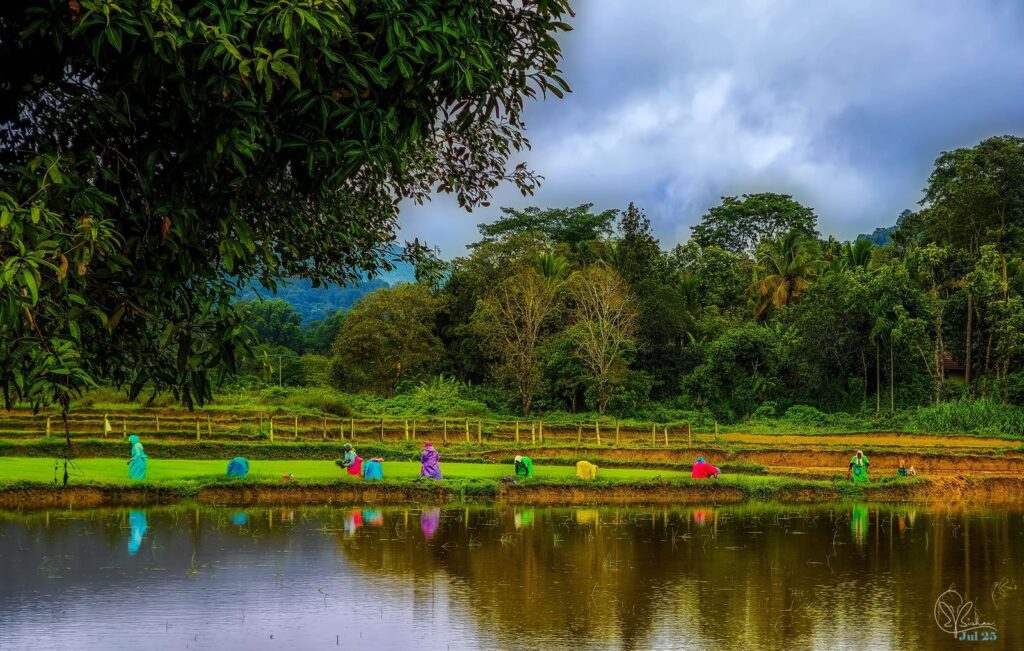
Transplanting paddy involves raising seedlings in a nursery and then transferring them to the main field. This method is widely used in Asia, particularly in labor-surplus areas and smaller rice fields.
Advantages:
-Ensures uniform plant stand, leading to better yields.
-Gives the crop a head start against weeds.
-Facilitates efficient water and fertilizer management.
-Can be more economical than direct seeding in some situations.
-May lead to higher yields compared to direct seeding.
Disadvantages:
-Labor-intensive and time-consuming, especially manual transplanting.
-Requires careful management of seedlings and main field preparation.
-Can be challenging to get sufficient labor at peak periods.
-May be less suitable for large fields or areas with limited labor.
Shot at Coorg
July 2025
© Dr.Bishan Monnappa.
Join our WhatsApp Group for News and Article Alerts



As the old adage goes – A man reaps what he sows! The one who sows to please the Ancestral Spirit of the Land, the Land will reap eternal life. That was the story of success of Kodavas in the days gone by – rice was the main stay of our existence and we traded this precious crop with the people of the plains for our existence and development.
To see uncultivated fallow lands is a collective failure. At least grow sufficient good quality, organic, pesticide free grain for the family’s table.
Better still, if the powerful Kodava Samajas underwrite the purchase of paddy by pre-booking the crop at a pre-agreed price with demand from members from the Samaja, it can restore paddy cultivation to its past levels. This is critical for the environment, use of land and for the health of the Kodavas and beyond.
Food for thought ☝🏼 – hope the local MLAs and District Administration take note.
I endorse the suggestion by Mr Kuttappa that the *Kodava community should take the initiative to grow paddy in Kodagu’s sacred wetlands and find a market from within the community itself.* the idea of the involvement by the wide network of Kodava Samajas is an excellent thought. Maybe the Akhila Kodava Samaja should also take this as one of the overriding priorities for Kodavas and Kodagu – as was their hugely successful mobilisation of the _Kodavamme Balo Nadp_ with Jabhoomi and others.
Cultivating our wetlands is crucial for the increase in our fast depleting water table, environment and most importantly *eating safe rice at the family table*! After all the very essence of our worship at Igguthappa Temple and at TaleKaveri is based on rice – cultivated by Kodavas.
Transplanting paddy is a time-honoured and effective method that continues to play a crucial role in our rice cultivation. In the agrarian communities that most of us grew up, there was no question of hiring labour – it was a community affair – where neighbours helped one another. It was a huge community bonding experience and also cost-effective. These skills are now lost.
It is sad to see huge tracts of paddy fields remaining uncultivated as you drive in the countryside in Coorg. Many reasons – this crop is economically unviable and increased human-animal conflict.
Having said this, everything cannot be measured in economic terms. If paddy is not cultivated, the water table keeps reducing year after year resulting in water levels in wells reducing drastically and drought. There has to be proper dialogue between the local people, district administration and the State Government to support the growing of rice – otherwise it will have implications on food shortage and downstream water availability for urban cities.
The rhythm of the monsoon brings life to our fields 🌧🌾 Transplanting paddy may be labor-intensive, but it’s a tradition rooted in wisdom — ensuring stronger crops, better yields, efficient resource use and in the days gone by – a sense of community. The elders will recall the fantastic camaraderie and bonds that got developed by unspoken participation in ploughing each other’s paddy fields. Salute to the hands that sow our future, one seedling at a time 🙌🌱
A word of caution has to be expressed on “news” based _Bael Pani_. Any such initiative has to be sustained and carried out year after year. Agricultural activity is a serious commitment and if done with sincerity, the land will NEVER forsake the tiller.