

As always, Dr. Bishan captures the precious treasures that Nature offers. The Blood Moon was not to be missed by him!
The total lunar eclipse of 2025, also known as the Blood Moon, occurred overnight on September 7–8. A breakdown of the key timings in India Standard Time (IST):
Penumbral eclipse: 8:58 PM on September 7
Partial eclipse: 9:57 PM
Total eclipse (Blood Moon phase): 11:00 PM
Maximum eclipse: 11:41 PM
Total eclipse ended: 12:22 AM on September 8
Visibility: This eclipse was visible across Asia, Australia, Europe and Africa, with India getting a full view from start to finish. – CLN Newsdesk.
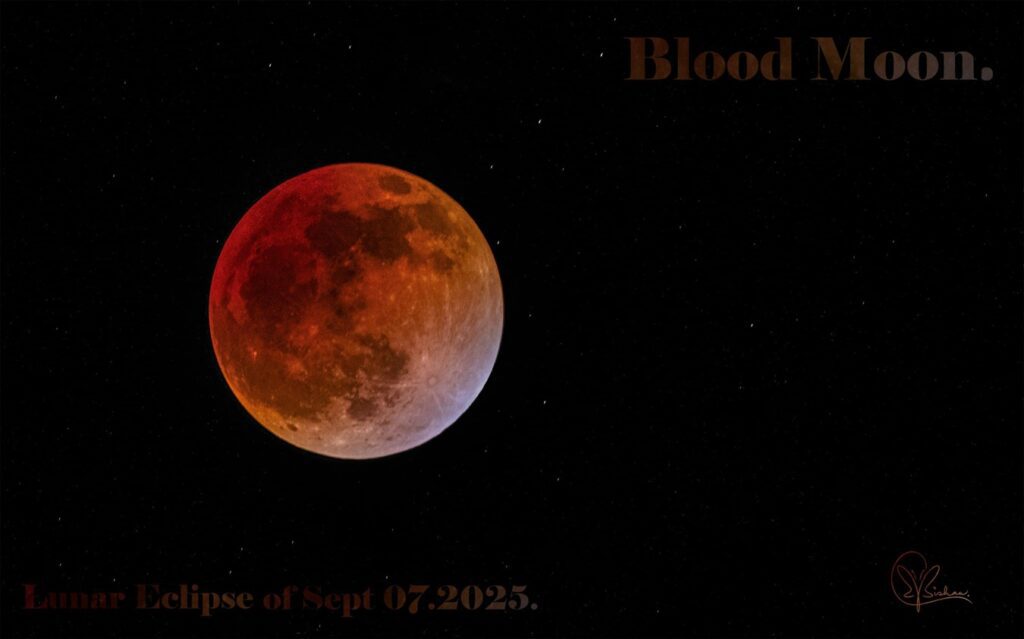
A lunar eclipse occurs when the earth comes between the sun and the moon, casting its shadow on the lunar surface.
It happens in phases. The moon will begin to creep into the outer part of Earth’s shadow, called the penumbra, causing its face to slightly dim. Then the moon will enter Earth’s umbra, the darkest part of its shadow, during which a growing portion of its surface will be hidden from view.
When the Earth’s shadow completely envelops the moon, the lunar surface will turn to a deep, dark red colour.
The moon’s red hue is down to refracted light. Shorter blue wavelengths of light are typically scattered by the Earth’s atmosphere, leaving longer red wavelengths to pass through and reach the moon.
This same atmospheric refraction effect is what causes sunsets and sunrises to look red.
Hence it is called as the Blood Moon.
Last night was one of the longest total eclipses lasting 82 mins.
Shot in Coorg, Sep 2025. © Dr.Bishan Monnappa
Join our WhatsApp Group for News and Article Alerts



I really like every post of Dr Bishan – his ability to find the time to capture all these pictures at the right moment speaks volumes of his passion for what he does!
I don’t know if people realise that through his images he is capturing the flora, fauna, butterflies and so much more in capturing the moods of the seasons in Kodagu.
Sincere thanks Dr Bishan and to CLN to publish them with pride regularly.