

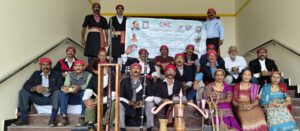
As part of the UN World Day of Indigenous Peoples, the Kodava National Council (CNC) held a peaceful sit-in in front of the District Collector’s Office and presented demands in support of the rights of the Kodava people.
Speaking at the dharna satyagraha, CNC President N.U. Nachappa stated that peaceful sit-ins are being held continuously to draw the attention of the country’s administration and the international community to the demands of the indigenous Kodava tribal people who have been deprived of their constitutional rights.
He said that the Kodava people belong to the indigenous tribal community and are the original inhabitants of the sacred Kodava land. The Kodava land is their only home and their traditional and inalienable homeland. The birthplace of the Kodava people is as old as the earth, and the Kodava tribe is as old as the human race. The historical continuity of the Kodava people in their homeland should be legally recognized.
He demanded constitutional protection for the Kodava habitat, ancestral lands, political and cultural rights, folk identity, divine forests (Devakad), sanctuaries such as Mand and Vanadevi, flora and fauna, natural water bodies, perennial rivers, the Devat Parambu Kodava genocide memorial site, and Talakaveri, the sacred pilgrimage site of the Kodava people, under the rights of indigenous peoples in international law. He also called for the right to internal political self-determination for Kodavaland.
Nachappa highlighted that the CNC has been peacefully advocating for the rights and protection of the Kodava people as an indigenous, animistic, mono-ethnic community for the last 35 years. He reiterated that the Kodava people’s historical continuity in their traditional habitat, their hereditary lands, their political and cultural rights, folk identity, sacred sites such as Devakad, divine Mands, DevatParambu, the Kodava genocide site, holy Talakaveri, and natural resources must be protected under international law.
He said that the Kodava traditional “ethnic sanskar” gun/thok rights should be protected on par with the Sikh community’s kirpan rights under Articles 25 and 26 of the Constitution. He also demanded that the Kodava language, Kodava Tak, be included in the Eighth Schedule of the Constitution and recognized as the third official language of Karnataka along with Konkani and Tulu. Kodava Tak should be introduced in the curriculum and administration under Articles 347, 350, and 350H of the Constitution.
Nachappa also called for the inclusion of Kodava folk heritage in the UNESCO list of intangible cultural heritage. To revive this heritage, he urged the government to provide land for establishing a World Kodava Research Centre and a Kodava Higher Studies Centre.He further demanded that the Cauvery River be given “the status of a legal person” as one of the seven sacred rivers of the Vedic period. Its birthplace should be recognized as a holy pilgrimage site for the Kodava community, similar to the Jewish Temple of Mount Moriah. According to the Helsinki Accords of 1966, a major share of the Cauvery’s water should be allocated to Kodagu. Out of the 740 TMC of Cauvery water annually, Kodagu produces more than 200 TMC.
Nachappa stated that the Nalnad Palace and Madikeri Fort should serve as memorials for political killings committed through conspiracy, and war memorials should be established to honor Kodava valor at Uluguli, Suntikoppa, and Mullusoge. The International Kodava Genocide Memorial at DevatParambu should be preserved under Article 49 of the Constitution and included in the United Nations list of Holocaust remembrance sites as per the Venice Declaration of 1964. DevatParambu, as an ancient battlefield and Kodava ethnic homeland, should be preserved as a heritage site equal in importance to the ancient battlefields of Kurukshetra, Kalinga, and Actium.
He demanded measures to prevent demographic change, protect hereditary communal properties, and safeguard spiritual and cultural sites such as Mand, “Kodava Divine Park” Devakad, Tutamgala, and Kyaukola. He called for statutory recognition of the Kodava people’s historical continuity on this land and the granting of an Inner Line Permit similar to those in Manipur, Nagaland, Arunachal Pradesh, and Mizoram.
Nachappa also called for special Kodava parliamentary and assembly constituencies in the new Parliament, modeled on the “Sangh” virtual constituency for the Buddhist monastic community in Sikkim. He demanded the return of hereditary properties lost due to historical injustices, including confiscation, lease, and sale to outsiders by kings, the British, and dictators.
The CNC petition was submitted through the district administration to the Secretary-General of the United Nations, the Director-General of UNESCO, the High Commissioner of the UNHRC, the President of the International Court of Justice, the President of India, the Prime Minister, the Home Minister, the Chief Minister of Karnataka, and economist Dr. Subramanian Swamy.
Participants in the satyagraha included Cholapanda Jyoti, Pattamada Lalitha, Nandineravada Rekha Nachappa, Kalianda Prakash, Bottanga Girish, Kiriamada Sherin, Areyada Girish, Mandapada Manoj, Pudiokkada Prithvi, Manavattira Chinnappa, Puttichanda Devaiah, CholapandaNanaiah, Changada Chami, TothyandaBoliyappa, Koopadira Sabu, Apparanda Prasad, Tolanda Somayya, Koopadira Uthappa, Palekanda Pratap, and Pattamada Prithvi Dharani.

