

💧
Before I write about the need for intensive water management in Kodagu as one of the utmost priorities, it is important to set the background on Climate Change and its consequences, especially on water resources. When trying to understand what the future might hold on the climate crisis, we often look to the past. After all, the Earth has seen apocalyptic warmings, dramatic sea level changes in the past too.
El Niño is firmly established and will intensify into a very strong event in the coming months, with big impacts on rainfall and temperature patterns and associated risks of floods, drought and extreme heat. According to a recent update from the World Meteorological Organization (WMO)… “El Niño is being supersized before our eyes. The science leaves no room for doubt: the planet is in uncharted waters, and those waters are heating up. Sea surface temperatures are rising, temperatures keep climbing, and the world is in the danger zone of extreme weather. The race now is between rising risks and our commitment to take climate action and protect people. We must win that race,” said UN Secretary-General António Guterres.
So, one may ask if the Global scenario sounds so ominous, what can we do in our small district?
Whenever Kodagu receives deficient rainfall, we hear the familiar news – “prayers are offered for rain at Padi Igguthappa” by no less than Ministers and our self-appointed leaders. At times the Gods even oblige them – but just for a day! As the heat grows stronger and the streams begin to dry up, our prayers are more vigorous. The shocking reality is that if it stops raining for a couple of days, we have near drought like situation in Kodagu – something that could not be imagined even a few years ago.
The monsoon spell in Karnataka has only worsened in September. Compared to the normal of around 51 mm of rainfall, the state has received only 10 mm, an 81 per cent deficit, according to data from the Karnataka State Natural Disaster Monitoring Centre. The state has received less than normal rainfall in all the monsoon months starting June. The deficit in June was 42 per cent as the state received 116 mm of rainfall against a normal of 199 mm, July was 29 per cent (192 mm against an average of 271 mm), and August (169 mm against an average of 220 mm). Crop loss was extensive across the state, and depleting groundwater levels have added to concerns. As a consequence, CM D K Shivakumar has warned that water, power shortage will be acute with significant crop loss.
But while we pray for the skies to open up, there is a question that we are obliged to ask ourselves. Are we doing enough to protect our water resources? We need to protect the streams and springs that feed our larger rivers. We need to keep natural drainage channels open, prevent waste from entering waterways and protect the forests and wetlands that act as natural water reservoirs. This has to be done at the grassroots level.
Solutions we need to consider:
- Protect springs and streams: identify and map local water sources and create community protection around them.
- Panchayats, institutions and households should address every measure to conserve water and avoid wastage.
- Rain water harvesting: Every household, Education Institution, Hotel, Homestay and government building should collect and use rain water wherever feasible.
- Stop polluting streams: Strict action against dumping plastic, sewage and other waste into waterways.
- Protect forests and recultivate fallow wetlands: Water conservation cannot be separated from forest conservation. Destroying natural water catchments ultimately affects our own water security; cultivating wetlands is crucial for maintaining the water table.
- Responsible and Sustainable Tourism:
To quote Gautham Machaiah – “Tourism undoubtedly generates employment and revenue. But without proper planning, carrying-capacity assessments, and environmental safeguards, tourism can become a threat to the very landscapes that attract visitors in the first place.
If Coorg’s pristine environment, unique culture, and water security are to be preserved for future generations, the government must adopt a sustainable tourism policy that includes visitor-management measures, stricter environmental regulations, and a cap on the daily and annual number of tourists based on the district’s ecological carrying capacity. It is time to move from unchecked mass tourism to responsible, sustainable eco-tourism before there is nothing left to save.
- Water conscious agriculture: Encourage methods that conserve soil moisture and reduce unnecessary water use.
Water conservation measures should become a permanent agenda for the Government and Residents of Kodagu. We have to change our attitude towards water. So let Kodagu’s prayers for rain become more than a plea to the heavens. Let them become a promise to the land.
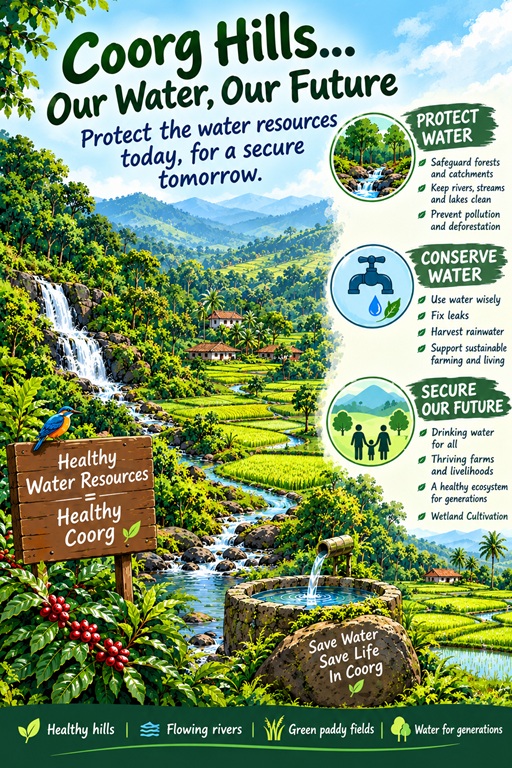
SAVE WATER – OUR FUTURE DEPENDS ON IT
JOIN HANDS AND SAVE WATER FOR OUR NEXT GENERATION
Join our WhatsApp Group for News and Article Alerts



Super El Nino – https://www.facebook.com/watch/?v=1515430550253084
The purpose of posting these warnings on El Nino is not to cause further unnecessary alarm. The need for doing so is to alert the population at large to be aware and prepared along with the District Administration.
We have already experienced wild fluctuations in rainfall (big deficits in most areas) and temperatures, which as we are well aware has major negative connotations for the coffee crop. By now we should’ve collectively acted to ask for insurance to protect the economic consequences, especially for the small growers.
And then of course the forward thinking measures to secure drinking water for the residents, while effectively managing the tourist inflow. At the risk of annoying some groups, should Kodagu be indulging in massive Dussehra celebrations instead of prudently conserving financial and water resources for the impending natural instability.
This is where “educated” citizens should be putting their heads together and proactively nudging the Government/District Administration to act with responsibility. Our politicians may not do it as their main interest is taking populistic measures to garner votes. Would look forward to an active debate on this matter.
There are numerous organisations that make well meaning and effective representations to the District Administration. After a brief appearance in the media – everything is forgotten. This is a sad recurring feature.
Within Kodagu, there should either be an organization like The Akhila Kodava Samaja (no one appears to know what their priorities and responsibilities are) or The Coorg Wildlife Society alongwith the Chief Executive Officer at the District HQ who can be made to provide a quarterly update on action taken. On the one hand everyone understands that protests are the means of last resort – but those who raise issues and the people responsible for remedial action should respond professionally.
I get excited to read the interaction that is taking place on this platform. I have not seen this ever before and it is very engaging.
I hadn’t realised that the Government agencies undertake such a vast amount of real work that gets lost in the archives. The District Administration, the local political leaders and community organisations like Akhila Kodava Samaja (if they are upto it) should proactively approach the district administration and local politicians to guide them in the right direction.
A typical thought-provoking article by Ms. Mamatha.
Kodagu’s water security is deeply connected to our forests, wetlands, streams, springs, and agricultural practices. Praying for rain cannot be our only solution—we must also take responsibility for protecting and conserving what Nature in its wisdom gives us.
Rainwater harvesting, protecting natural water sources, recultivating wetlands, regenerative agriculture, and sustainable tourism needs to become a collective commitment of the government, communities, and every household. Now that’s a tall order and can only be fulfilled if everyone understands the “seriousness” of the future.
I recall that back in 2017–18, tourism was restricted in Cape Town, South Africa, due to a severe water crisis, and Capri in Italy temporarily banned tourists in 2024.
Given Kodagu’s severe water table depletion, should we consider “controlled” tourism for a few months as well?
SHOULD WE NOT CONSIDER AND EVALUATE UNCONTROLLED MIGRATION FROM NEIGHBOURING STATES where the influx is distorting the demographics to a point where the original Kodava ethos is at a risk of being lost?
Thank you, CLN, for once again bringing such an important issue to the forefront.
There is a famous quote – IF WE ONLY KNEW WHAT WE ALREADY KNOW. Essentially what it translates to is that there are hidden reservoirs of intelligence that exist and can be efficiently tapped to create value. So we came across this wonderful report which can be accessed at:
https://antharjala.karnataka.gov.in/uploads/Kodagu_CORRECTION-GROUNDWATER%20YEAR%20BOOK%202024KodaguFinal%20-%20Copy_1777292134.pdf
Conclusion and recommendations:
The analysis of monitoring data and other information reveals that the water level declination, in irrigation tract does not suffer high water declination. But in non irrigated area of the district, the water level considerably declines. To improve the groundwater table, construction of ARS is to be taken up on top priority. The problem of storm runoff disposal and aquifer depletion can be tackled together through construction of artificial recharge structures. Storm water in small urban areas can be deviated to the existing tanks, which will subsequently infiltrate and recharge the Groundwater body.
1. Construction of different water harvesting/ Recharge structures like Vegetative check, Rubble Check Boulder Check & Check dam sand sub surface dykes at appropriate places across the nallahs and streams in the water table depleting areas, over exploited, critical and areas of the district and the areas where water quality problem exists may be taken on priority basis.
2. Considering the fresh water scarcity in the district, a comprehensive programme should be formulated to harvest the rain water through roof top, check dams, surface tanks, bunds and subsurface dykes to use the resources directly from the structures, which in turn to arrest the sub surface flows and augment the groundwater resources.
3. The groundwater worthy areas such as topographic lows, valley portions low fluctuations zones should be developed with an adequate soil conservation measure to prevent the soil erosions during rainy seasons.
4. Constant monitoring of ground water quality should be carried out in the fluoride- contaminated areas to prevent further deterioration and related problems. The determination of trace elements and organic compound be done to help in categorizing the quality of water.
5. A detailed geophysical study with the help of the state-of-the-art technology should be conducted to demarcate the extent of potential aquifers and it is geometry, especially in central plain region.
6. Farmers shall be educated with regard to conserving the groundwater by adopting water economy methods like drip irrigation and sprinkler irrigation in a large way in irrigated agriculture to save water.
The reason for highlighting the above report is that these studies already exist and the District Authorities and Civic Agencies need to use it. These reports should be made to educate the public at large.
A much-needed reminder for Kodagu. We have always taken our water and natural wealth for granted, but the changing situation shows that we can no longer afford to. Conservation has to move beyond awareness and become a responsibility shared by every household and every generation.
Delighted to see your comments Janan – we at CLN treasure comments sent in by youngsters. The future belongs to you and what you say matters.
You are amazing Mamata and how precisely you focus on a subject that is playing on our minds. In fact I was thinking myself that the government should restrict the inflow of tourists to Kodagu and conserve every drop of water for the months ahead.
God has given you an amazing gift of writing with clarity and in turn you are an amazing gift to our community by the Almighty.
After decades of hoping to come for the Meedi Beppa ceremony at the Balliamane on December 1st, it would be my pleasure and privilege to personally meet you. God bless!!
Your encouragement is invaluable and for any writer it is a dream for get this consistent support.
Kindly spread the word within your network for people to take note and write in with their views. Look forward to meeting you in early December.
Mamatha Subbaiah writes with heart and is right about the need to take conscious steps to save our water. Climate Change should not be taken as an excuse to forfeit our responsibility in taking measures to conserve water, undertake rainwater harvesting and store water in tanks and take measures to give the land the opportunity to keep the water table high. We have too many resorts and overtourism that exploits our precious natural resources.
Your well written article brings back so many verdant memories of lush green valleys with paddy fields, evergreen landscapes and the innumerable springs during monsoon on virtually every hillside. That was our vintage Kodagu.
Now the streams are dry, the waterways laden with garbage and drought like conditions if there is a break in the rains. Go to Kootpole at the outskirts of Madikeri – the water levels are so low, most unlike the past when it was full most parts of the year. With the explosion of population, uncontrolled tourist footfalls and resorts, water is in terrible shortage already.
Paddy fields remain fallow, drilling of bore wells is rampant, mindless irrigation – all leading to demand for water far exceeding supply.
Unless coordinated action is taken by all stakeholders, Kodagu will be in serious trouble.
We are experiencing our share of the fresh water crisis the whole planet is facing. Even developed countries with advanced water management policies and technology are waking up to this reality with depleting waters in their reservoirs and rivers. There are no quick fixes; we have to make water and general ecological conservation/awareness a part of our normal lifestyle, not merely during a crisis. Every time I flush the toilet after minimal use this thought crosses my mind. Not for nothing, experts predict the future wars will be fought over water, not oil.
Having said all that I still subscribe to the sensible tips the author offers to mitigate the crisis at the hyperlocal level in Kodagu during the present dire situation.
Appreciate your views and support. I really wish more people would participate on this platform provided by CLN Online. Politicians and Government authorities do take note of CLN as being a serious and proactive well meaning platform/media house.
It is encouraging to see youngsters like Neer Somakka responding. The future is theirs and they must make their voices heard.
Water is getting depleted every where. Nilgiris is shortly going to face a huge problem. The Rallia dam in Coonoor was completely dry and today water is being diverted from the Parsons Valley, beyond Ooty for supply to Coonoor.
My open well has packed up too. Overtourism continues unabated. The world looks bleak and unless drastic action is collectively taken, there will be disastrous consequences.
Frightening scenario 😢
Thank you for providing your perspective from Ooty/Coonoor. Sadly, we are also headed the same way in our beloved Kodagu – overtourism, uncontrolled migration – all leading to a picture of a landscape that we can hardly recognize of being Kodagu.
Also, I am told that the purchase of a “country dwelling” by piecemeal development of small tea land holdings by folks from Mumbai and Delhi has ruined the picturesque and enviable Ooty landscape. Coorg and other hill stations are being marauded by such mindless investors. We must put an end to this.
I genuinely loved reading this. There is something very heartfelt about the way the author has written it. About something we see and hear every summer. Prayers for rain and turned it into a much deeper reflection on how we treat the water and land we are blessed with.
What stayed with me most is the reminder that while we look up and pray for the skies to open, we also need to look around us and ask what we are doing to protect every drop. Every write up of Mamatha feels sincere, grounded and very close to the reality of kodagu.
When one reads of Ministers and politicians rushing to Igguthappa temple and Talecauvery to pray with pictures of the priest and the Thakkas it seems so hollow.
What we need is determined support to keep our wetlands cultivated with selective support from the Government (although that’s should not be the guiding principle). My family has grown paddy from time immemorial, it is our commitment to the value systems passed on to us by our ancestors. Also it provides clean, safe and nourishing meals at the family table.
Imagine devotees having to offer bought rice for Tulebara at Padi Igguthappa – goes against the grain of what the custom is meant to be.
Timely and very important article. Beautifully written.
What makes this piece especially effective is that it moves beyond concern to responsibility. Kodagu has always been blessed with abundant rainfall, forests and natural water systems, but we cannot take these resources for granted anymore.
Protecting streams, springs, forests and wetlands, harvesting rainwater, preventing pollution and managing tourism responsibly have to become a collective responsibility. These are not just environmental concerns they are essential for the future of Kodagu.
Our prayers for rain should also be supported by sincere action to protect and conserve the water we already have. Your closing thought is particularly meaningful let our prayers for rain become a promise to the land.
Thoughtful, practical and very well said.
Very Good initiative Mamatha kodandera 🙏
A much-needed conversation for Kodagu. Our streams, springs, forests and wetlands are all interconnected, and protecting one without the others is not enough. Water conservation needs to become a way of life, not just a response to a dry spell.
Always a delight to see your youthful participation Neer. With your background in Agricultural and superb academic qualifications, we should encourage more youngsters to express their views on important matters that affect the future of Kodagu. I look forward to meeting you in person too.
I always admire Mamatha’s dignified way of choosing the topic. The way she has connected our shared prayers for rain with our responsibility to protect every drop of water is truly meaningful.
What makes the article stand out is that it doesn’t stop at highlighting the problem, it makes each of us look within and ask what we can do. The message about the Cauvery, our forests, streams, and every day water wastage is both timely and powerful. Congratulations to the author for raising such an important issue with sensitivity and clarity.
Thank you for your kind words. The thoughts and words come from deep within. The parched countryside which used to be full of lovely green paddy fields is now hardly visible. I fear for my homeland.
Beautifully written, Mamatha. What makes this piece especially effective is that it moves beyond concern to responsibility. Kodagu may be blessed with extraordinary rainfall and natural water systems, but, as you point out, abundance is no excuse for complacency. Protecting streams and springs, preserving forests and wetlands, harvesting rainwater, and managing tourism responsibly are not abstract environmental ideals — they are acts of stewardship. Your closing thought is memorable: our prayers for rain must also become a promise to the land. Thoughtful, practical and very well said.
One of the hallmarks of the way our ancestors existed was their absolute respect for Nature. Protecting our Forests, our Sacred Devarkadus (Sacred Forests), Rules for hunting (no longer relevant), respect for rice cultivation and the concern for the environment was an envy of the visitors from time immemorial. Sadly, this has diminished. Jamma lands are being sold, “outsiders” with no commitment for our sacred land from neighbouring states have been buying relatively cheap land and building resorts with no basic appreciation of the fragile landscape – and we are beginning to lose our green cover. The sale of BBTC and the related resale for pure commercial conversion is a desecration of the land. It must stop. Thank you again for the support that you have expressed.