

For over a decade, a narrative of fear has dominated discussions around the High-Level Working Group report on the Western Ghats, led by Dr. K. Kasturirangan. Across Kodagu, local communities have been repeatedly told that its implementation will trigger mass evictions, strip away ancestral land rights, and paralyze our shade-grown coffee economy.
These anxieties have not arisen by accident. Vested commercial interests – most notably quarrying operators, timber lobbies, and speculative real estate aggregators – have weaponized local fears to turn the public against ecological regulation. By conflating conservation with displacement, they have built a shield around their own destructive operations at the expense of our region’s future.
It is time to discard this defensive posture. When examined objectively, the Kasturirangan framework is not a threat to our livelihoods; it is a statutory shield designed to protect our land, river basins, and cultural autonomy from commercial exploitation. Rather than resisting it, Coorg should actively demand its implementation.
A SCIENTIFIC DISTINCTION: NATURAL VS. CULTURAL LANDSCAPES
The core strength of the Kasturirangan report lies in its practical, geospatial approach. Unlike earlier, broad-brush conservation models that drew rigid boundaries over human settlements, Kasturirangan explicitly divides the Western Ghats into two distinct categories:
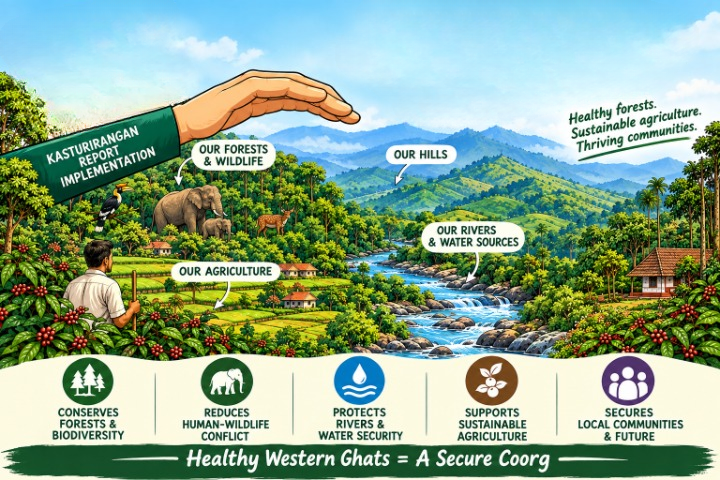
- Natural Landscapes: Contiguous primary forests, national parks, and protected wildlife reserves.
- Cultural Landscapes: Villages, agricultural fields, human settlements, and managed coffee plantations.
The report limits Eco-Sensitive Area (ESA) restrictions to natural landscapes. Existing homes, agricultural holdings, and coffee estates remain governed by standard local civil laws. Traditional farming practices, estate operations, land ownership, and local village life remain untouched.
WHAT THE REPORT ACTUALLY BANS
The prohibitions under the Kasturirangan ESA target high-impact commercial industries that pose a direct threat to Kodagu’s fragile ecology:
- Mining, Quarrying, and Sand Extraction: A complete ban on stone quarrying and sand mining within ESAs. Uncontrolled hill-cutting and stream disruption have directly contributed to the severe landslides that have plagued our district in recent years.
- Red-Category Industries & Mega-Townships: Prohibitions on heavily polluting industrial units and massive commercial township developments. This measure prevents aggressive urban expansion from consuming our agricultural valleys.
- Unfiltered Linear Infrastructure: Major power transmission corridors, highways, and railway cuts through primary forests are subjected to strict, transparent environmental impact assessments.
DISPEL THE MYTHS: THE REALITY BEHIND THE SAFEGUARDS
When we contrast political misrepresentations against the actual legal facts of the framework, the reality becomes clear. Contrary to claims of mass evictions, the report guarantees zero displacement, as private land holdings, coffee estates, and existing settlements are explicitly excluded from ESA mandates. Fears of agricultural bans are equally unfounded; standard plantation management and farming operations continue uninterrupted. Finally, rather than imposing a complete freeze on local infrastructure, the framework bans only high-impact mining and heavy industry, ensuring that essential civic projects—such as local roads, schools, and housing—remain fully permitted under standard environmental safeguards.
TURNING CONSERVATION INTO ECONOMIC ADVANTAGE
Beyond regulatory protection, establishing Kodagu as a legally protected ecological zone provides the district with distinct economic leverage:
- Payments for Ecosystem Services (PES): Kodagu serves as the primary catchment basin for the Cauvery River, providing fresh water to millions downstream. ESA recognition creates a legal framework for local institutions to demand direct fiscal compensation from government budgets to reward local landholders for maintaining the watershed.
- Global Premiums for Produce: In a global market dominated by mass commodity agriculture, protected ecological status allows local growers to market their shade-grown coffee, pepper, and honey as sustainably produced, commanding higher prices in specialty markets.
- Community-First Eco-Tourism: By restricting massive corporate resort developments, the framework favors low-impact homestays and community-managed initiatives, keeping tourism revenue within local families rather than outside conglomerates.
PROTECTING OUR ANCESTRAL CUSTODIANSHIP
Kodavas and local residents have stewarded this land for generations, maintaining sacred groves (Devakadus) and preserving micro-climates through sustainable agroforestry. Rejecting the Kasturirangan report does not safeguard local autonomy; it leaves our region vulnerable to unregulated commercial pressures that deplete our soil, dry up our streams, and force younger generations to migrate.
The Kasturirangan framework is not an external imposition—it is a legal mechanism to ensure Coorg remains green, economically viable, and self-reliant for generations to come. It is time for Kodagu to welcome it.
Join our WhatsApp Group for News and Article Alerts



Article like this enlighten people and encourage a more informed discussion about the Kasturirangan recommendations. Instead of reacting through fear or misconceptions, kodagu needs to understand what the recommendations actually propose, how they may affect local communities, livelihoods and the environment and then engage in a fact based dialogue about their implementation. Awareness must come before protest.
Balanced, non-political and well thought out analysis negating the rabble-rousers’ blind opposition.
ಉತ್ತಮ ಲೇಖನ…
Excellent article. It’s time we get more articles like this to dispel the wrong notions people have in kodagu due to vested interests. The more we bringout and share such articles the more we create awareness among general public to the unwanted FEAR BEING INSTILLED AMONG GENERAL PUBLIC.
PAYMENT FOR ECOLOGICAL SERVICES is something every resident and guardian of KODAGU LANDSCAPE AND ECOSYSTEM SHOULD VOCALLY DEMAND FROM THE GOVT.
Hats off to CLN for yet another brilliant article and always keeping an eye open on false rumours being spread especially regarding Kasturirangan Report.