The Codava National Council (CNC) celebrated the traditional Kodava festival KakkadaPadinet with great enthusiasm at Capital Village near Madikeri. Addressing the gathering as the chief guest, senior journalist and former media and political advisor to former Deputy Chief Ministers, Deepak Thimmaiah, expressed concern that the loss of Kodava ancestral land would ultimately threaten the very existence of the Kodava community.
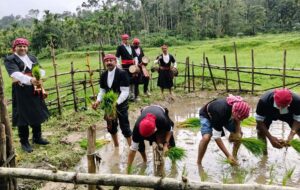
The celebrations commenced at the sacred Mand of Kodava heritage. CNC President N.U. Nachappa, chief guest Deepak Thimmaiah and Mandapada Manoj Mandanna ceremonially fired traditional guns into the air as a mark of respect to the ancestors. This was followed by the traditional banana tree-cutting ceremony. Leading a procession to the paddy fields, Nachappa fired another ceremonial gunshot to signify the commencement of the agricultural season. CNC members, volunteers, and members of the Kodava community, dressed in traditional attire, participated in the symbolic paddy transplantation ceremony.
Later, during the public meeting, N.U. Nachappa presented a 10-point Constitutional Resolution, which was unanimously adopted and signed by those present. Participants also took a solemn pledge in support of the CNC’s 36-year constitutional movement, invoking Guru-Karona, Surya-Chandra, Bhutai, Prakriti and the Constitution of India.
The gathering was also served traditional Kodava cuisine, including Natikoli chicken curry, Madd Payasa and various dishes prepared using Kakkada.
Kodava Land is the Soul of the Kodava Community
Addressing the gathering, Deepak Thimmaiah said that Kodava land is inseparable from Kodava identity.
He observed that merely wearing traditional Kodava attire or performing Kodava dances does not define the identity of the community. According to him, the self-respect, traditions and moral values of the Kodava people are deeply rooted in their ancestral homeland.
“If Kodava land is lost, the Kodava people will lose their identity. Without the Kodavas, there can be no Kodavaland or Kodagu. The Kodava community and Kodagu are inseparably linked through land, water and nature. If these are lost, the very existence of the Kodava people will be endangered,” he said.
He further remarked that the Kodavas are an ancient indigenous community whose traditions revolve around ancestor worship and a close relationship with nature. Their forefathers lived according to enduring values and customs, but these traditions, he said, are gradually being replaced by external influences.
Thimmaiah also expressed concern that the Kodava community is slowly being assimilated into the majority population of the State, thereby weakening its distinct cultural identity. Appreciating the efforts of the Kodava National Council, he said the organisation, under the leadership of N.U. Nachappa, has consistently worked to preserve and assert Kodava identity, culture and constitutional rights. He described Nachappa as “a true Kodava leader” and appealed to every Kodava to extend wholehearted support to the movement.
Constitutional and Cultural Demands
Presiding over the function, CNC President N.U. Nachappa reiterated several longstanding demands of the organisation.
He called for geo-political autonomy and self-governance for Kodavaland, on the lines of regions such as Gorkhaland, Leh-Ladakh and certain North-Eastern States, by invoking the relevant provisions of Articles 244 and 371 of the Constitution of India.
He demanded constitutional recognition and protection for the Kodavas as an ancient indigenous, mono-ethnic, nature-worshipping community, in accordance with the Constitution of India and the United Nations Declaration on the Rights of Indigenous Peoples (UNDRIP.
Nachappa also urged the Government to recognise the traditional Kodava sacramental firearm (Thok/Gun) as an essential religious practice protected under Articles 25 and 26 of the Constitution.
He further sought inclusion of the Kodava language in the Eighth Schedule of the Constitution and requested that Kodava cultural traditions, sacred groves (Devarakadus), sacred sites, folk arts, songs, Parayakali, Ummattat, Kolaat and Bolkaat be included in UNESCO’s Intangible Cultural Heritage List.
Among the other demands raised were:
- International recognition for Kodava historical monuments and tragedies.
- Construction of a memorial at DevatParamb to commemorate the Kodava genocide.
- Inclusion of the political killings at Nalnad Palace and Madikeri Fort Palace in the United Nations’ international remembrance records.
- Construction of war memorials at Valgalli, Mullusoge and Lakkadikote to honour Kodava valour.
- Implementation of an Inner Line Permit system across Kodava homeland to prevent demographic change and illegal land acquisition.
- Declaration of Talakaveri as a sacred pilgrimage centre for the indigenous Kodava community.
- A fair share of Cauvery waters for Kodagu based on the 1966 Helsinki Principles.
- Guaranteed representation for the Kodava community in Parliament and the Karnataka Legislative Assembly.
- Restoration of ancestral Kodava lands allegedly lost during different periods of history due to taxation, mortgages, sale and other circumstances.
- Creation of a separate Kodava code and column in the 2027 National Population Census and Caste Census.
Nachappa alleged that while the Kodavas were recognised as a separate race until 1941 and had a distinct homeland until the merger of Kodagu State in 1956, both these identities had subsequently been lost.
Describing this as a “double loss of identity and existence,” he appealed to both the Union and Karnataka Governments to address what he termed as a historical injustice.
A large number of CNC office-bearers, members, community leaders and invited guests were present at the function. Among them were Pullera Swati, Appachira Reena, Nandetira Kavita, Cholapanda Jyoti, Nandineravada Rekha, Pattamada Lalita, Nandineravada Bina, KoothandaSarsu Appiah, Nandineravada Nisha, Nandineravada Sumitra, Principal of Kodagu Vidyalaya, Elapanda Pushpa Uthappa, Master Appiah, Almanda Jai Ganapathy, Nandeti Ravi Subbaiah, PorimandaDinmani Poovaiah, Bachiranianda Chippanna, Mandapada Manoj and several other members of the Kodava community.
Join our WhatsApp Group for News and Article Alerts