Various workers’ and tribal organisations staged a protest in Madikeri on Tuesday, expressing concern that members of tribal, Dalit and economically weaker communities could lose their voting rights due to the lack of documents required under the Special Intensive Revision (SIR) of the electoral rolls.
The protest, organised jointly by the Centre of Indian Trade Unions (CITU), the Karnataka State Tribal Rights Coordination Committee and the Karnataka State Agricultural Labourers’ Association, was held in front of the Deputy Commissioner’s Office. The protesters demanded that the authorities ensure the preservation of the voting rights of all eligible citizens by facilitating the issuance of the necessary documents.
Addressing the gathering, CITU District Secretary P.R. Bharath said that, in the years immediately following Independence, the Election Commission had focused on including those who had been left out of the electoral rolls and ensuring that every eligible citizen was able to exercise the right to vote. However, he alleged that the present SIR exercise had given rise to concerns that eligible voters could instead be excluded from the electoral rolls. He stated that it was not the responsibility of election officials to determine or revoke the citizenship of voters. Bharath expressed concern that nearly 7,000 members of the tribal and Dalit communities in Kodagu district could be excluded from the electoral rolls under the current SIR process. He further claimed that lakhs of people had reportedly been left out of electoral rolls during similar SIR exercises conducted in states such as West Bengal, Bihar, Gujarat, Kerala and Tamil Nadu.
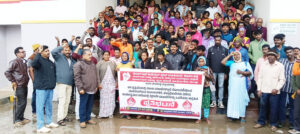
The protesters pointed out that the State Election Commission is conducting the SIR process from June 30 to July 29 and has provided an opportunity for eligible persons to enrol in the electoral rolls. However, they expressed concern that many tribal families, Dalits and economically weaker sections do not possess documents such as Aadhaar cards, identity cards, ration cards or birth certificates required under the SIR process. They urged the district administration to take immediate steps to facilitate the issuance of such documents.
Following the protest, a memorandum was submitted to Additional Deputy Commissioner Dr. Sahana S. Hadimani.
In the memorandum, the organisations stated that a large number of tribal and Dalit families in the district reside in estate line houses and labour settlements. Many of these workers migrate from one plantation to another in search of employment.
The petition further stated that original documents belonging to many workers are often retained by estate owners. As a result, when workers leave plantations without repaying loans advanced by employers, they are unable to recover their original documents and are forced to migrate elsewhere. Consequently, a considerable number of tribal and Dalit families have lost possession of their essential documents, increasing the likelihood of being excluded from the electoral rolls during the SIR process.
The organisations also demanded that special officers be appointed and adequate facilities provided to ensure that eligible residents of tribal hamlets (Hadis), line houses and Dalit colonies are properly included in the Special Intensive Revision of the electoral rolls. Among those who participated in the protest were CPI(M) leader H.B. Ramesh, CITU District President A.C. Sabu, Adivasi Rights Coordination Committee District President J.R. Prema, Agricultural Labourers’ Association District President T.K. Ramesh, Parvati Suresh, P.V. Ravi, Amin, Bhagya Changappa, Sadiq, J.R. Seethe, Y.R. Raghu, J.R. Suresh, Y.R. Mutta and several other leaders and members of the participating organisations.
Join our WhatsApp Group for News and Article Alerts