

CLN is priviledged to publish Star of Mysore editor’s excellent article on the need for Tree Cover. In the last few months there has been an encouraging movement towards highlighting and solving the garbage problem in Kodagu, the need for regreening, including planting of trees across the length and breath of Kodagu, and celebration of Vana Mahotsava with meaningful environmental education. Furthermore even the MP Shri Yaduveer Wodeyar has receieved a positive response from the central government to address human-elephant conflict where Kodagu has been identified as a focus area.
These are small steps, but a meaningful beginging.
Our city is getting hotter with every passing year. As temperatures soared yesterday, the Karnataka Government advised citizens to turn into camels: “Drink sufficient water whenever possible, even if you are NOT thirsty.”
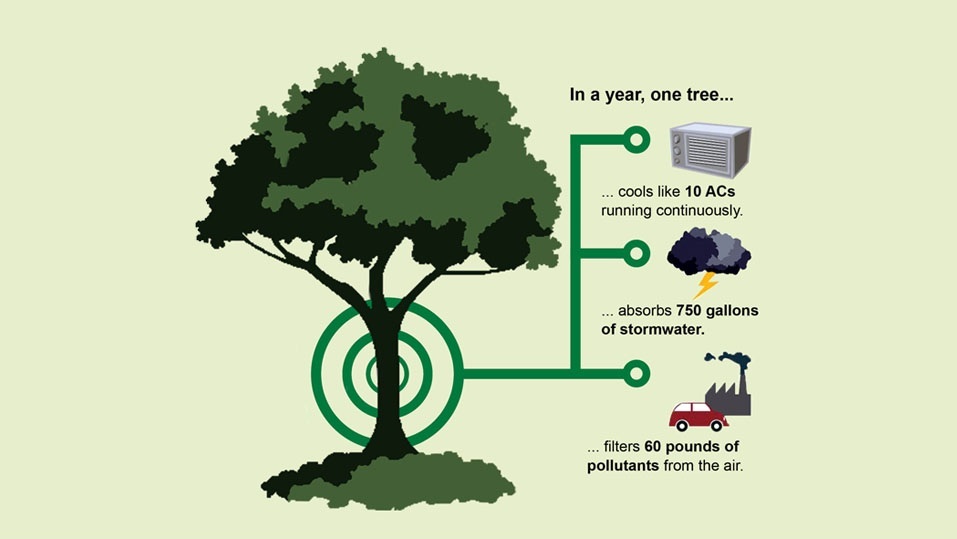
But where is the water to drink when our cities are as dry as a desert? Instead of just issuing some orders from their AC chambers in Vidhana Soudha, shouldn’t the Government authorities get their hands dirty and plant some ‘green guardians’ to fight this heat wave for the long haul?
It has been confirmed that trees are the only way to scuttle urban heat waves. Yet, our Government doesn’t do much to that end.
In 2013, scientists ran a simple experiment in Bengaluru. They compared stretches of roads with and without trees. It was found that the road stretches lined with trees had much lower surface and ambient air temperature. Of course, no one was surprised, but…
But what was surprising, though, is how much the temperature was reduced. The difference in road surface temperature was 21.5 degrees! The highest road surface temperature recorded in a segment with no trees was 55 degrees, while the segment with tree cover was 33.5 degrees.
Scientists at the Indian Institute of Science (IISc), in 2017, using Satellite imagery from 1973 to 2017, showed that there has been an 88 percent decline in green spaces in Bengaluru.
The same report warned that by 2020, only 2.96 percent of the green cover will remain in Bengaluru and added that in the future, this would make the “region greenhouse gas-rich, water scarce and unliveable, depriving the city dwellers of clean air, water and environment.” It’s come true.
Yet a reply to an RTI query revealed that the Bangalore Development Authority had not planted a single tree for two years, from 2017 to 2019, while simultaneously giving approvals for numerous layouts !
As more and more layouts are developed, more trees will be cut and Mysuru, like Bengaluru, is bound to get hotter.
It is the right time to make a case for turning large parks with garish statues, amateurish animal figurines and gaudy fountains into an urban forest with walking paths and ponds.
Mysuru, in 2021, had a forward-thinking officer — Deputy Conservator of Forests (DCF) Dr. K.C. Prashanth Kumar, who had said that his Department had a blueprint for increasing green cover and even had planned urban forests within the city.
This urban forest concept was implemented on a small scale behind Cheluvamba Park at Vontikoppal. The Forest Department also identified Lalithadrinagar, KSRTC Layout, Vijayanagar 4th Stage and J.P. Nagar as areas with the potential to nurture urban forests. Dr. Prashanth Kumar left, and with him, the urban forest project.
The issue with us is that we constantly find a ‘workaround’ to a problem instead of demanding that our Governments solve the problem once and for all.
Let us start with water. Just a few decades ago, in the early 1990s, almost no one knew what a ‘submersible pump’ was. We all had an overhead tank to which MCC would provide a direct connection and a water meter, and we would have a steady supply of decently clean water.
Then, MCC’s water supply became erratic and the tax-paying middle class did not have time to protest, so we invested in ‘Plan B’ — a sump tank.
This article was previously published in Star of Mysore on, 30th March, 2024. Published here with permission from Star of Mysore.
Join our WhatsApp Group for News and Article Alerts



Very good article and more such writing should be published to keep reminding the public at large and children especially that what we need are jungles full of trees and NOT “concrete jungles”.
Also, tree planting has to be done responsibly and with guidance from Horticulturists. Introduce political overtones and attempts to create irrelevant world records could be disastrous. Take the headline grabbing recent sapling plantation in Bengaluru – “The entire city has come together to plant 15 lakh saplings on Kempegowda’s birth anniversary. By planting and nurturing these trees, we’re taking a step towards restoring Bengaluru identity as the Garden City.”
“The successful plantation of 15 lakh indigenous saplings is one of the most significant environmental conservation programmes undertaken by BDA.”
Prominent media houses took part in the extravaganza too!
Ten days later – “Over 10 days after the city set a Guinness World Record by planting 15 lakh native saplings in 12 hours, hundreds have already withered, are damaged or remain unplanted, residents said after a reality check.”
Regreening or rewilding is a serious matter. IPL boasted – Whenever a bowler bowls a green dot ball, the Tata Group contributes by planting trees in return. In IPL 2025, 18 trees were planted for every green dot ball, and in IPL 2026, 19 trees will be planted for every green dot ball. This initiative started in 2023 – so there must be millions of trees planted by now – it’s very unlike large corporations not to take credit for the implementation.
On a more serious note – if large organisations can genuinely support NGOs seriously involved in such initiatives – “intent” could be “delivered” and executed for the greater good of humanity and the greening of our country.
Native tribal communities tend to connnect with their natural surroundings in a more meaningful manner than the city bred citizens. This is true of the Native Americans, African Tribal communities, Aborigines and closer home the North Eastern States, Ladakh, vast number of forest tribal communities and of course our own ancestors who created the richest density of Devarkadus and a protocol or rules for the hunt. I would like to reproduce a Native American quote:
“We must protect the forests for our children, grandchildren and children yet to be born. We must protect the forests for those who can’t speak for themselves such as the birds, animals, fish and trees.” - Qwatsinas (Hereditary Chief Edward Moody), Nuxalk Nation
The article and comments contain eye-opening data:
– Humans and our livestock are now 96% of all mammal biomass. Every wild mammal left, every elephant, whale, bear and mouse, shares the other 4%.
– Our footprint already overshoots what the planet can regenerate by roughly 78%. The arithmetic that follows is a contraction of the human enterprise somewhere near 45%.
What are we waiting for – the land mass is finite.
Star of Mysore reported the documentation of 1,21,789 trees across all 65 wards by a citizen led initiative – Namma Tree Census. A comprehensive scientific report containing species wise analysis, ward wise tree density, canopy cover estimates, carbon sequestration data, heritage tree listings – all scheduled to be released in August. This was possible because of a civic movement led by the Bherunda Foundation adopted the initiative and involved the District Administration, MCC, Educational Institutions, businesses, civil society organizations and citizen volunteers – very similar to the COHERA initiative on garbage clearance (for a day!) in Kodagu.
Perhaps a similar exercise can be conducted in all the bigger towns in Kodagu – starting with Madikeri. Once a data base is created on the inventory of trees, perhaps the Forest Department, Forestry College and COHERA backed by the District Administration could evaluate a planned tree planting initiative. There were already encouraging posts on Swacha Kodagu Sundara Kodagu Abhiyana’s social media group for planting trees in all the towns urgently. It is absolutely crucial that there should be assigned caretakers for the tree saplings planted as also the suitable mix of trees that are relevant for our landscape.
Coming to the Garden City of the country – Namma Bengaluru. It is called the Garden City of India because of its well-planned gardens, tree-lined streets, and large green spaces developed during the rule of Hyder Ali and Tipu Sultan, and later expanded during British rule. The city’s moderate climate also supports the growth of a wide variety of plants and trees.
According to a report published by Indian Institute of Science (https://wgbis.ces.iisc.ac.in/energy/water/paper/ETR75/results.html)
Intra city analysis show that major cities such as Gandhinagar, Bangalore, Ahmedabad, Brhihan Mumbai are with spatial extent greater than 400 sq.km. Gandhinagar has 416 trees for every 100 people followed by Bangalore with 17 trees, Brihan Mumbai with 15 trees and Ahmedabad with 11 trees. Reduced vegetation cover with urbanization has serious implications for the city’s environmental and ecological health. This highlights the city has crossed the threshold of urbanization evident from a range of psychological, social and health impacts for residents including dramatic increase in recent times of instances such as higher instances of domestic violence, obesity, enhanced asthma levels, traffic bottlenecks, road accidents, etc. Overall improvements in human well-being and community vitality necessitate urban planners to maintain at least 33% green cover in the region. In such a case there would be at least 1.15 trees/person in the city.
Even the well known gardens like Cubbon Park in Bangalore is poorly maintained. Strong gusts of wind result in poorly maintained fallen trees which remain an eye sore for months. Again, if left to the Government, planting and maintenance of trees is unlikely to get the attention it deserves. Perhaps the vast number of Technology Companies could come forward with CSR funds to adopt wards and make the city greener and environmentally more healthier.
I agree with the poor standards of maintenance within the few prominent public spaces that we have – Cubbon Park especially: it is so poorly maintained. The above pictures were taken last week. There is no regular trimming and maintenance of these precious trees planted at the turn of last century or before.
Seven in Ten, Gone in a Lifetime – a post by Kasper Benjamin Reimer Bjørkskov is shockingly scary to read. I am in the process of creating visuals that will hopefully excite the readers in CLN and a wider audience to understand the magnitude of the DEGROWTH required to restore some sense of equilibrium to human greed. I have presented a sample of the set of visuals under preparation with this comment.
Even though it is an old article, it is relevant and will remain relevant for all time to come.
The mass of everything humans have ever built now outweighs every living thing on Earth.
This was forwarded to me recently and I thought I’d share it for a wider well-meaning readership.
We definitely need to plant more trees, albeit of the right native species.
Large scale attempts to artificially alter natural landscapes and weather systems should be approached with extreme caution. Deserts have evolved as deserts, grasslands as grasslands, and rivers have naturally carved their own courses over thousands of years. Every ecosystem has a role in maintaining Earth’s ecological balance.
Development is necessary, but it must be sustainable. If a tree is cut down for road construction or any infrastructure project, at least three to ten native trees should be planted within a 3km radius of the site. This helps preserve the local ecosystem, supports biodiversity, and reduces the environmental impact of development.
Instead of trying to redesign nature, we should learn to work with it. Protecting natural ecosystems is the key to maintaining long term climate stability and ecological balance.
Absolutely concur – China’s model is inappropriate.
Regreening or more importantly rewilding is best done after understanding the natural tree selection for the landscape concerned. Having said that, post 1956 the environmental degradation in Kodagu and loss of tree cover across the landscape has been severe. The worst consequences of corporate restructuring was the takeover of Consolidated Coffee (the large scale timber extraction was a defining change in plantation tree cover practices) and more recently the sale and subsequent resale (some properties closer to townships being earmarked for real estate development by unscrupulous greed by buyers without concern for the environment ). This has to STOP and be reversed if possible.
The recent developments at the Igguthappa Malma caused widespread dissent from the Kodava community at large. This should extend to the creation of large resorts without proper environmental clearance and sale of Jamma land outside of the community, especially for non-agricultural use.