Every award season, the same pattern plays out. Cameras flash. Famous names trend. Social media fills with highlights from glittering ceremonies.
And then the quieter names are forgotten almost immediately.
Yet it is precisely those names – the teacher from a remote district, the farmer who developed a drought-resistant crop, the woman who spent three decades preserving a dying art form – that young people most need to know.
We are raising a generation that measures success in followers and speed. Visibility has become confused with value. In that environment, national honours carry an important counter-narrative: that the most consequential work in a society is often done far from the spotlight, over many years, by people who simply refused to stop.
Most award recipients did not begin with advantages. Many worked in conditions that offered little encouragement. Recognition, when it came, was often decades in the making.
That gap between effort and acknowledgement is worth reflecting on.
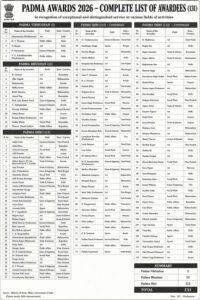
When young people understand that excellence is a long game – and that it exists in teaching, in agriculture, in medicine, in craft, in science, and in community service equally – their sense of what is possible begins to shift.
Families can make this a habit. A conversation over the newspaper. A question at the dinner table. A simple prompt: have you heard of this person, and what did they spend their life doing?
What we are really asking is that children grow up with a different kind of role model – not the celebrity, not the overnight success, but the person who showed up for years and made something matter.
Every child deserves to know that such people exist. That they are recognised. And that an ordinary beginning is no barrier to an extraordinary contribution.
The stories are there. We simply need to make sure the next generation is hearing the responsibility now rests with families and the broader culture of how we expose children to these stories.
By Reshma Gowramma Machamada
Educator at KALS.
Join our WhatsApp Group for News and Article Alerts