

War is often remembered in numbers—millions of lives, years of conflict, the cold arithmetic of bombs and dates. But numbers, for all their weight, rarely tell you how a war felt. For that, you have to look at something smaller. Something human. Something that fit in a young soldier’s pocket.
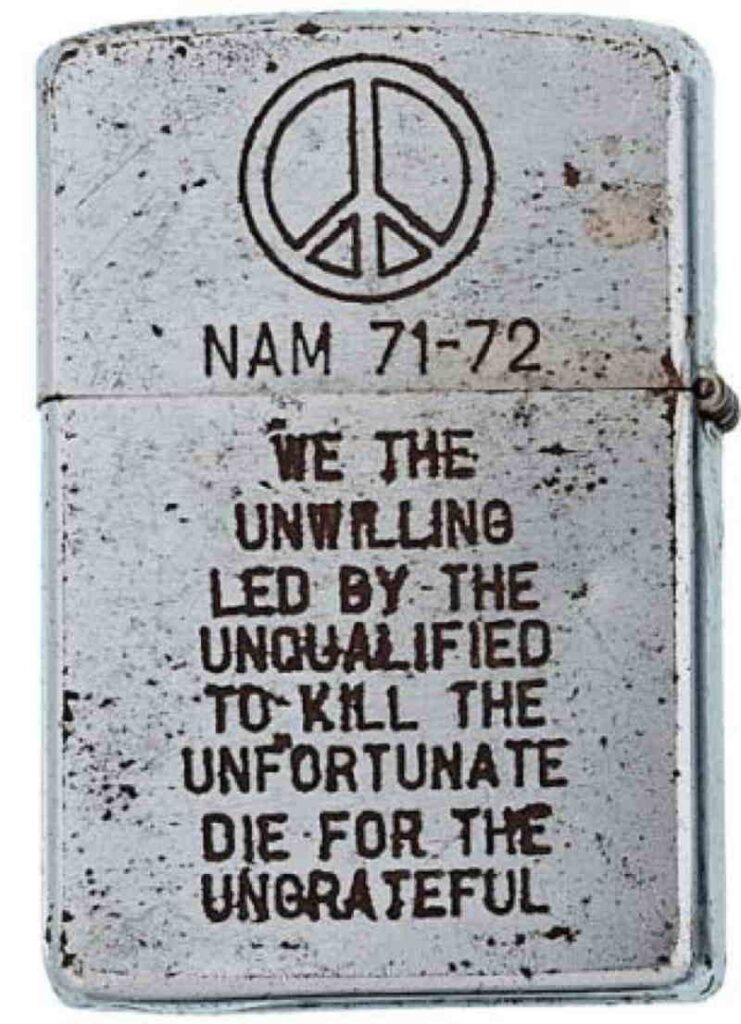
A lighter
Not issued with ceremony. Not meant to last beyond a tour. And yet, etched into its metal is a sentence that has outlived speeches, strategies, and slogans:
“We the unwilling, led by the unqualified, to kill the unfortunate, die for the ungrateful.”
No historian wrote that. No government approved it. It wasn’t meant for the world. It was a thought—raw, unfiltered—scratched into steel by someone who had seen enough to stop believing in neat explanations.
Fifty years on, we can debate the war endlessly—who was right, who was wrong, what was gained, what was lost. Those arguments will never quite end. But this lighter doesn’t argue. It doesn’t persuade. It simply exists, carrying a moment of clarity from someone who stood inside the storm rather than studying it from afar.
And perhaps that is the point.
Because every war leaves behind two histories. One is written in books, in treaties, in numbers that try to make sense of chaos. The other is quieter. It lives in objects, in memories, in the things people keep and don’t quite know how to explain.
This lighter belongs to that second history
The one that doesn’t shout.
The one that doesn’t resolve neatly.
The one that still flickers—long after the war itself has gone silent.
Join our WhatsApp Group for News and Article Alerts



.
On the one hand we are confronted by such well meaning articles and on the other we see senseless screaming and shouting at IPL matches. One CANNOT MAKE SENSE of HUMAN PRIORITIES. There are small establishments closing for want if LOG, tens of thousands of civil construction workers trying to flee middle-eastern existential threats and there are cricketers irresponsibly dancing a jig with construction workers is studios – we live in a very illogical world.
One is amazed by the masterminds dictating and showcasing military strategy, geopolitical manoeuvres, WhiteHouse/Pentagon insights,
Control over the Nuclear button – the mind boggles!
If there has been relative stability against war mongering after the WW II, it is the earnest dialogue, diplomacy and detente amongst world leaders behind closed doors and sans the media. This has sadly STOPPED and the new mantra of sabre rattling and raking in the spoils of the war that has taken centre stage attention.
All wars have ironically demonstrated that the people initiating the aggression do not ever have to face the physical consequences first hand.
HOPE BETTER SENSE PREVAILS – NOTHING ELSE MATTERS.
“There are no winners in a war” – there are only those who lost, and those who suffered for it.