

A meaningful time to take a pledge by the people of Kodagu:
– Preserve our sacred Devarkadus; the density is the largest for any place in India and perhaps in the World.
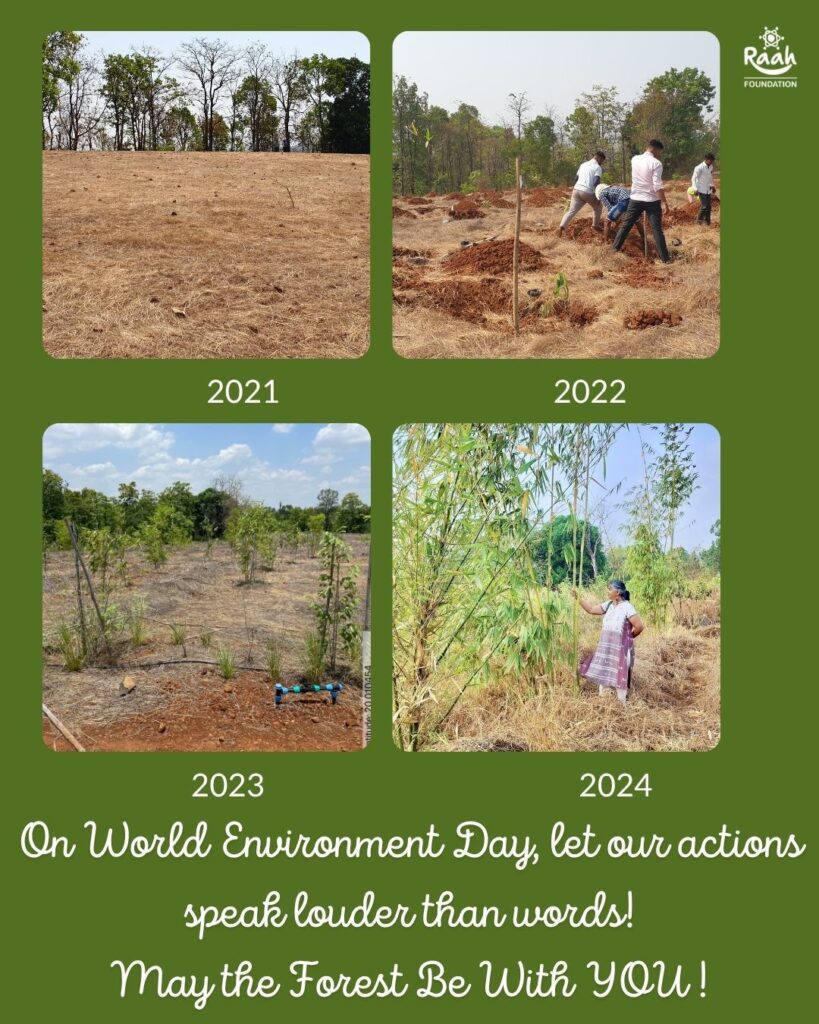
– Work on a collaborative basis with the District Administration/Department of Forests to regenerate and regreen our forests – especially Nagarhole Sanctuary. Amongst others, some of the most impactful work has been undertaken by https://raahfoundation.org/.This could go a long way in managing the Human-Animal conflict. Perhaps the Coorg Wildlife Society should take the lead.
– Plantations to be encouraged to plant native trees instead of the environmentally harmful commercial varieties like Silver Oak. Government to provide appropriate incentives.
– Cultivate wetlands – with paddy; it is only then that we earn the right to celebrate Puthari and sustain our ground water levels.
– Eradicate garbage pollution as a community wide initiative, with punitive fines.
– Stop the sale of Jamma Lands and put an end to setting up of further Five Star Resorts – the landscape CANNOT withstand the onslaught or irresponsible tourism. There are an alarming number of new resorts burgeoning on the landscape – HOW DO THEY GET APPROVED in an endangered and ecological sensitive area?
– Introduce Environmental Science study and projects in all educational institutions.
Most of all, Kodavaame includes respect for Nature as demonstrated by the erstwhile verdant and lush forests of Kodagu preserved by our ancestors – swiftly depleting due to human greed.
Join our WhatsApp Group for News and Article Alerts



.
A wonderful short film showcasing the western ghats on World Environment Day!
Our rivers run dry soon after the rains due to sand mining and mindless tourism. Not to mention the large scale sprinkler irrigation taking place on the plantations. Kodagu faces serious drinking water shortages in summer.
Without water there is no life, no business growth, no future. The very good news is no one is against clean water. Many topics in the world today are very polarizing. Water is not.
How can society address water scarcity?
The problem is that the way we use water today is linear: We use water, and we dump water. That’s not going to work long term. If you were to bring all the water on Earth together in one bubble, that bubble would be a little over 800 miles wide. But here’s the catch: If you look at just the surface water, including lakes and streams, it would be a bubble that’s roughly 35 miles wide. That’s all we’ve got. And when we look down the road to 2030, the world will need 56 percent more than what nature can replenish through the rain cycle. We will need to reuse and recycle water.
Business and the new world of water: A talk with Ecolab CEO Christophe Beck by McKinsey
https://www.mckinsey.com/industries/chemicals/our-insights/business-and-the-new-world-of-water-a-talk-with-ecolab-ceo-christophe-beck?
The deforestation in the name of progress has been inversely proportional to population growth.
Population growth of India per decade:
Year Population Change (%)
1951 361,088,003 –
1961 439,235,000 21.6
1971 548,160,000 24.8
1981 683,329,000 24.7
1991 846,387,888 23.9
2001 1,028,737,436 21.5
2011 1,210,193,422 17.7
How can we sustain this ?
The Trees, Birds, Bees, Reptiles, Animals – Large and Small…. also should be included in the Forest Rights Act (FRA) of 2006, which aims to empower local communities with rights over forest land and resources, and promote their participation in the conservation and sustainable management of forests!
The story of many corporates in Kodagu too – the recent sale of one of the oldest plantations in Coorg and it’s aftermath, is a case in point.
While there is a World Day for all practical purposes, every day, the World Environment Day takes special significance based on the Climate Change crisis we are facing in Kodagu, and across the world for that matter.
Here is some food for thought – in 1956, when Coorg was merged with the then Mysore State (Karnataka), the population was 229,405. There was hardly any tourism.
The population now is estimated to be above 6 lakhs – a three fold or 300% increase. To top it all, the influx of tourists exceeds 45 lakhs, growing at an incredible rate of between 35 to 40%. A large proportion of these are day trippers who contribute to the massive traffic jams and littered garbage.
THIS IS CLEARLY NOT SUSTAINABLE. the water resources simply cannot bear this load, so also every other form of infrastructure. Do we want to become like Goa where the cultural identity is being replaced with aggressive and greedy tourist demands?
The District Administration and people need to wake up and address this serious issue. The depleted condition of the forests, the increasing human/animal conflict, the aggression on the roads, the littered landscape, the demand on water/electricity, food and more makes the equation totally unsustainable.
Unless this is recognised as a CRISIS, life will go on as normal and before long there will be chaos.
The awareness on environmental concerns needs to be highlighted and commented upon on a continuous basis. CLN needs to be appreciated for raising the awareness on this critical situation and keep following it up on a sustained basis till remedial action is taken.
The article is timely and apt. This made me to think as responsible citizens, have we done enough to keep our environment safe and clean? Have we realized what is harming our planet?
A major pollutant is none other than plastic which we mindlessly litter everywhere. Why haven’t these plastic bans worked over years? Why have repeated attempts to ban single use plastic failed?
And further, illegal logging is a driving force for a number of environmental issues such as deforestation, soil erosion and bio diversity loss which can result in much larger scale environmental crisis. So much is said and nothing done about land conversion for commercial purposes. The greed to loot Kodagu by the developers fir commercial activities in and around western Ghats needs to be stopped once and for all.
Kodagu is already destroyed by the politicians in the business of land grabbing. Can we leave the hills of kodagu just the way it is? Why can’t we enjoy the pristine beauty? Why load more concrete on the hills to make it similar to unplanned cement cities?
The scourge of Land conversion has become rampant and the Government needs to address this firmly. Not only trees are lost , alongwith it we have lost rare species of birds and reptiles too. Unless we allow fellow creatures of Nature to coexist, the delicate balance will be lost resulting in disastrous calamities.
Time to seriously reflect and take corrective remedial action.
WildCAT-C wishes everybody, a happy World Environment Day!
On this occasion, let us drain our brain and top up ourselves with whatever we can learn about the wildlife.
Take a good break and great breath, and get quizzical to know wildlife!
Go to the following link to take the quiz! Hurry up!!
https://forms.gle/tCTrvfPPHb4FyzVW8
Globally, deforestation of around ten million hectares of forest takes place every year. That’s an area the size of Portugal every year. Around half of this deforestation is offset by regrowing forests, so overall, we lose around five million hectares each year. Nearly all — 95% — of this deforestation occurs in the tropics.
India has lost approximately 668,400 hectares of forests between 2015 and 2020, making it the second-highest deforestation rate globally during that period. This loss increases the risks of desertification, erratic monsoons, and declining crop yields, putting the population at risk.
Sadly the story in Kodagu is no different. Kodagu had 202 kha of natural forest, extending over 49% of its land area. In 2024, it lost 214 ha of natural forest cover. This leads to extensive landslides which devastated large parts of Kodagu last year and it does not help to see vast areas being cleared to set up new resorts. How they get permission for these completely unimaginative projects is anyone’s guess.
Goa experienced massive mudslides recently with uncontrolled construction along hillsides. Ooty had similar problems and what happened in Wayanad was a real disaster. Before we go any further, should there not be a meaningful interaction between the District Administration and responsible civil bodies like COHERA (Coorg Hospitality and Resort Association), CWS, etc on how to prevent things from getting worse? The district needs to undertake measures for SUSTAINABLE TOURISM before matters result in an irreversible disaster.
This is a strong and meaningful message. It is important to protect Kodagu’s special environment especially the sacred Devarkadus and evergreen forests, especially Nagarhole.
The suggestions are practical, like working with the government, planting native trees, saving wetlands, stopping harmful development, and teaching children about the environment. The warning about pollution and “irresponsible” tourism is very important. Intrinsic to Kodava culture is respecting Nature.
I understand that Goddess Kaveramma symbolically is the owner of the land and it is very touching to know that the Kodavas are custodians during their lifetimes. Such a strong belief that has stood the rest of time and also should guide the next generation. Sale of land is akin to selling the abode of one’s ancestors. This is so similar to the Native American belief!
Many organisations and forest department had taken initiative to plant trees in western ghat mountain ranges specifically down Thadiyandamol peak grass lands. Their focus has to be around dry zones, wildlife sanctuaries and noton grasslands which is a natural landscape, formed over millennia, not man made – which acts a a water feeder funnel to Shola forests which is the main source of river.
Natural landscape has been damaged by these initiatives which may give rise to landslides.
Scientific approach has to be the focus not the easy to execute and show- like planting eucalyptus, hardwood etc. Forest department has to replace all hardwood trees in wildlife sanctuaries and plant soft wood and fruit bearing plants and trees for the betterment of the ecology.
A drive to the Nandhi hills which is rich with eucalyptus trees and a Trek to Thadiyandamol peak in Coorg, which is also one of the highest rainfall zones in India, where the beautiful grassland mountains are converted into forests, gives an example to demonstrate the unscientific way of reforestation just to utilise the funds and for social publicity. The same implies to any other development without proper and relevant scientific planning.
It is time for the people of Kodagu to reinforce our respect for Nature and take immediate steps to regreen, contain irresponsible tourism and prevent any pollution of garbage. If Indore as a city can accomplish this, why can’t we keep our landscape clean; especially our larger towns like Madikeri, Virajpet, Gonikoppal, Kushalnagar, Sidapur …. should take the lead?
.