

Karnataka to Establish 20 Sq Km Centre for Conflict-Prone Elephants
Following a meeting with the Forest Minister in Kodagu, the Executive Committee of the Coorg Planters’ Association (CPA), represented by EC member Pradeep Poovaiah, met senior State government officials in Bengaluru on Tuesday (September 1) to discuss measures to address the growing human-elephant conflict in the region.
The CPA delegation submitted a representation seeking the establishment of an elephant sanctuary spanning between 5,000 and 10,000 acres, aimed at protecting human lives and reducing damage to coffee plantations. The meeting was attended by Virajpet MLA A.S. Ponnanna, Forest Minister Ramalinga Reddy, and Kumar Pushkar, IFS, Principal Chief Conservator of Forests (PCCF) and Chief Wildlife Warden, Karnataka.
According to CPA, Kumar Pushkar has confirmed that the Karnataka State Government (as per Govt Order No.: APJEE 79 FWL 2025, Bengaluru, Dated: 28-04-2025) had fully funded the project, approving Rs 53.20 crore for the establishment of a “Soft Release Centre”. The proposed facility will be located on 20 Sq km of reserve forest land, at Lakkavalli in Tarikere Taluk, in Bhadra Tiger Reserve.
According to the information shared during the meeting, the tender process for the construction work is expected to be floated by September 10, 2026.
The proposed facility is intended to isolate and manage conflict-prone elephants that pose an imminent threat to human settlements. It has been reported that – The entire 20 Sq Km facility is proposed to be enclosed with a railway barricade to prevent elephants from straying out of the designated area.
The Coorg Planters’ Association said the project could represent an important step towards addressing the persistent human-elephant conflict affecting Kodagu and other coffee plantation regions of Karnataka.
Environmentalists & Forest Officials differ and call it a knee-jerk reaction
CLN spoke to some prominent environmentalists and forest officials and according to them, the plan is not a feasible long term one. According to them – If the proposal is essentially to remove “problem elephants” from coffee landscapes and permanently confine many Wild Bulls or the Matriarch with her herd within 20 sq. km, it would be regarded as a high-risk and scientifically questionable experiment unless Karnataka can demonstrate a very strong, evidence-based management plan. The task will involve – pursuit and darting, separation from family and familiar areas, immobilisation, handling and transportation by humans, introduction into unfamiliar surroundings and exposure to unfamiliar elephants. The costs can run into crores, without any permanent solution.
A wild elephant is not necessarily adapted to having its movements restricted to a permanently fixed 20 Square Kilometer landscape. “Caging Wild Elephants is not the solution.”, said a forest official. The proposed limited area may become particularly problematic if several adult bulls are placed together. They will fight it out., the official added. Recent experience reported from Tamil Nadu has also raised questions about elephant translocation as a long-term conflict solution.
A Sri Lankan research on translocated male “problem elephants” is particularly worth noting. It found that several translocated bulls – travelled long distances and attempted to return or orient toward their original areas or entered human settlements in their new areas and continued crop raiding which caused further conflict. Some died following subsequent conflict.
In the past many elephants that were relocated from Coorg, have travelled back to their native forests. Some have traversed 100s of Kms to come back.
The only effective solution is to clear encroachments from forest land, restore degraded elephant habitat, recover forest lands which were given out illegally for other purposes, and create undisturbed elephant corridors connecting the National Parks, Reserve Forests and Wildlife Sanctuaries.
Food for the Giants. Restore degraded elephant habitat
Lantana in Nagarhole has formed dense thickets and displaced grass and other native vegetation that elephants were used as forage. Reports have identified substantial invasion by Lantana and other invasive plants in Nagarhole and Bandipur. By 2024, 40-50% of the 67,224-hectare area in Bandipur Tiger Reserve and 30-40% of 64,139-hectare in Nagarhole Tiger Reserve have been infested by Lantana and other invasive species.
Remove Lantana and other invasive species on large scale and restore native grasses, bamboo, shrubs and other natural elephant fodder. Elephants require access to productive feeding areas. Forest restoration should not simply mean planting more teak trees and digging more waterholes everywhere; natural grasslands and forest openings can be extremely important for large herbivores.
“Although teak is a native species of the region, the Colonial Forest Department substantially expanded its distribution in parts of Nagarhole and other forests by clearing natural forests and establishing teak plantations primarily for timber production, as a source of revenue to the government. Unfortunately, successive governments after Independence have continued this colonial legacy.”, a forest official said.
The Hatikhuli model of Assam where over 800 bighas (roughly 266 acres) of previously unproductive land which was converted into elephant feeding grounds is particularly interesting because it combines habitat and food security interventions with local community participation and has contributed to reducing conflict in those places. Every landscape has a unique pattern which should be studied and improved.
The MoEF (MINISTRY OF ENVIRONMENT, FOREST & CLIMATE CHANGE) in its report clearly states that – Habitat fragmentation, blocked movement routes, attractive agricultural crops and changes in land use are also major parts of the problem.
Restore Elephant Corridors
As per the environmentalists – When it comes to addressing the human-elephant conflict in Kodagu, the most effective way forward would be to recover encroached forest land and restore it, and, wherever feasible – acquire strategically important private land by providing fair and adequate compensation to landowners. Such efforts should focus on restoring traditional elephant corridors and reconnecting key forest landscapes, including Dubare, Bandipur, Nagarhole, Brahmagiri, Talakaveri, Pushpagiri, Kutta, Begur, Tholpetty, Wayanad Wildlife Sanctuary and other contigious forests.
“Thousands of square kilometres of forest cover extend across the Brahmagiri, Talacauvery and Pushpagiri Wildlife Sanctuaries, as well as adjoining contiguous forest landscapes, including Bisle Ghat and other forest areas. These landscapes provide elephants with extensive natural habitat, including access to food and water. However, over the years, elephant movement and access to many of these traditional forest habitats have been disrupted or severed,” another retired forest official stated.
Restoring and protecting undisturbed wildlife corridors between these forest areas should therefore be a key priority. If these landscapes are properly reconnected, allowing elephants to move freely between suitable habitats with minimal disturbance, the human-elephant conflict in Kodagu could potentially see a significant and long-term decline.
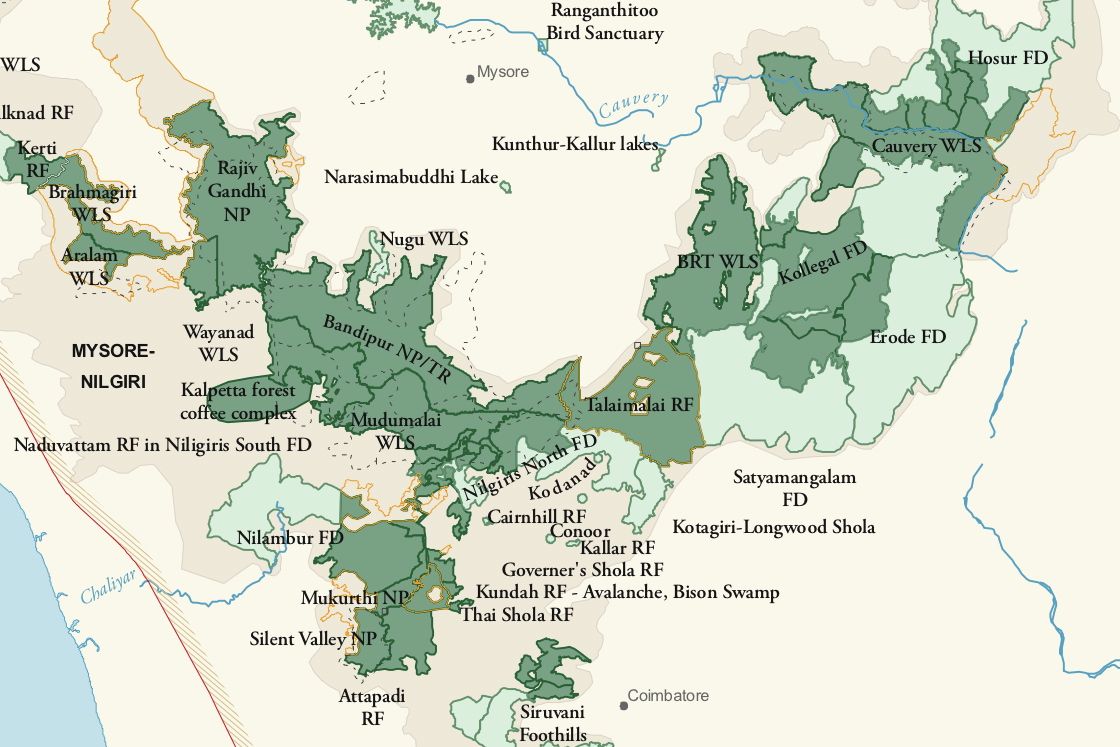
“Coorg has to be seen as very important and integral part of Nilgiri Biosphere and requires a serious, scientifically monitored pilot project, and policymakers and politicians must understand the gravity of the situation. They should move away from knee-jerk solutions designed merely to appease affected vote banks and instead adopt long-term, science-based measures to address the crisis. If they fail to do so, the human-elephant conflict will only continue to worsen,” stated an environmentalist.
Note: None of the environmentalists or forest officials we spoke to wished to be identified. Accordingly, their names have not been mentioned.
Join our WhatsApp Group for News and Article Alerts



Dr Krithi Karanth is possibly the most feted award winning Wildlife conservationist and Expert. Her organisation The Centre for Wildlife Studies appears to have all the solutions. Why are they and CWS(Coorg Wildlife Soceity) not been approached or included in such hugely important initiatives??
Our vision is a society that values and protects its natural heritage, where wildlife thrives and human well-being is deeply interconnected with nature. Through our research, conservation efforts, and community empowerment, we aspire to create a future where wildlife and humans can coexist, ensuring the perpetuity of India’s extraordinary natural wildlife heritage.
https://cwsindia.org/wild-seve/
https://americanbazaaronline.com/2025/08/27/in-conversation-with-dr-krithi-karanth-wildlife-leader-awarded-the-150000-mcnulty-prize-466759/
There are numerous models for tackling human animal conflict that needs to be studied and adapted for Kodagu. Politicians are required to push the agenda, but honestly the Forest Department needs to pull up it’s bootstraps and involve NGOs and genuinely interested local groups to get involved.
If it has to be believed, in the Nilgiris, Forest Department teams carry out daily monitoring of elephant herds near human settlements. They alert local communities to stay indoors when herds are nearby and simultaneously conduct operations to drive stray lone males and herds back into reserve forests.
We cannot count on elections with happy consequences every time questionable decisions are made. Much of the destruction of nature is probably due to endemic corruption. If we do not correct what is ultimately the cause of enormous wastage of ecological resources, then major restoration projects will not succeed. The best example is that of endeavours to reduce global warming will have little chance of success, if only half hearted action is taken
The elephants won’t be able to read the signs warning them not to step out. This is typical govt-speak to show we-are-doing-something even if we know it’s going to fail