

In the emerald heart of Madhya Pradesh, where the forest breathes through sal trees and the ground murmurs with the soft tread of wild paws, lies the Sanjay Dubri Tiger Reserve — a haven of mystery, survival, and silent dramas. Among its whispering canopies and sun-dappled paths lived a tigress known not for her kills or her territory, but for something far rarer in the wild: compassion.
She was called Mausi Maa — literally, “maternal aunt.” She was not just a tigress. She was legend.
It began one harsh summer. The forest was parched, the watering holes shrinking, and survival came at a steep cost. Tigress T-7, a dominant female with two young cubs, ruled the Dubri sector. Her movements were tracked by rangers, admired by tourists, and followed by photographers hungry for a glimpse of her stripes. But fate, in the form of poachers or nature’s own ruthlessness, struck one dark night.
T-7 vanished.
Her cubs ,still too young to fend for themselves,began to wander, confused and hungry.
In tiger society, orphaned cubs are often doomed. Males are known to kill, and other females shun them. But this is where the forest broke its own rules.
Her sister, an older tigress known to trackers as T-11, lived in a neighboring range. She was solitary and wary of humans,rarely seen, never photographed clearly. She had cubs of her own that season, younger then her sisters. Ordinarily she would have shunned these orphans, that she did initially, but the insistent cubs latched on to the group.
Then something tripped .
Perhaps the cubs sensed some primeval genetic connection with her & her cubs. Perhaps she sensed the vacuum left by her sister’s death. Perhaps something older than instinct stirred in her blood. Whatever it was, she did the unthinkable. She adopted them, not just tolerated, but mothered then. She shared kills with them, defended them from threats, and taught them the forest’s ancient ways, how to stalk silently through Sal shadows, how to wait at a stream without rippling the water, how to know when to fight and when to vanish.
Trackers, who noticed the cubs’ pugmarks overlapping with hers, were stunned. This was not normal tiger behavior. This was extraordinary, a Surrogate mother to a clutch of orphaned cubs.
Soon this extraordinary news spread like wildfire.
Wildlifer’s flocked to the park to watch the spectacle of a tigress leading a litter of 9 juvenile tigers some her own, the others adopted by her.
Soon, she earned her name ,”Mausi Maa” ,the aunt who became a mother. Over the years, Mausi Maa grew more elusive. Unlike other tigers who had grown accustomed to safari vehicles and camera shutters, she stayed deep within the core zone. She came to symbolize the part of the forest that refused to be tamed or documented.
Tourists came hoping for a glimpse. All they ever saw were signs, fresh pugmarks in the mud, scratch marks on ghost trees, a half-eaten sambhar carcass dragged neatly under a bamboo thicket.
Rangers would exchange glances. Mausi Maa has passed through. Even the cubs, now grown, were seen more often than she was — thriving, strong, independent. Her job, it seemed, was done.
But the forest never stops watching. One early monsoon evening in June, when the clouds lay heavy and the cicadas cried loud, a guide paused near an old game trail by the riverbank. Something stirred in the tall grass. He raised his binoculars.
There she was.
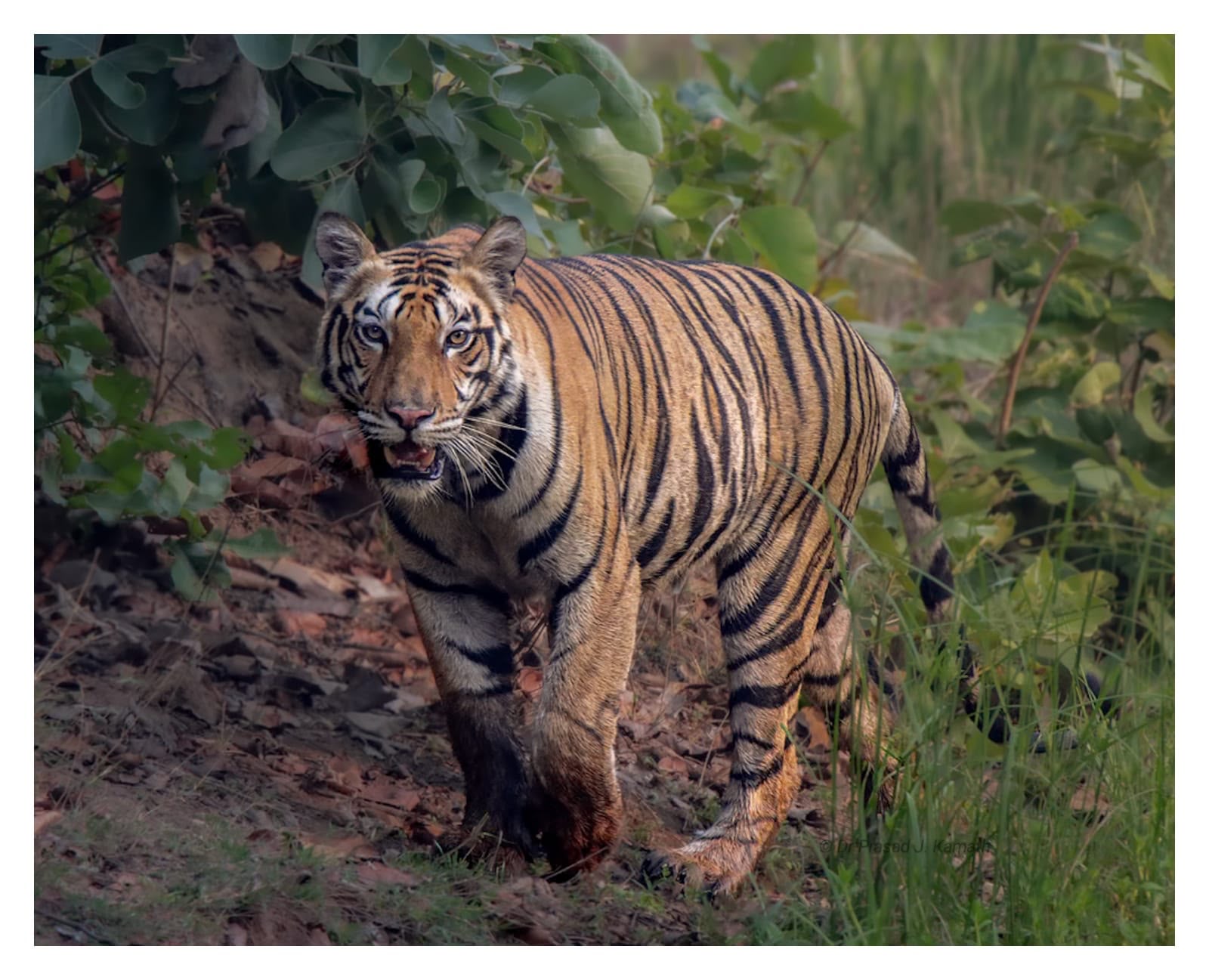
Old, leaner now, her coat faded slightly with age but her eyes sharp, glowing like embers under the storm-lit sky. She stood still, watching the jeep from a distance, not in fear, but with the calm of a creature who had seen much, and owed nothing. She disappeared into the woods moments later, like a memory.
Today, few have seen Mausi Maa. She remains a whisper, a story passed around campfires and ranger posts, a face on a blurry camera trap image. But her legacy lingers ,in the survival of her nephews, in the quiet respect of forest guards, and in the way Sanjay Dubri’s wilderness still seems to hold back one secret, just out of reach.
Some say she has passed away. Others believe she roams still, far from roads and roadsides, where the forest is thickest and the silence deepest.
Either way, Mausi Maa has become something larger than life, the tigress who defied the law of the wild and chose family over instinct.
A ghost of stripes and grace, forever stitched into the soul of Sanjay Dubri.
(This is a dramatized version of the true story of Tigress T-11, from Sanjay Dubri Tiger Reserve, who went around with the moniker, “Mausi Maa”)
© Dr Prasad J. Kamath, Gynaecologist; Endoscopic Surgeon. A Nature Enthusiast by passion.
Join our WhatsApp Group for News and Article Alerts



Very nicely written. Dr. Prasad puts his heart and soul in his writings. He unfolds nature’s wonders in very humane ways. This story toe, reads like a poem!
Mausi is always more loved than a maa. ❤️.
Beautifully penned. Truly moved by the way the maternal instincts of the tigress has been portrayed. Always a fan of your beautiful pics and wonderful articulation with words. You bring the entire scene on move,right in our minds eye . Thanks Dr.Prasad…simply waiting for more👍
A beautiful expression of motherhood beyond biological boundaries. I am deeply moved by this beautiful story so beautifully written and profoundly touching. A reminder that compassion and motherhood can transcend even the boundaries of the world. Nature has its own extraordinary ways of teaching humanity.
Nature has such amazing stories of compassion. Truly moving.
The extraordinary sight of tiger cubs with their protective Mama is a lifetime’s experience. Have shared a picture below that literally gives goosebumps.
Dr Prasad writes with passion and has the ability to make the reader “feel the excitement” of the experience. The ability to convey this with simplicity is no mean achievement and is a characteristic thread that is evidenced in all his articles that he has shared with CLN.
Much appreciated Dr Prasad and look forward to more.