

Kishore was sitting on the edge of St.Marks Square in Venice, watching the world go by. Next to him was this older Italian guy, who could speak some English. They sat for a while and then he turned to Kishore and said “Dolce Far Niente”
He Googled it and just loved the meaning………the article follows.
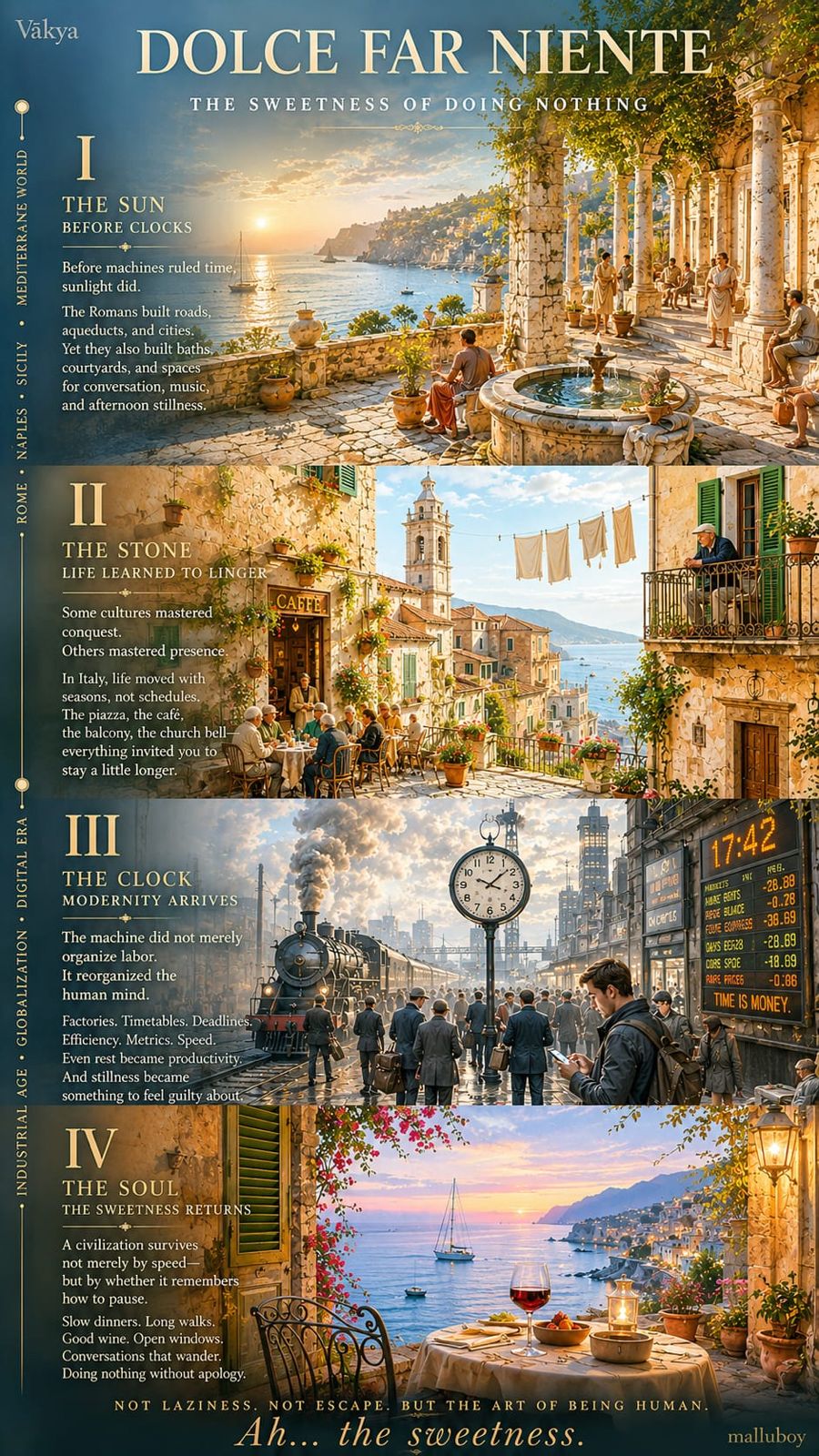
Somewhere in our late 60s and early 70s, many of us finally begin to understand the Italian phrase:
Dolce far niente — the sweetness of doing nothing
Not laziness.
Not boredom.
But freedom from urgency.
After decades of deadlines, responsibilities, careers, school fees, traffic, ambition, and constant motion… life slowly teaches us the forgotten luxury of simply being.
The morning tea tastes better.
Rain becomes something to watch again.
A balcony becomes a destination.
Silence no longer feels empty — it feels earned.
Modern life trained us to believe that value exists only in movement.
But age quietly reveals another truth:
peace is not always found in achievement.
Sometimes it arrives through an open window at dusk… with nowhere urgent left to be.
Ah… the sweetness
N. Kishore — Private Banker, JPMorgan Chase. Numbers by day, Narratives by Night. History buff and restless wanderer, mapping old empires onto new journeys.
Devoted husband, grandfather. Practitioner of tactical silence. Quiet fortitude in reserve.
Join our WhatsApp Group for News and Article Alerts



Lovely.. I had the experience of doing nothing in the stunning St Mark’s square.. what a coincidence. It was pouring and the square started flooding from the tidal swell. And people casually sat with the water around their ankles while sipping their drinks.
The “real meaning” hit me only when I paused to think about the circumstances, and the 25 odd minutes of companiable silence I shared with an unknown senior Italian gentleman in the unlikeliest of places; San Marco square!!
There were a zillion tourists zinging around, selfies, music, lovers, people from the world over. And both us experienced this serenity……..
Thank you for the kind words Mamatha !
A beautiful reminder that life isn’t always about rushing from one thing to another. Sometimes, the most meaningful moments come when we simply pause, breathe, and just exist.
🙏🏽
Thanks for your comment.
We need to adopt this Italian maxim as a part of our lives; regardless of our age…….Best, Kishore
Good article, has a gentle, reflective charm that many readers in their 60’s and 70’s will instantly relate to. The phrase ” Dolce far Niente” is beautifully introduced, and the writing captures the quiet transformation that comes with age from chasing life to finally learning to pause and absorb it.
It speaks about something modern life has forgotten, the ability to sit still . In.an age obsessed with productivity this idea feels quietly revolutionary.