

Another evocative addition to the series presented by Dr. Prasad Kamath on the plausible animal perspectives on human presence and interaction. His stories have become hugely popular with CLN readers as is evidenced by the response. In his words “These are non-judgmental but meant only to be an animals point of view”. For those who keep pets – even cats and dogs will reproachfully depart when they are exposed to strong perfumes.
Dr Kamath’s writings also appear at a time when the much celebrated Dr Jane Goodall’s rich life has appeared in what we consider to be amongst the best obituaries written about any human being.
– CLN Newsdesk
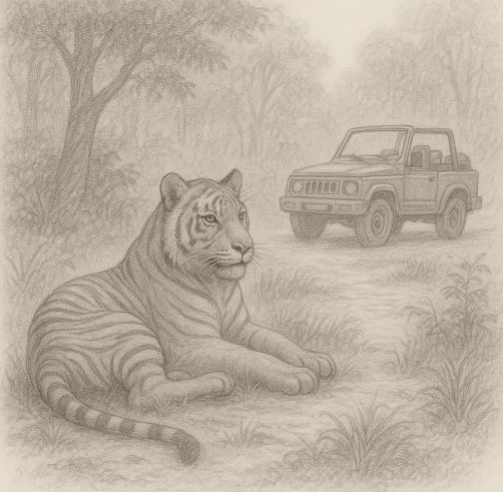
The dawn in the Satpura forest of central India was a symphony of life. The forest stirred awake with the rustling of Sal leaves, the distant cry of a peacock, and the gentle hum of a breeze carrying the earthy scent of dew-soaked soil. For Sundar, a magnificent male tiger with a coat like liquid gold and stripes etched in charcoal, this was his kingdom. He prowled silently through the undergrowth, every sense honed to detect prey, intruders, or danger.
Sundar had recently claimed this territory after a fierce battle with an older tiger. The boundaries of his realm were marked meticulously with claw scratches on trees and sprays of his scent. To him, the forest was a delicate balance of smells, each tree, each creature, each gust of wind told a story. It was his map, his lifeline, his way to navigate and survive.
But over the past few weeks, something strange had begun to disturb his world. The familiar, natural smells of the forest were tainted by something foreign, something he could not identify. It came in waves, sharp and cloying, an intrusive cocktail of floral, citrus, and musk. It was unnatural and overwhelming, masking the scents he relied on. Sundar often found these strange smells near the jeep trails where humans came to observe him and his forest.
This morning was no different. As Sundar padded along the riverbank, the scent hit him like a wall. His nostrils flared as he pulled back, agitated. The smell clung to the air and the leaves, drowning out the delicate notes of the jungle. He couldn’t smell the herd of spotted deer grazing nearby or the territorial markings of a rival tiger who had trespassed into his land. His instinct told him there was danger, but his senses, his most trusted tools, were rendered useless.
Unbeknownst to Sundar, the source of the disruption was a group of safari tourists. They had gathered excitedly on an open jeep, doused in perfumes and colognes, eager to spot the elusive tiger. Their guide had warned them against wearing strong scents, explaining how it could disturb the animals. But the warning had gone unheeded ,a small indulgence in the name of comfort or habit. Sundar crept closer to investigate. The sharp scent made his head swim, but his curiosity outweighed his discomfort. Hidden behind a clump of bamboo, he watched the humans in their noisy, clattering machine. They pointed cameras and whispered in hushed voices, oblivious to the chaos they had introduced into his world. For a moment, Sundar considered retreating; the overpowering smell disoriented him, and he could not assess whether they were a threat.
But retreating meant giving up control of his territory, a risk he couldn’t afford. His agitation grew. He let out a low growl, a warning that rippled through the forest. The tourists gasped, their eyes scanning the trees, cameras poised. One of them exclaimed, “I smell flowers! Is there some special plant here?” The irony was lost on them.
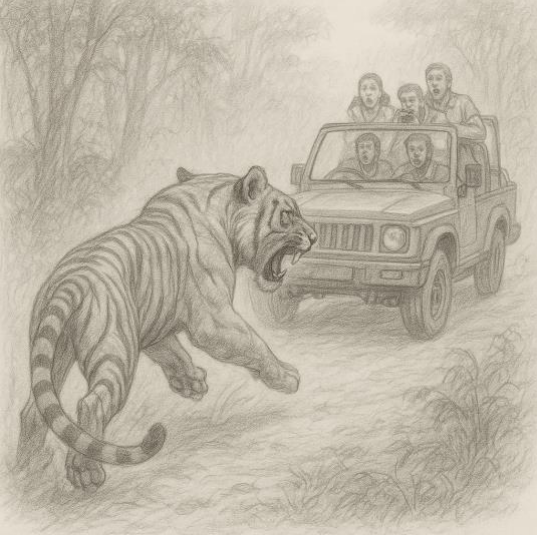
Sundar’s growl escalated into a roar, a thunderous sound that silenced the forest and sent the jeep into a hurried reverse. The tourists were thrilled, their faces lighting up in awe and terror. But for Sundar, it was no triumph. He had driven them away, but the damage was done. The foreign scents lingered, muddling his perception of his territory. The prey he was tracking had scattered, frightened by his roar and the humans’ commotion.
For the rest of the day, Sundar roamed restlessly. He sniffed the air, searching for familiar markers, but the cloying perfume seemed to follow him, sticking to the grass and the trees. That night, when he lay beneath the stars, he felt vulnerable in a way he never had before. The forest had always been his sanctuary, a place where he was king. But now, it felt alien, invaded by something he could neither see nor fight.
The following days brought more encounters with the foreign scents. Prey grew harder to find, their trails masked by the lingering perfume. Other predators, sensing Sundar’s weakened hold on the territory, began to encroach. Sundar fought them off, but each battle left him drained. The balance of his world was unraveling, all because of a simple act by creatures who would leave the forest after a few hours, oblivious to the consequences.
Epilogue:
Months later, the forest authorities launched a campaign to educate visitors about their impact on wildlife. Guides were stricter about enforcing the no-scent rule, and signs were placed at entry points, urging tourists to respect the animals’ natural habitat. Slowly, the forest began to recover its rhythm.
For Sundar, the scents eventually faded, and the forest’s natural symphony returned. But the memory of those days lingered like a ghost, a reminder of how fragile the balance of his world could be. And though he could never understand the why of it, he remained wary of the strange creatures in their noisy machines, whose presence was both fleeting and profound.
Join our WhatsApp Group for News and Article Alerts



What a profoundly moving piece by Dr. Prasad Kamath. Through Sundar’s quiet observations, we are invited to see the forest not as a place we visit, but as a living, breathing world of its own, one that reacts, feels, and remembers. The moment the tiger senses the intrusion of human scent is striking; it captures how something as simple as perfume can disrupt the natural harmony that animals depend on.
A story that stays with you, reminding us that true conservation begins with mindfulness and respect.
Thank you friends ,once again for your enthusiastic response.
This helps me to remain motivated to write more often.
May be I shall write on the Elephant next time or shall I do some justice to our household friend ,the lowly Gecko…..?!!!
Thank you Dr Prasad.
Thought I would share an important point made by Dulmini J, Liyanage, Prithiviraj Fernando, P.Nihal, Dayawansa H. K.Janaka, Jennifer Pastorin – The elephant at the dump: how does garbage consumption impact Asian elephants?
African elephants can distinguish higher levels of sugar content in crops from scent alone, suggesting the smell of crops is likely what first attracts them to the crop fields – similar to Jackfruit trees and Bananas plantations In Coorg. Olfactory cues could also be responsible for attracting Asian elephants to garbage dumps, where consumption of foods with high nutritional content can lead to improved body condition. Unfortunately, there may also be a risk of health issues from accidental consumption of non-food items in these dumps (similar to the negative impact of such consumption on nutrient absorption and endocrinology in marine mammals. This is a familiar sight at the periphery of Mudumalai forest and the garbage dumps in our towns – especially Sidapur in Kodagu
This may appear as an interesting article – but it is much more than that. Every movement, gesture, and expression shapes how others see you, often before you say a word – even amongst humans, let alone animals. That is the reason why we have the phrase ANIMAL INSTINCT!
There are certain essential oils and other ingredients that some perfumes contain that are toxic to cats. Natural fragrances can irritate your animal’s eyes, skin, and airways…. including pets.
Visitors to Game Parks should be briefed about etiquette, discipline, what to wear and what NOT TO DO (especially littering) before they set off on a safari. CWS has made a salutary beginning – but much more needs to be done. Maybe a simple must-see film trailer in a room before being seated in a safari jeep.
While tigers may become accustomed to human presence & smell it’s essential to distinguish between habituation and tolerance. Habituation can lead to a decrease in natural behavior, while tolerance allows them to coexist with humans without stress.
Managing tourism in tiger habitats requires a balance between promoting eco-tourism and minimizing disturbance to the tigers and their habitat.
Felines primarily use their sense of smell for social communication and territorial marking, not for hunting, this subject of foreign smell effecting them is debatable. However completely agree on wearing perfumes and deo’s are a strict no no inside any wildlife reserves.
What a beautifully written and deeply evocative piece. The story of Sundar not only captures the majesty and vulnerability of the tiger but also serves as a poignant reminder of how even our smallest, thoughtless human actions can ripple through the delicate web of nature. The contrast between the tourists’ excitement and Sundar’s disorientation is striking , it perfectly illustrates the silent suffering caused by ignorance disguised as admiration. A powerful call for empathy and mindfulness in wildlife tourism.
Great article!
Very true and educative!
Over crowded Ranthambore National Park with 75 Tigers pursued by hordes of tourists has become like a zoo of humans. There are more than 500 hotels around the sanctuary 🤦🏼♂️😡
Just few days ago, one of my friends who lives there was complaining about the chaos caused by the unrestricted tourists, especially the local Indians. They have no respect for flora and fauna and are specialists in littering. Sad state of affairs. The Government and Forest Department should hike the entry fee and impose strict penalties. Restricting the number of visitors should also be done.
A really beautiful crafted thought-provoking message by Dr. Prasad Kamath. Through Sundar’s eyes, we are reminded of how deeply connected the natural world is to every scent, sound and movement forming part of its delicate rhythm and how easily human presence can unsettle that balance.
The way Dr. Kamath captures the tiger’s confusion and distress at the overpowering smell of perfumes is both poignant and powerful.
This narrative goes beyond wildlife observation; it’s a reflection on empathy and awareness. Often, in our eagerness to experience the wild, we forget that we are intruders in someone else’s home.
Reference to Dr. Jane Goodall’s legacy feels especially fitting on both voices urging us to see animals not as a “spectacle”, but as sentient beings whose lives and instincts deserve our respect.
A story that stays with the reader long after it ends, reminding us that conservation begins with small acts of mindfulness – the simple choice to enter the forest in silence, leaving no trace of ourselves behind.
My father is used to narrate that tigers were seen passing in Manipal near Valley View Hotel. The road which would its way up is known as Pili Kundel earlier and that circle is now called as Tiger Circle even now.
Just shows how much we humans have encroached the land that was earlier shared with all other Natures creatures. Humans have multiplied upwards of 300% since the last World War and all other living animals, birds, bees, trees, flowers and fauna and creatures of the Seas have reduced by 50%. Shocking!!
The entire area is a concrete jungle now.
https://maps.app.goo.gl/yUxj3VModxY49D3r6
Very interesting and educative. I didn’t realize that strong perfume affected wildlife to such an extent. I knew that we don’t use perfumes on a safari but did not realize the impact.
Beautifully written. This made a touching read. Never knew that Tigers like “Sundar”‘ could sense the scent/perfume that people wear. His story is a gentle reminder that the tiger belongs to the forest and not to the indiscriminate indulgence of self-proclaimed wizardry with the lens – all for a “moment” of self-aggrandizement in social media. We must learn to respect their world and let these majestic beings live in peace.
What a beautifully written, simple and thought-provoking piece. The story of Sundar offers a rare, empathetic window into the unseen consequences of human intrusion into wild habitats. It’s easy to forget, amid the excitement of a safari, that our smallest actions – like wearing perfume – can disorient and endanger the very wildlife we excitedly venture to admire.
This article is a powerful reminder that conservation is not just about protecting land, 𝐛𝐮𝐭 𝐚𝐥𝐬𝐨 𝐚𝐛𝐨𝐮𝐭 𝐫𝐞𝐬𝐩𝐞𝐜𝐭𝐢𝐧𝐠 𝐭𝐡𝐞 𝐥𝐢𝐯𝐞𝐬 𝐚𝐧𝐝 𝐢𝐧𝐬𝐭𝐢𝐧𝐜𝐭𝐬 𝐨𝐟 𝐭𝐡𝐞 𝐜𝐫𝐞𝐚𝐭𝐮𝐫𝐞𝐬 𝐰𝐡𝐨 𝐜𝐚𝐥𝐥 𝐢𝐭 𝐡𝐨𝐦𝐞. I hope more tourists and authorities take this message to heart. Nature is not a theme park – it’s a delicate, living world and we have to behave responsibly so as not to tilt the delicate balance that Nature has so magically created.
Extremely well written – some “facts” are not well understood until written and communicated so succinctly.
When we Indians travel to the famous game parks in Kenya, Tanzania or South Africa, we follow and respect the rules so obediently. So what is it that makes us behaves so badly in our own Tiger Reserves?🤦🏼♂️🤔
Well written. Didn’t know that strong perfumes can disrupt animals who rely on smell 😱
Very, very interesting!
Dr. Prasad,
I always wait for your articles. They are so evocative and hold a mirror before us. And thank you Coffeeland News for carrying his articles.
Warm regards
Sarayu