

We are fortunate to present Dr Prasad Kamath’s delightful stories and insights on Nature, Wildlife and Culture. This story on Tigers is ever so relevant to what happens when jeep loads of safari enthusiasts take the roads into Nagarhole National Park in different directions.
The sad truth is the forest is largely overgrown with Lantana and Parthenium, with monoculture of Teak and Acacia trees. The water ponds have not been cleaned and the animals are forced to seek greener pastures for food.
On the rare and unlikely occasion when a tiger is spotted, people should pay heed to Dr Prasad’s heartfelt advice – And this is where her dilemma becomes ours. For Taru is not just one tigress, she is every tigress, every mother who carries the wild in her blood. Her cubs are the future of the forest. If the jungle is broken by noise, by greed, by careless footsteps, then their spirit will dim.
– CLN Newsdesk
In the heart of the dense jungles of central India, a tigress named Taru ruled her territory with quiet dignity. She had recently given birth to five cubs, whom she had hidden inside the cool hollow of a fallen tree, tucked deep within a thicket of bamboo.
Taru was the undisputed queen of her forest. But beyond the stripes and strength, she was also a mother, watchful, tender and fiercely protective of her little brood. Each cub carried a spark of life that made them unique: Chitru, bold and headstrong; Mala, forever curious; Piku, playful and restless; and the inseparable twins, Rani and Raja, always tumbling about together like shadows in a mirror.
For weeks, Taru had shielded them from the world. But cubs were not meant to remain hidden. To one day claim their own kingdoms, they had to learn the ways of the wild : how to stalk silently, how to sense danger in the whisper of a breeze, how to fight and endure. And so, one fine morning, Taru nudged them into the open for their first walk beyond the safety of the lair.
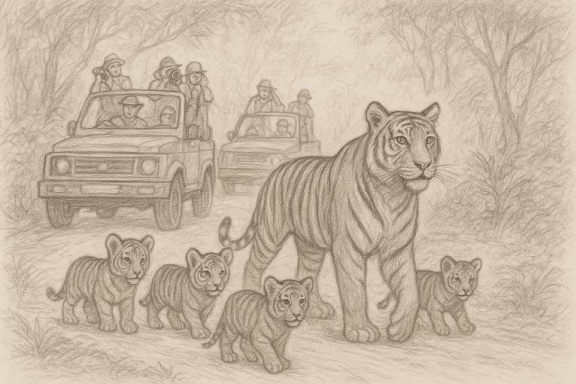
The little parade set out: Taru in front, muscles rippling, ears pricked for danger. Behind her, Chitru and Piku bounded forward in clumsy leaps, while Mala lagged behind, her nose buried in every strange scent. Rani and Raja dawdled too, until one sharp growl from their mother made them scamper to catch up.
The forest itself seemed to awaken to them, the creak of bamboo, the chatter of langurs, the rustle of unseen prey. But Taru’s sharp ears caught something else: a low mechanical growl, alien and jarring, the growl of engines. The sound of the safari jeeps.
Every morning and evening, the forest was broken open by these intrusions. Engines coughed, tires chewed into the soft earth, and voices rang out, loud and careless. Tourists, swathed in bright clothes and camera straps, jostled for vantage points, their excitement mounting whenever her shadow slipped between the trees. For them, a glimpse of Taru meant photographs, social media glory, and for the Jeep Drivers & Safari Guides,a sighting of Taru & her 5 cubs meant hefty tips.
For Taru, it meant disruption, the loss of prey and worst of all, fear in her cubs’ wide golden eyes. At first, the cubs had been curious about these strange metal beasts and the noisy creatures inside. But fascination soon curdled into unease.
The tourists were relentless. Flashbulbs flared like sudden lightning, startling the little ones.
Human shouts echoed through the Deciduous Forest, drowning out the softer, older language of the jungle, the warning calls of deer, the alarm notes of birds.
One afternoon, Taru led her brood toward a quiet watering hole, a secret place veiled in thickets where she often rested. But as they approached, the engines were already there. Jeeps crowded the bank, their occupants leaning dangerously far out, lenses glinting.
Taru let out a deep growl, a sound that rippled with menace. Instead of retreating, the intruders grew more excited. A woman in garish clothing shrieked with delight on spotting little Raja.
Chitru bristled and growled back, his tiny form rigid with defiance. But Taru swept him close with a firm nudge, herded the cubs, and melted back into the shadows.
That night, beneath a velvet sky glittering with stars, Taru lay atop a rocky ledge. Her cubs huddled at her belly, warm and safe. Yet her amber eyes reflected unease. She remembered a forest once wilder, where rivers ran undisturbed and her kind moved unseen. Now, even in her own kingdom, the silence was broken.
And so, she adapted. Each day, she led her cubs along secret paths, across ravines, and through thorny underbrush to avoid the jeeps. She taught them to still their bodies at the first rumble of an engine, to vanish into undergrowth without a sound. Slowly, the cubs learned, trading their carefree play for the lessons of survival in a jungle no longer free.
But in her heart, Taru longed for what was lost. For a time when her cubs could grow without the shadow of strangers, without the harsh interruption of engines and flashes. Until that time returned ,if it ever would, she bore the burden of both queen and mother: to guard her little princes and princesses, and to keep alive within them the spirit of the wild, untamed and eternal.
Because the forest was still theirs, if only they could hold onto it.

And this is where her dilemma becomes ours. For Taru is not just one tigress, she is every tigress, every mother who carries the wild in her blood. Her cubs are the future of the forest. If the jungle is broken by noise, by greed, by careless footsteps, then their spirit will dim.
Join our WhatsApp Group for News and Article Alerts



Wildlife tourism in India, particularly in all tiger reserves &; sanctuaries, has become increasingly popular with affordability.
However, it’s crucial to acknowledge the adverse & negative impacts of irresponsible tourism on the animals and the ecosystems.
Increased human presence in wildlife sanctuaries can disrupt natural habitats & can cause stress and alter animal behavior.
Over-tourism in wildlife sanctuary can lead to degradation of habitats and loss of biodiversity.
Wildlife tourism can’t be curtailed or halted, but it is essential to mitigate the impact and to promote responsible & sustainable wildlife tourism practices by regulated tourism, limiting visitor numbers and implementing strict guidelines for Safari operators, drivers and guides.
Supporting conservation efforts while promoting eco-tourism has to be the order of wildlife tourism.
Dashcams needs be fixed on all safari vehicles to monitor such misuse & misadventure by the jeep operator, drivers anticipating extra tips & this is a critical area where the forest dept has to have stricter guidelines imposed.
Tourist also must be mindful of the impact of unethical practices of wildlife safari and follow responsible tourism.
Dos and Don’ts has to be educated well in advance to all safari goers and this at large sets an precedence to wildlife tourism to be mindful the environment.
Thanks friends for your comments. Appreciate your reading and commenting .That in itself is satisfaction enough for me to write more on these issues.
I am attempting to write a series on the possible animal perspectives in these human animal interactions. These will be non-judgmental but meant only to be an animals point of view.
It’s not that the animals actually feel this way, but an empathetic understanding of their feelings is essential for all those humans who claim to love nature.
That’s my only point in this exercise.
Hope to convert more humans to this empathetic relationship with nature, animals & the plant kingdom.
Thanks once again.
It is our good fortune in Coorg that CLN has been able to feature your thoughtful insights from “fellow” creatures that live in our beautiful planet. These posts should really make us think and act responsibly.
If we think rationally, human population has grown by possibly 300% since the last major world war and the birds, animals, fish and other wonderful creatures have shrunk by 50%. Human greed is insatiable until Nature presses a “reset” button – which alarmingly doesn’t seem to too far, given the quality of our global leaders and statesmen.
Tiger concentrations are among the highest in Corbett – around 225. Tigers love the park’s diverse terrain of riverine, grasslands and deep forests. Because of Corbett’s bio-diversity they thrive.
Photo Courtesy: Jason Fernandes
Divine Maya Queen of Tadoba. Maya Tigress Tadoba, also known as T-12, she is the most photographed tigress, earning another name “Queen of Tadoba”. She reigned over the Pandharpauni area, a region known for its rich prey base and water sources, she has a nickname “Lady of the Lakes”.
There’s an excellent write-up at https://tadobajungle.com/MayaTigressLifeline.aspx
From what we have observed, due to the poor management of our forestry resources and depleting tree cover, combined with electric fencing of age-old elephant movement corridors, the animals have no option other than to venture out of the forest perimeter.
About a month ago we saw a tiger with her cubs in our coffee plantations in Kakkabe/Yavakapadi. It had obviously wandered a far distance from its natural habitat- in all probability in search of sustenance.
First of all, we must compliment the author for the simple yet beautiful prose – he captures every nuance so well.
From time immemorial, Kodavas are tuned with Nature and have learned to coexist in a very responsible manner. However, with the passage of time and post the merger in 1956, our forests do not seem to be maintained with the same care as when Kodava Forest personnel were in charge. Nagarhole is badly kept with overgrown lantana, poorly maintained water bodies, hardly any trees other than monoculture with Teak – so the animals have no nourishment. Human Animal conflict is on the rise. Also, the rush of visitors to Nagarhole is uncontrolled like tourism in the district and badly behaved visitors to the park. This has to change!
Final one from a massive collection – such elegance. Would be nice if humans reciprocated with equal measure.
Leopards are equally graceful.
In Tadoba, Tigress Choti Tara carrying a cub to safety!
Our group was well behaved – it’s all about showing respect to fellow creatures.
This video relates to a small Sanctuary – Umred Karandla near Nagpur; infact it forms a corridor between Tadoba and Nagzira.
These cubs are grown up, all 5 of them. The video created a furore in Maharashtra in wildlife circles for the mobbing and harrasment by tourists and eager photographers.
Shall share the story on another occasion!
My two experiences in Kabini were very positive. I found the staff both knowledgeable and caring for the welfare of the animals and the environment. The tigers which we spotted didn’t seem disturbed or famished either, indicating they were happy and not troubled by their twice-a-day audience. The safari staff should instruct visitors on proper behaviour when animals are sighted
So moving. This is a double edged sword though – the wild-life parks need the tourists to fund their maintenance and motivate their staff. Having said that, there are very few Tiger Sanctuaries who are really committed to their job.
The Tigress – queen of the forest, now faces a dilemma more cruel than the wilderness itself. Her once vibrant home is overgrown, tangled and suffocating, while ponds that once sparkled with life lie neglected and choked. Every step Taru takes is s gamble – prey us scarce, water bodies are parched the shadow of human encroachment looms large.
Forced to choose between survival and safety, she prowls a terrain that seems to have forgotten her, a silent victim of nature’s neglect. She has her rightful place – can’t humans be more sensitive to fellow creatures?!
A serious dilemma indeed ! Sadly, the forest department & game park managers are not addressing this, as commercial gains are more important!
Ooty is an absolute mess with the influx of tourists over the Dussehra week, consequently, the road through Bandipur and Mudumalai is choked with mayhem in the form of uneducated, unruly, indisciplined tourist travellers.