

Elephants are fascinating mammoths that roam the land. The sheer size and presence of these emotionally intelligent beings is awe inspiring. Theirs is a different story in Kodagu as people are smarting under an elephantine problem for many years now. Several human beings have lost their lives in the recent times. Coffee growers, large and small alike, agriculturists, are the worst hit. Crops losses are immense. People feel haunted by the “gentle giants” that are no longer gentle. The pachyderms roam all parts of Kodagu day in and day out with great impunity. In many areas, it is self-imposed curfew after 6 pm.
Reports of wild elephants attacking vehicles, by-passers, school-goers, cyclists, motor cyclists, autorickshaws, some resulting in deaths, knocking down hutments, people ending up with serious injuries, are a daily occurrence. Plantation labourers bear the brunt. They refrain from going for work in the mornings as they are chased away by the elephants. It is too close for comfort for Schoolchildren. There have been as many as 26 human deaths in the last 27 months in Kodagu, according to Sanketh Poovaiah, a member of the State Wildlife Board.
Elephants have become aggressive and attack humans as gun shots are fired by the residents some times, to shoo away them as also due to sheer frustration or fear. Elephant depredations have spiralled out of control in Kodagu. Let us try to assess the “cause and effect”. If cause can be counted as rise in the elephant population, shrinking forest cover (due to encroachments), fragmentation or degradation of forests, non-availability of food and water in the forests, blockage of elephant corridors, loss of human lives crops can be counted as the effects.
This is not just one problem pertaining to Kodagu. Attacks by tigers, gaurs, bears, wild boars too occur. Monkeys too are part of this baleful list. There are about 17 States in the country that are affected by the elephants.
Apart from numerous human, livestock deaths, there are more than 56,000 persons hospitalised in different parts of the country owing to wild animal attacks, says Poovaiah. Reports of elephant attacks also emerge from districts such as Hasan, Chikkamagaluru, Chamarajanagar, Kanakapura, Ramanagara, parts of Karwar, Dandeli. Poovaiah states that Kodagu was seeing the problems grow menacingly in the last 20 years. More than 10 panchayats are severely impacted owing to elephants. They include, Maldare, Polibetta, Chennayanakote, Siddapura, Ingilgere, Kakkabe, Kunjila, Ammathi-Hosur, Puliyeri, among others. It is exasperating to state that over 300 human lives have been lost in Kodagu in the last 20 years, apart from scores of injuries.
Control Measures : Control measures initiated by the Forest Department have been rendered futile for several reasons. Solar fencing is not maintained well in many areas. Elephant proof trenches (EPT’s) have silted up allowing elephants to cross over nonchalantly. Rail barriers are of no help. Chief Conservator of Forests, Kodagu Circle, Ms. Sonal Vrishni, said that through the “Wildlife Advance Alert System,” location-based SMS warnings were being sent to villagers to alert them about the presence of elephants in their areas.”Hejje” software was being used for tracking collared elephants and immediate action taken to drive them back to the core areas of the forests. Live LED display boards have been installed along roadsides in elephant crossing areas to alert and warn travellers about the presence of elephants.
Twenty-nine Man-Animal Conflict sub-units were deployed for daily monitoring of elephant movements. A 24×7 control room has been established in Aranya Bhavan, Madikeri, to provide prompt responses through a helpline number for the benefit of farmers and public. Vrishni said that in Kodagu as many as seven human fatalities were registered in the 2024-25 period so far, apart from 20 cases of injuries. During the same period, as many as 16 elephants had died due to various reasons, including five from electrocution. Kodagu falls in the Eco-Sensitive area of Western Ghats and the conflict zone stretched up to 900 km boundary. But due to fragile geology and rainfall, elephants damaged the contiguity of physical barriers. In addition, use of AI cameras and drones were contemplated in the near future for which pilot studies are underway, she noted.
More than 200 elephants have become “resident estate elephants”, says Mr. Poovaiah. Elephant calves born in the plantations such as Maldare, Siddapura areas have never seen forests in the last 25 years. Solar fencing, to some extent, have blocked their way back into the forests. The young ones feel the coffee, areca, banana, coconut plantations are forests themselves. Of the counted total of 6,395 elephants in Karnataka, more than 2,000 were in Kodagu forests and plantations. Travellers come to Kodagu and enjoy the natural beauty. “It is cheers to tourists but tears to the farmers of Kodagu”, Poovaiah, who rushes to the spots of elephant and other animal attacks to console the kin of the dead or those injured and pave way for reliefs.
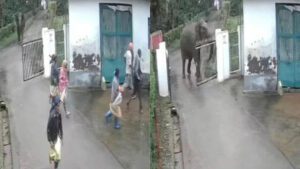
Farmers in and around Siddapura areas are desperate and dejected lot. They face the elephants almost every day, some reaching out to the flowerpots of houses any time of the night. They have posted pictures of tuskers approaching their living rooms in the nights at times. “This (elephant movements) cannot be stopped, we are going to live with it”, said, Pratap Muthanna, a distressed grower. Elephants are chased from the plantations to forests but they return in the nights, he averred. When the animals are chased out of plantations they rush out rapidly destroying coffee, areca, coconut plants. This is a routine affair in many infested localities. Solar fencing that are working well in some plantations have created a sort of island for some elephants that are stuck in those plantations, Mr. Muthanna adds.
Growers are an exacerbated lot. Another grower in the Siddapura area, K.P. Devia, does not blame the ground workers of the Forest Department. “They come and drive the animals back to the forests but top officers don’t care two hoots”. Two of his neighbours, both brothers, were trampled by the marauding elephants some time ago. None of the senior forest officials cared to turn up, he laments. The motivation is gone among the Forest Department staff. Mr. Devia, who is a retired Air Commodore, says he too has lost the motivation. “As a retired pilot of the Indian Air Force, I have forgotten the aircraft in keeping count of the elephants in the last 20 years”, he quipped. The Forest Department has collared about 30 elephants. The Department has no clue at all as to where the collared elephants are moving, he notes.
Protests:
A huge rally was organised at Thithimathi some time ago following human deaths under the stewardship of Raitha Sangha. The agitated people formed a human chain in the town to register protests. Elephant calves move around his home like calves of cows, Mr. Nanda Subbaiah a progressive grower from, Maldare said. Farmers, people, have been fighting a “lost battle” for many years now. Ad hoc measures apart, their plights have not had any effect on the Governments.
In another instance recently, the residents falling under Chembu village, near Sampaje, on the Kodagu-Dakshina Kannada border, were up in arms against the Forest Department owing to the death of a man there. They had demanded steps by the Forest Department to curb the elephant menace in Chembu, Dabbadka, Oorubailu areas. Mr. Poovaiah said that permission had been obtained to capture two trouble-making elephants in those areas. Virajpet MLA, A.S. Ponnanna, had intervened personally to solve the issue. Similar protests were held at Sringeri in Chikkamagaluru district recently led by former MLA, D.N. Jeevaraj recently.

Elephants account for 2/3 of problems :
The State Government has issued new guidelines to deal with the human-elephant problems as elephants account for two thirds of conflicts with wildlife in Karnataka. Guidelines were issued specially keeping in view 13 divisions. They were issued following intervention by the High Court. Regarding the rescue and relocation of problematic elephants guidelines state that death of wild elephant, whether from natural causes, accidents or human actions, required a systematic and prompt response. However, Forest Department sources indicate that mobilisation resources in a jiffy was a tough ask to initiate remedial measures immediately. Besides, rushing rapid response teams (RRT) to another division in the face of over 50 per cent of shortage of the sanctioned staff positions, had added to the woes. The outsourced staff, who are not paid enough, risk their lives during operations.
According to information received, during the year 2024-25, a total of 35,580 incidents of conflicts were recorded in Karnataka of which 22,483 were involved with elephants. An amount of Rs. 22 crore was paid as ex-gratia to the affected of which Rs. 13.50 crore related to conflicts with elephants. Some growers in Kodagu feel that tamed elephants from Kerala wander into Kodagu forests for grazing. Bursting fire crackers would have no effect on them since they are used to the cracker sound in Kerala temples.
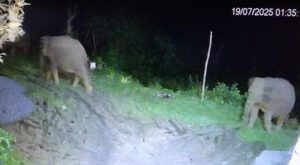
Remedies
What could the State Governments-Centre do to reduce, if not totally avoid, the human-elephant conflicts? It is futile to discuss the loss of human lives and crop losses in Kodagu as the numbers and statistics swell with each passing day. Will the Forest Department agree for rehabilitating the wild elephants under the Gujarat model, asks Devia. The process of culling of elephants was in vogue in some foreign countries. Could that be a reality in the State? Or, at least, could Governments think of castrating the animals, he asks.
In the absence of statutory powers, as a member of the State Wildlife Board, he does not enjoy any “special power” to take a decision on remedial measures other than attending the affected victims’ families, Poovaiah laments. Who is empowered to get into the core forest areas and assess the remedial measures such as creating water bodies and Where was the mechanism to investigate the funds spent on digging EPT’s, putting up solar fencing and rail barriers, he questions. Why are the Forest Department officials not held accountable?
Join our WhatsApp Group for News and Article Alerts



I did some reading on the human elephant conflicts, especially in Karnataka.
I have read G P Sanderson’s – Thirteen Years Among The Wild Beasts Of India.
The problem is essentially a massive shrinkage of the wild areas open for these pachyderms to roam around, which is part of their life and very essential for their survival.
While for humans, development may be essential, leaving behind inviolate corridors for them to pass through may be a necessity if at all to prevent losses to human, both property and life.
The other is to grow non palatable produce like ayurvedic herbs instead of tasty sugarcane in agricultural fields bordering wildlife areas.
More work specific to Coorg is required especially by the Forest Department. With intense pressures on the corridors and sterile forests that do not have sustenance for the elephant herds, the poor elephants have nowhere to go nor anything to eat, except garbage.
Sadly, this is an animal worshiped as a God in many parts of India. Humans have put this poor God in shackles….
This is precisely what should be STOPPED 🛑 at any cost – it will be annihilation if Kodagu like what happened and is happening in Ooty and Goa. Private plantations being converted to second homes for the fashionistas from Delhi and Mumbai. EvolveBack is already advertising large scale property development – which is NOT IN KEEPING with the respect for the terrain. And then we complain about elephant menace after blocking their ancient corridors for movement.
Kodagu’s coffee plantations are not just about coffee – they are living landscapes where people, culture, and wildlife share space. As coffee remains Central to Kodagu’s identity, it is equally important to ensure coexistence with the wildlife that has always called these lands home.
We have denuded the forests, blocked their centuries old corridors of movement, encroached their safe havens – Devarkadus – leaving them with no option when they traverse. WHO IS AT FAULT?
Don’t necessarily agree with what’s been written. What do the poor animals have to eat? With extensive mono-culture of Teak and Acacia trees; completely overgrown parthenium, lantana impeding movement with none of the water bodies being rejuvenated.
So quite naturally the elephants, bisons, bears, wild boar head to “so-called civilised” land – coffee plantations included. Elephants have their legendary “corridors of movement” passed down from generation to generation. This included Devarkadus (sacred groves) which provided them shelter which has beeb desecrated by none other than humans!
The saddest story though is elephants eating from garbage dumps 🤦🏼♂️😡
Humans are considered to be the most intelligent species with the responsibility of ensuring other creatures also have a chance to service. Just like monoculture is not good for a forest, we humans have to make provisions for fellow creatures to survive. Regreening and rejuvenation of forests is the Forest Department’ responsibility – not allowing the timber mafia to loot our sacred forests – now there’s nothing left!