

Dr Prasad Kamath’s stories are delightful to read, savoured, appreciated and to be re-read many times over.
CLN has “chosen” this as a prized Saturday morning post to jog the memories of people residing in Kodagu who, we are absolutely sure, have similar stories to narrate. Prized monsoon treats Koile Meen has now become part of folklore with the usage of chemicals and sadly unacceptably declining cultivation of our precious wetlands (https://kaveriponnapa.com/the-coorg-table/ancient-evenings-and-a-promise-of-plenty/). So also the famed Paddyfield crabs 🦀(https://kaveriponnapa.com/the-coorg-table/town-and-country/).
Take your time, read these delectable stories and PLEASE DO SHARE your own stories and experiences. After all that’s what a community platform like CLN is all about – looking forward to readers reactions, comments and stories.
– CLN Newsdesk
The first light of dawn spread softly across Gangoli. It was late in the monsoon season. The air smelled of salt and wet earth as the swelling tide of the Panch-Gangavalli River pushed into the wide Arabian Sea. At the breakwaters, a wooden doni rocked gently. A lantern cast a surreal glow over the men in the boat. Subraya and his crew of three kharvi men, crouched low in the boat. Their eyes were focused on the water, watching for signs that years of experience had taught them. They were ready with the yella bale, the fine gill net, meant to trap a fish both elusive and precious.
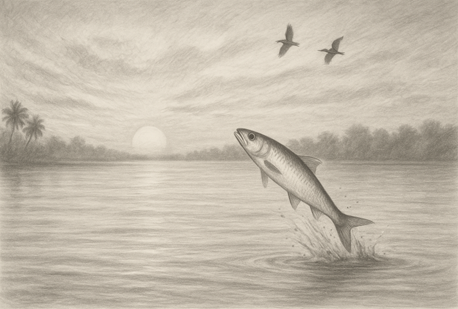
“Its Nogli season,” Subraya whispered, his voice carrying the certainty of one who knew the sea’s secret language.
“Today, It should be good catch by Lord Bobbarya’s grace.”
They were waiting for Nogli …!!!
Kane, the Ladyfish, Elops machnata.
The Nogli was a fish of mystery. A creature of two worlds. Slender and silver, with a sharp snout and soft flesh. It shimmered in the morning light like polished steel. Gangolli fisherman knew its strange life rhythm: it spawned far away in the open sea at the onset of the monsoons. Its transparent larvae, riding the incoming tides, swam into the mangrove-lined rivers of the Pancha Gangavalli Holles. For the next few weeks and months these lagoons, backwaters, and estuary mouths became brackish water nurseries, were the young grew up, feeding on tiny crustaceans and fish fry.
Kharvi children playing by the riverbanks often squealed when they saw these quick, glassy juveniles darting in the shallow water. By the time the fish grew sleek and long, they start to move in shimmering shoals close to the surface. Sometimes these sleek fishes leap out of the water as if to catch the sun itself. For the Kharvi villagers, the sight of a silver body somersaulting through the air was a sure sign that the Nogli season had arrived.
To the kharvi fisherfolk, catching Nogli was more than livelihood. It was a craft, a memory, and a heritage passed down from father to son. The fish never swam too deep, so the doni men relied on gill nets (yella bale) with their fine mesh. These were passed down from fathers and grandfathers who had perfected their weave. On shore, when shoals came close, entire groups of men joined in hauling the suruku bale, shore seines, in rhythm, their songs carrying across the surf like ancient prayers.
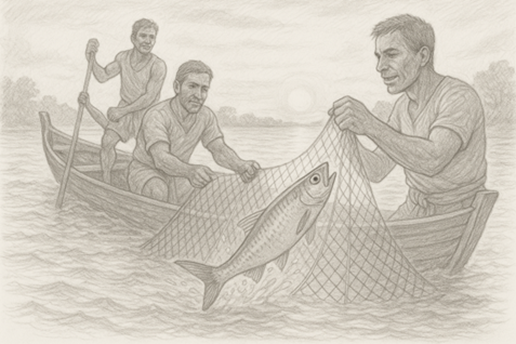
This was a time of celebration. Just as farmers rejoiced when the first paddy turned golden, so too did the fisherfolk when Nogli shoals arrived in hundreds. The season linked land and sea, harvest and tide, people and their gods.
That morning, Subraya watched the rippling water. At the turn of the tide, when the river’s fresh push mingled with the salty sea, his eyes caught the faintest tremor.
“Now!” he cried, and the men cast the net wide. The silence was heavy with expectation. Then, within an hour, the net shivered. Hand over hand, they hauled the net, in rhythm to a practiced song to the gods .
The first silver bodies thrashed onto the doni’s planks, scales glinting pale against the faint sun.
“Nogli!” Govind shouted, and laughter burst from the men.
Not an abundant catch, like sardine or mackerel. Nogli never were caught in such abundance, but even a basketful was a treasure.
By the time the doni slid onto the sandy beach, the kharvi fisherwomen were already waiting, sarees hitched, baskets in hand, voices rising in playful argument. Among them was Girija, who had walked barefoot from the haadi before sunrise, brass anklets ringing softly. She leaned over the heap, sharp eyes inspecting.
“Voledhu Nogli, Maharaya, hyage kodudu”
Very nice Nogli fish, how much is your quote?
she asked, bargaining half in jest, half in ritual.
Finally, with a smile, Subraya nodded and Girija claimed her load.
She packed the Nogli neatly into her wicker cane basket lined with banana leaves, covered it with a damp gunny sack, and with a practiced grace, lifted the basket high onto her head.
But Girija did not turn toward the bazaar. Her anklets tinkled as she took the sandy lanes past the Church, past coconut palm grooves swaying, past school children rushing to school, She came directly to the large tiled house known to all as Shahukar Mane…..
Shuhukara Mane, OmPrakash, was the house of U. Panduranga Pai — my grandfather.
“Abu” as we children, called was a strict vegetarian. But he was also a merchant tied to the rhythms of the fish trade. He was respected for his philanthropy and loved by the fisherfolk. But it was Mamama, his wife, our grandmother Anjanibai, who was the true connoisseur. In her hands, fish and spice met in perfection.
When Girija entered through the side gate, Mamama called out from the backyard, “Come, come.” Both women squatted near the well as Girija swung her heavy basket down.
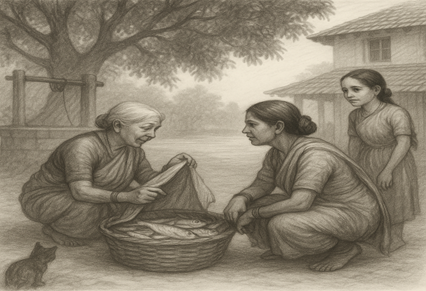
Peeling back the wet sack, she revealed the heap of shimmering Nogli, their bodies still gleaming. The freshness of the sea still clinging on to their fins & scales.
“Ayyo! Very fresh!” cried Kaveri, the house help.
Mamama’s eyes twinkled as she bent close. The familiar bargaining followed, ending with a laugh, a blessing and the gentle promise.
“Tumbha ananda aayitu Amma..….. Makallige nalla oota madona.”
Let the children enjoy their meal.
Soon the fish were carried beneath the great mango tree. Fins trimmed, guts cleaned, the soft flesh filleted. The heads, a delicacy loved by the women of the house, were set aside. A patient cat circled, rewarded with the trimmings.
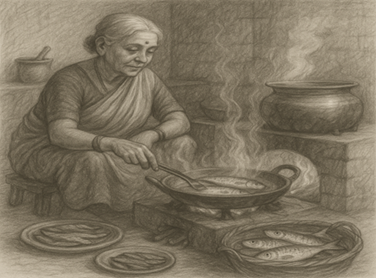
In the kitchen, Mamama guided the rhythm of preparation of the Ambot, the fish curry. Krishnabai, another of her house help, ground a fiery-red masala on the Ragado, the mortar, the sound echoing like a soothing drumbeat. Tamarind, dry chillies, garlic, roasted spices and dry coconut went in. Mamama judged each handful by instinct, not measure. In a wide brass pot, Nogli fillets and heads simmered slowly in a coconut-rich curry, balanced with the sharp tang of raw mango. The air thickened with fragrance.
On the iron tava, another batch of fish sizzled in coconut oil. The fish fillets were marinated with turmeric, salt, and chilli. Mamama watched each piece, lifting it just in time so that every slice was crisp outside yet melting within.
By noon, the long dining room was ready. Banana leaves glistened with a sprinkling of water. Red rice steamed in generous mounds. Fried Nogli gleamed golden, and ladles of tangy curry spread over the rice mounds, across the leaves.
We cousins chattered impatiently, elders settled cross-legged, Mamama waited with a twinkle in her eyes until the first mouthful was taken.
The taste was unforgettable, sea and spice, tide and hearth, all in a single bite.
Outside, the Arabian sea roared and the Gangavalli estuary flowed gently with the endless rhythm of life.
Inside Sahukar’s Mane, laughter rose, bowls emptied and stories flowed.
The Nogli had travelled far: from ocean to estuary, from Subraya’s net to Girija’s basket, from Mamama’s brass pot to our hungry tummies.
Wherever the Nogli may have started its journey in the sea, it always ended here, in the joy of family, in the memory of a meal that carried the soul of Gangoli itself.
Afterword: Nogli in Coastal Memory
Along the Konkani coast, Nogli has always been more than just food. In the fisher hamlets of Gangoli, Malpe and Bhatkal, its arrival was whispered about as if it were a guest from the sea, shy, delicate and fleeting. Families spoke of it with the same reverence they reserved for mango blossoms in spring or the first sheaves of paddy during Monsoons.
Old kharvi men often said that the sea gifted Nogli only when the rivers and backwaters were healthy, when mangroves sheltered crabs, prawns and fish fries, when tides flowed unhindered, when the estuaries still sang with life. In that sense, Nogli was like a sentinel of abundance: if it was there, the coast was well and healthy.
In village folklore, children were told stories of silver fish leaping toward the moonlight, their bodies carrying the blessings of the sea goddess. Women sang lighthearted songs while cleaning baskets of Nogli, teasing each other about whose husband would eat the biggest share of fried fish that day.
Even today, among the older generation, the memory of Nogli carries a softness. People recall how its curry would perfume an entire courtyard, how its fried flesh seemed to vanish on the tongue and how a simple afternoon meal became a celebration when the Nogli lay on the banana leaf.
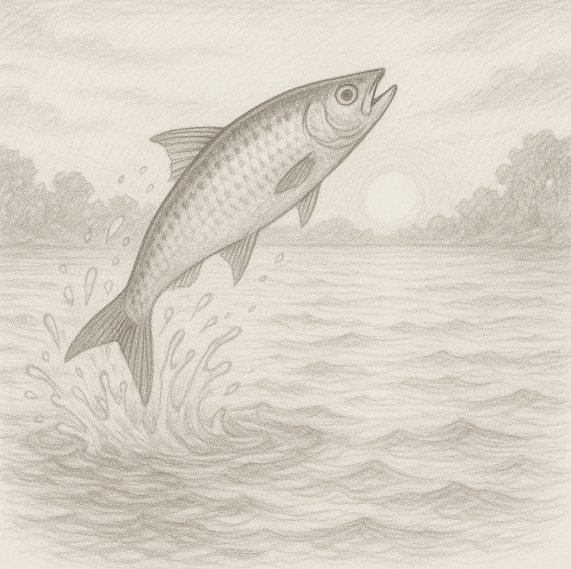
Nogli is not just a fish, it is a season, a memory and a taste of home.
Join our WhatsApp Group for News and Article Alerts



A lyrical celebration of the Konkani coast, this piece transforms the humble Nogli into a symbol of memory, heritage, and belonging. Vivid in detail and rich in feeling, it carries the reader from sea to hearth, leaving behind the lingering taste of spice, salt, and home.
At its heart, this is more than a story telling, story about fishing — it is a meditation on continuity. The Nogli is not just a seasonal catch; it is a marker of ecological health, a token of community, and a bridge between generations. The piece gently reminds us that traditions tied to land and water –akin to koile meen of Coorg.
What a beautiful and deeply nostalgic story. It brought back a flood of memories. Though I don’t eat fish myself, the descriptions of the preparation and the family gathering remind me of my own home—my father would eat fish, and my mother would lovingly cook it for him. This article truly captures the soul of a place and a family’s traditions. Thank you, CLN, and Dr. Prasad Kamath, for a great story.
Nostalgic is bittersweet. It reminds us of the joy we once knew, even as it aches for what we have lost. The “koile meen” may have been tiny, but they carried within them the essence of Kodagu – its simplicity, its community, its harmony with nature.
Today, those memories feel like echoes of another time. With paddy fields lying abandoned or converted for other uses, and with the shift to commercial crops, the little fish has almost disappeared. The silence of the empty fields reminds us not only of the loss of koile meen but of a vanishing way of life.
What a beautifully written article. Nogli or Kane or even more easily known as Lady Fish is known for its light, delicate flavour and tender, flaky texture. This fish has a slightly sweet taste and is characterized by its soft, moist flesh, making it ideal for grilling, frying, or preparing in curries. It is probably the best known and popular “starter” at Karavalli Restaurant at Taj Vivanta Residency Road.
In Kodagu, we have Koile Meen, commonly called Spiny Loach, with the scientific name Lepidocephalichthys thermalis. Difficult to get these days but a much sought after delicacy.
Wow, very nicely written story.
I could visualize the scenes while reading the story. Felt as if I was witnessing it….
Enjoyed the feel of coast, food, fish……
I have been receiving Koile Meen in my store for so many years – basket loads used to arrive as recently as ten years ago. These days, all the normal sources complain that there is hardly any fish as paddy cultivation has reduced dramatically and the use of chemical fertilizers has virtually finished off whatever little can be harvested.
A sad reflection of the times we live in.
Such an interesting read. Coorg must have a lot of stories to share which will educate tourists and visitors to understand the nuances of the need to be environmentally conscious and act responsibly.
Nostalgic..this story reminds me of my grandmother making koile meen curry and otti during monsoon holidays
I loved the way you traced the journey (destiny?) of Nogli. From the seas to the nets and then the taste buds of the family. The rich folklore and vivid descriptions are evocative.
Narayan Pai
Nogli is popularly known as KANE in coastal districts..Udupi and Mangalore.
Panch Gangavali river estury is the prime source this fish for both above districts.
Honnava , on North Kanara is another big source.
Stry reminds us of forgotten times.
What a Proustian effect this has initiated in me. A multi sensory experience just reading every sentence, so well crafted and narrated. Thank you Dr. Kamat. You certainly don’t have to fish for compliments.
I grew up hearing about Nogli season from my grandparents, but this tale paints it so vividly, I can almost taste the Ambot and smell the coconut oil. Such memories!
Thank you, Dr. Kamath, for reminding us that every seasonal arrival once meant a festival, a gathering, a moment of joy. Nogli will never taste the same without the stories behind it
What a beautifully written piece! The story brings alive the sights, smells, and emotions of the coast so vividly that one can almost taste the Nogli on the banana leaf. A true treasure of heritage, memory, and food culture—thank you for sharing this priceless slice of monsoon and a coastal life.🙏🌊🐟