

Another delightful story from an accomplished story teller Dr Prasad Kamath.
This was narrated to Prasad by his Grandfather when he was a child. The authenticity or otherwise of the facts cannot be verified despite earnest attempts, but even as an
anecdotal story, it is interesting as well as gently humorous!
While we don’t necessarily make Pathrode from Tree Colocasia amongst Kodavas, it is a monsoon delicacy relished with fresh Akki Ottis! The health benefits are immense –
the leaves contain phenols, tannins, flavonoids, glycosides and sterols, which help in reducing chronic inflammation such as rheumatoid arthritis. The leaves have significant amounts of vitamin C and beta carotene.
CLN eagerly awaits similar stories from Kodavas – what are you waiting for?!
– CLN Team
Back in the early years of Independent India, when statesmen wore sherwanis and the aroma of diplomacy mixed with spices, Pandit Jawaharlal Nehru had a special treasure in his kitchen — a Goud Saraswat Brahmin (GSB) cook named Padyar.
Stationed in New Delhi, Padyar was no ordinary cook. With his mastery of Saraswat cuisine, he had quietly charmed the palates of ambassadors and dignitaries from across the world. Among his arsenal of dishes, one humble item stood out — the delicious, earthy Phatrodo.
Now picture this: it’s the 1960s. President John F. Kennedy and First Lady Jacqueline Kennedy are on a state visit to India. Nehru, ever the gracious host, organizes a grand dinner at Teen Murti Bhavan. The menu is a blend of imperial meats and regal sweets — but nestled among them is a humble GSB marvel: Phatrode Phodi — crispy pan-fried leaf rolls, stuffed with spiced coconut and steamed to perfection.
As the Kennedys sampled this curious vegetarian dish, JFK paused mid-bite, visibly impressed.
“What is this?” he asked, eyes wide in wonder. “A leaf that tastes like a whole festival?”
Nehru chuckled and summoned the man behind the magic — Padyar himself.
With quiet pride, the GSB chef explained, “It is a leaf wrap of local herbs, coconut, tamarind… layered gently and steamed till tender. Then lightly fried.”
Kennedy was enchanted. “But what leaf is this? It melts in the mouth and leaves a spicy tingling behind. Surely, this must have a scientific name!”
Now, Padyar was in a fix. He only knew the leaf as ‘Patroda paan’ — its Konkani name. No English name, no Latin genus, nothing botanical.
But being a quick-witted GSB, he didn’t blink. With calm confidence, he announced:
“It is known as… Digdentelia khorjufolia.”
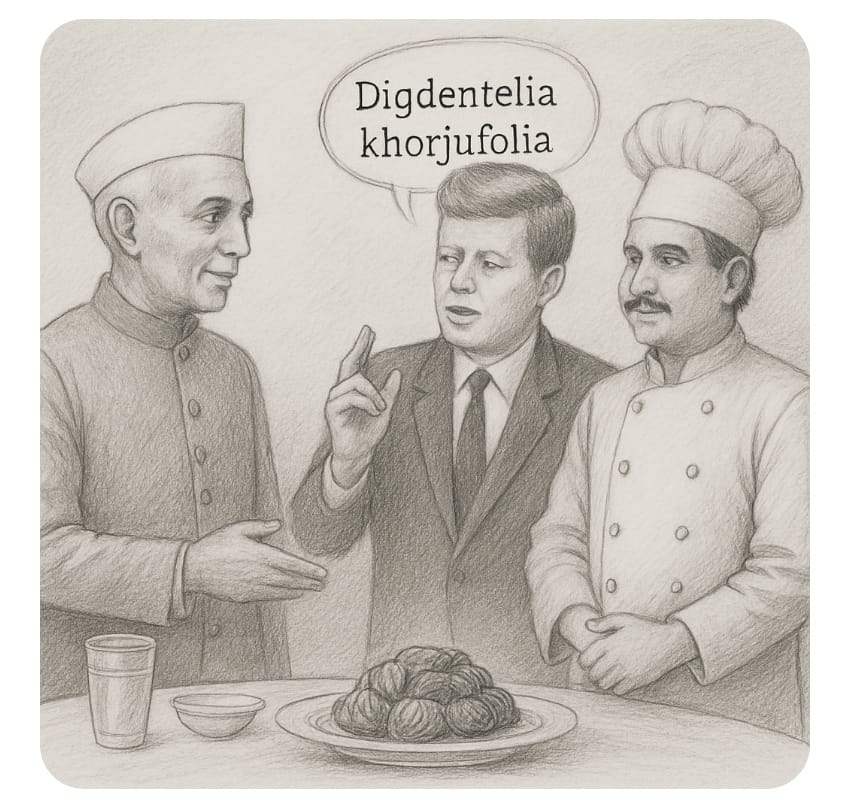
Kennedy nodded, impressed by the exotic-sounding name. “Beautiful,” he said. “Please give this man a raise, Panditji — on behalf of the United States!”
The other chefs stood stunned. How did this village-born cook rattle off such an elegant Latin name?
Padyar, ever the gentleman, later revealed the secret with a twinkle in his eye.
“Digdentelia,” he said, “comes from Diga dentu ashilo — meaning, ‘it had a long petiole’ in Konkani.”
And Khorjufolia? That was just his poetic take on ‘galek khoroju jatt mahnu’ — “that which gives a slight itch in the throat.”
A mix of sciencey mumbo-jumbo and Konkani genius. That’s GSB wit for you — the kind that can impress Presidents and invent botany on the spot.
Join our WhatsApp Group for News and Article Alerts



Delightful!!!! We are GSBs and can resonate with Padyar 😊
Good one. I am sure there are similar stories involving famous personaly from Coorg too. The land must be replete with hunting stories from the days that colonial planters owned coffee estates pre-Independence.
An Interesting story. Hope our own culinary custodians from Kodagu will showcase stories from our stable!
Sharing real life stories cannot be substituted with ChatGPT. What a wonderful anecdote that brings to life the showcasing of the simple culinary variety of food in India, hospitality and etiquette that bonds great leaders. And of course the most interesting character of the cook – Padyar – at his creative best!