With the arrival of the monsoon, the bridges of Coorg often attract negative attention – especially when floodwaters rise above them. But to me, they are a sight for sore eyes. In many ways, these bridges serve as informal rain gauges in the region. A villager in Bittangala once told me, “To know if the monsoon has been good, just count how many times the bridges were submerged and for how long.”
Two of the most important submersible bridges in Coorg are the Kushalnagar Bridge and the Bethri Bridge. The Kushalnagar Bridge connects Mysore with Coorg and Mangalore, while the Bethri Bridge links Kerala to the center of Coorg and Mysore.
Prior to 1834, permanent bridges across Coorg were virtually nonexistent. Temporary structures made of wood and rattan were erected before the monsoon and dismantled afterward. They were reconstructed during the trading season and again removed when their purpose was served. This practice was part of a deliberate military strategy by the Kodavas, who sought to keep Coorg free from permanent roads and bridges to prevent easy access for invading armies. Whenever Hyder Ali or Tipu Sultan attempted to build bridges, forts, or blockhouses, the Kodavas would destroy them at the earliest opportunity.
After the British annexed Coorg in 1834, development of new Roads and bridges became a priority, for their vested interest. The new Roads and bridges were constructed to maintain year-round communication between Mysore and South Canara (Mangalore) and to make it easy for British troops to access Coorg.
On March 18, 1835, Colonel Fraser wrote to William Hay Macnaghten, the Chief Secretary of India, requesting funds from the East India Company, stating:
“I consider it to be of great importance that a bridge should be built here [at Kushalnagar], as a measure that will tend in every respect to the improvement of Coorg and render the country at all times accessible to our troops.”
Initially, a metal and wood bridge was constructed at Kushalnagar. It was later upgraded to a stone-and-mortar structure and, in the 20th century, replaced with a reinforced cement concrete (RCC) bridge.
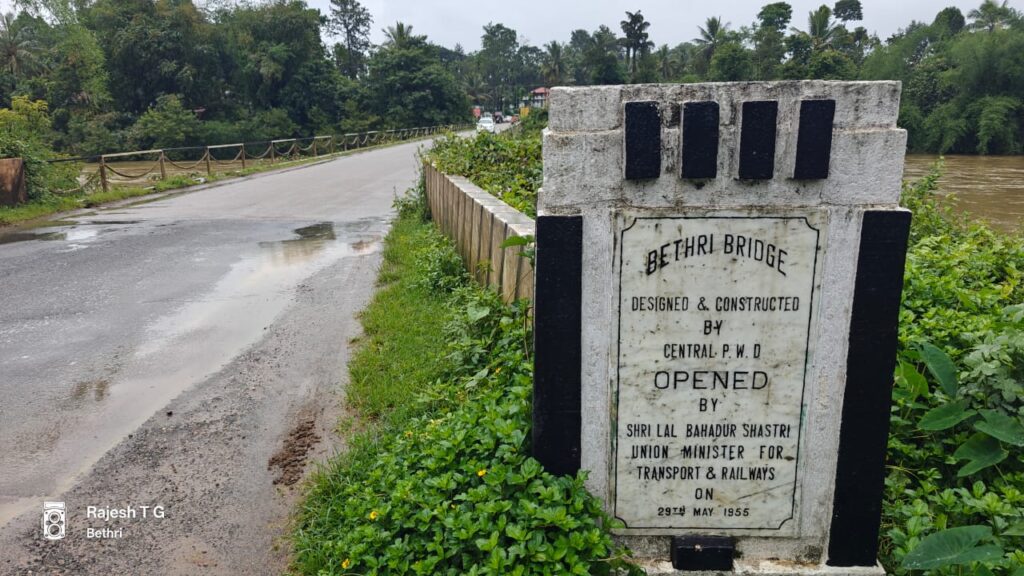 Interestingly, the plaque on the current Bethri Bridge states that it was inaugurated on May 29, 1955. However, the Mysore State Gazetteer (Coorg District), 1965 reports that the construction was completed in 1956.
Encroachment of River Banks
Flooding during the monsoon is a natural phenomenon and has long been part of life in Coorg. However, when people suffer losses and public outcry follows, the blame often lies with those who have encroached upon the riverbanks. Many of these dwellings or estates have been built on land that should never have been occupied.
The district administration would do well to remove these encroachments and resettle the affected people away from the rivers. This would not only help prevent recurring flood-related distress but also save public resources. Eliminating these annual crises could end the cycle of reactionary relief efforts and reduce the burden on taxpayers.
Join our WhatsApp Group for News and Article Alerts