

I begin this article by extending my deepest condolences to the families who have lost their loved ones in the ongoing conflict between humans, elephants, and other wildlife.
Both Victims: Humans and Elephants
Nowhere is this tragic reality more evident than in Kodagu (Coorg), Karnataka’s coffee heartland. This beautiful district has recorded the highest number of human fatalities arising from encounters with wild elephants in the State. Equally tragic is the number of elephants that have also lost their lives in this prolonged conflict.
The presence of elephants in Kodagu is nothing new. They have inhabited this landscape for centuries. Historically, the Kodavas and other communities who have lived on this land for generations coexisted with elephants in relative harmony, long before the emergence of coffee plantations. However, that relationship has changed dramatically over the past several decades. In particular, the last ten years have witnessed an unprecedented rise in human-elephant conflict.
To understand why elephants are increasingly venturing into agricultural plantations and human settlements, we must examine the historical disruptions, large-scale infrastructure projects, and changing land-use patterns that have systematically dismantled their traditional habitats and migratory corridors.
The Public Perception
Whenever human-elephant conflict intensifies, a familiar public perception emerges that the elephant population has increased dramatically in recent years. However, this assumption deserves closer examination, particularly when viewed against the backdrop of historical population estimates.
Community elders, retired forest personnel, and earlier generations who spent their lives in these forests often recall seeing far greater numbers of elephants deep within the wilderness than are commonly encountered today. While these observations are anecdotal, they raise important questions about how elephant populations have been estimated over the decades.
Estimating the Elephant Population
For many years, India’s wild Asian elephant population was officially estimated at between 25,000 and 30,000 animals, with Karnataka consistently supporting the country’s largest population of more than 6,000 elephants.
A significant advancement in population estimation came with the Wildlife Institute of India’s first nationwide DNA-based All India Elephant Estimation, which employed genetic mark-recapture techniques. This scientifically rigorous methodology established a more reliable national estimate of approximately 22,446 wild elephants.
Although Karnataka’s elephant population has shown a modest increase in successive state censuses, the available evidence does not support the notion of an unchecked population explosion. The much larger rise in human-elephant conflict is more plausibly explained by habitat fragmentation, the loss of traditional migratory corridors, expanding human settlements, and the increasing concentration of elephants within shrinking landscapes. Furthermore, India’s first DNA-based elephant estimation, in 2025, has established a new scientific baseline, making direct comparisons with earlier census figures inappropriate.
The widespread perception of an exploding elephant population is therefore misleading. What many people are witnessing today is not necessarily a dramatic increase in elephant numbers, but the increasing concentration of elephants within shrinking landscapes. As forests have steadily given way to agriculture, infrastructure, commercial development, and expanding human settlements, elephants have lost substantial portions of their traditional habitat and many of their historic migratory routes.
Consequently, elephants are now forced to traverse plantations, roads, and villages far more frequently than they did in the past. This increased visibility often creates the impression that elephant numbers have surged, when, in reality, habitat fragmentation has compressed their movements into landscapes now dominated by human activity.
The available scientific evidence suggests that the greater conservation challenge today is not unchecked population growth, but the continued fragmentation of habitat. This makes the protection, restoration, and legal recognition of ecological corridors more urgent than ever.
Herd Fragmentation
Another profound and highly visible consequence of habitat loss is the fragmentation of elephant herds. Over the past two to three decades, there has been a marked shift in elephant social structure and herd behaviour.
Until the latter half of the 20th century, it was not uncommon to witness large herds of 50, 60, or even more than 100 elephants moving together across the forests of southern India and the Nilgiri Biosphere landscape. Such large congregations have now become exceedingly rare. Instead, elephants are increasingly found in much smaller, isolated family groups scattered across fragmented habitats.
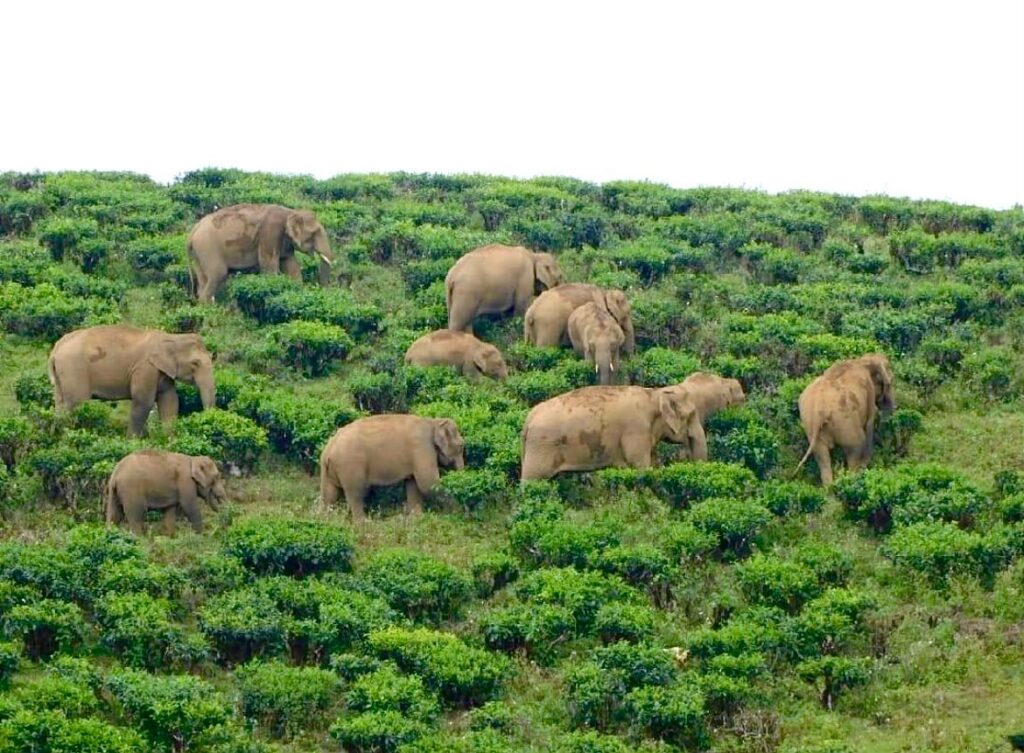
Elephants are among the most intelligent and socially complex mammals on Earth. Their herds are matriarchal, with family groups maintaining strong social bonds that have evolved over generations. These family units generally remain within their traditional home ranges and seldom integrate with unrelated herds.
As human development has progressively divided once-continuous forests into isolated patches, these closely knit elephant families have also become fragmented. Rather than merging with unfamiliar herds, many family groups have retreated into smaller pockets of habitat in search of security while avoiding both human activity and competition with other elephant groups.
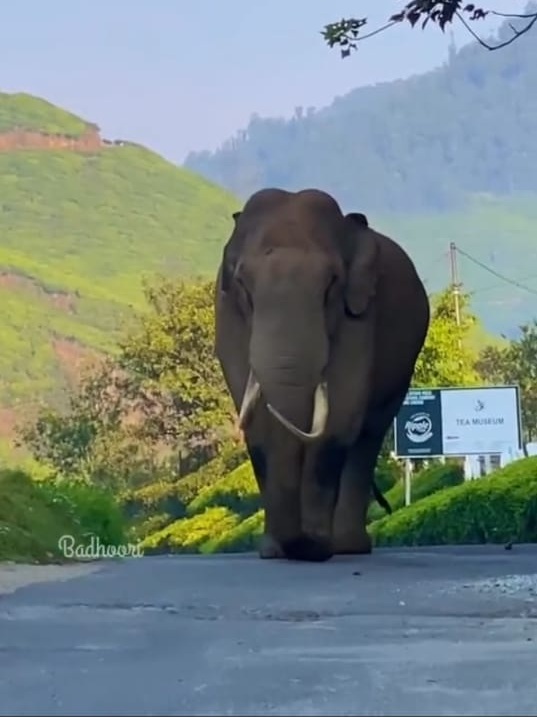
Adult bulls, on the other hand, naturally roam over much larger areas in search of mates. As habitats become increasingly fragmented, these solitary males are compelled to move through plantations, roads, and villages while travelling between isolated elephant populations. Consequently, the growing number of lone bulls seen in human-dominated landscapes is often interpreted as evidence of rising elephant numbers, when it may instead reflect the breakdown of traditional habitat connectivity.
What appears to be an influx of elephants is, in many respects, the visible consequence of a fragmented elephant society attempting to navigate a landscape that has been fundamentally altered by human activity.
Historical Habitat Degradation
The roots of this displacement can be traced back more than six decades.
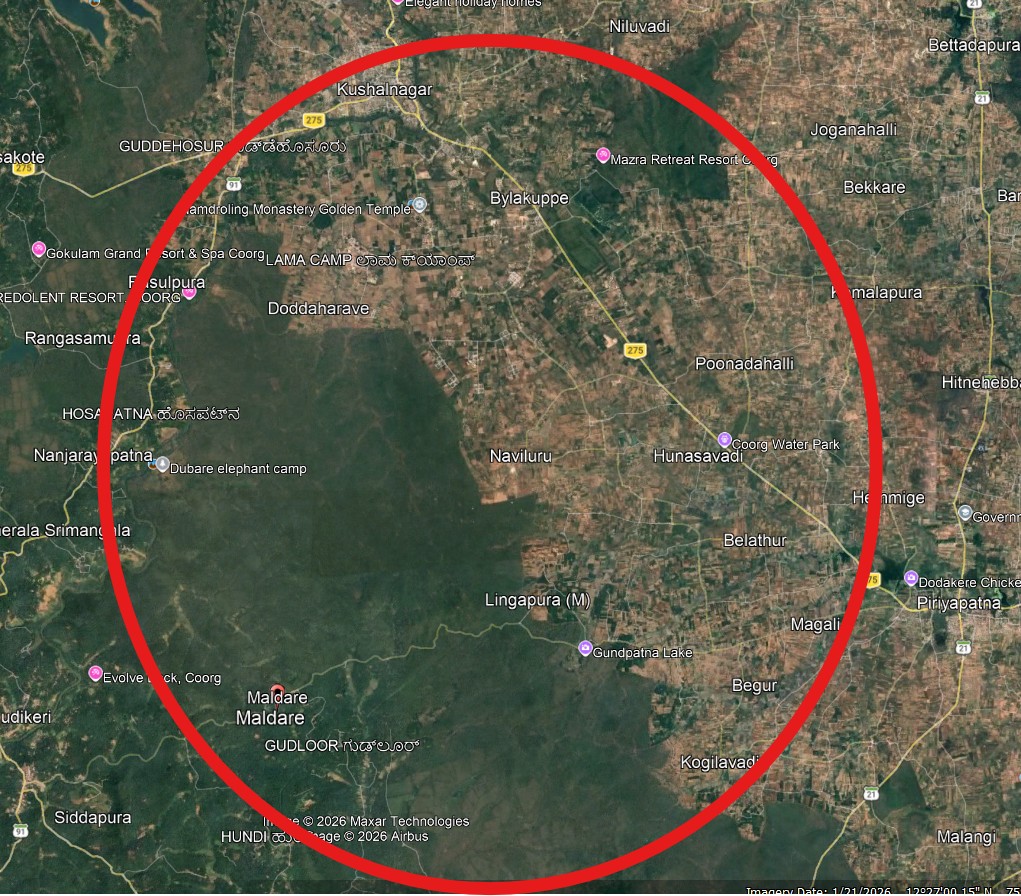
The region encompassing Maldare, Kushalnagar, and Bylakuppe was once an extensive elephant habitat, consisting of thousands of acres of dense forests interspersed with vast bamboo groves. These forests served as important seasonal feeding grounds and congregation areas for migrating elephant herds. More importantly, they formed a vital link in one of southern India’s major elephant migratory routes, connecting Maldare through Thithimathi and Nagarahole to the wider Nilgiri Biosphere Reserve.
A significant ecological transformation occurred during the 1960s with the establishment of the Tibetan refugee settlements at Bylakuppe. Large stretches of the original forest were cleared to accommodate the settlements, resulting in the loss of substantial elephant habitat. Among the most significant losses were the extensive bamboo forests, which constituted an important natural food source for elephants.
The consequences extended beyond the loss of forage. The clearing of these forests disrupted a landscape that had supported elephant movement for generations. Today, the region has become heavily populated and extensively developed. Human activity now dominates the area, leaving little trace of the once-continuous forests through which elephants historically migrated.
The Harangi Dam and the Expansion of Commercial Development
The next major turning point came with the construction of the Harangi Dam between 1968 and 1986.
The project permanently altered the landscape and further disrupted elephant movement across the region. The corridor extending from Maldare and Kushalnagar towards Anekad, Somwarpet and the Madapur region was effectively severed. When viewed together with the earlier loss of habitat around Bylakuppe, the construction of the dam represented another major interruption to a long-established migratory route.
For several decades thereafter, Kodagu’s interior remained relatively insulated from large-scale commercial development. Through much of the 1980s and 1990s, significant portions of the district retained their traditional land-use patterns and comparatively low levels of urbanisation.
However, the landscape underwent another profound transformation following the abolition of the Jamma land tenure system. As traditional landholding patterns changed, increasing commercial interest in Kodagu’s interior accelerated land transactions and altered the character of the district.
The Real-Estate and Infrastructure Boom
The early years of the new millennium witnessed an unprecedented real estate boom. Rising purchasing power and substantial external investment fuelled widespread land acquisitions, ownership transfers, and land-use conversion. Commercial development expanded rapidly into previously undisturbed areas, bringing roads, buildings, resorts, plantations, and other infrastructure deeper into the district.
The cumulative impact of six decades of habitat loss, interrupted migration routes, infrastructure development, and expanding commercial activity has fundamentally altered Kodagu’s ecological landscape. As elephant habitats have become increasingly fragmented, human-elephant interactions have become not only more frequent but also increasingly inevitable.
Great Forests and The Choked Corridors
Kodagu occupies a unique geographical position within the Western Ghats. It is surrounded by extensive forest ecosystems and protected areas, including the Talakaveri, Brahmagiri and Pushpagiri Wildlife Sanctuaries, Nagarahole National Park, and the forests of the Maldare region. These landscapes have historically functioned as interconnected habitats through which elephants migrated seasonally in search of food, water, and mates.
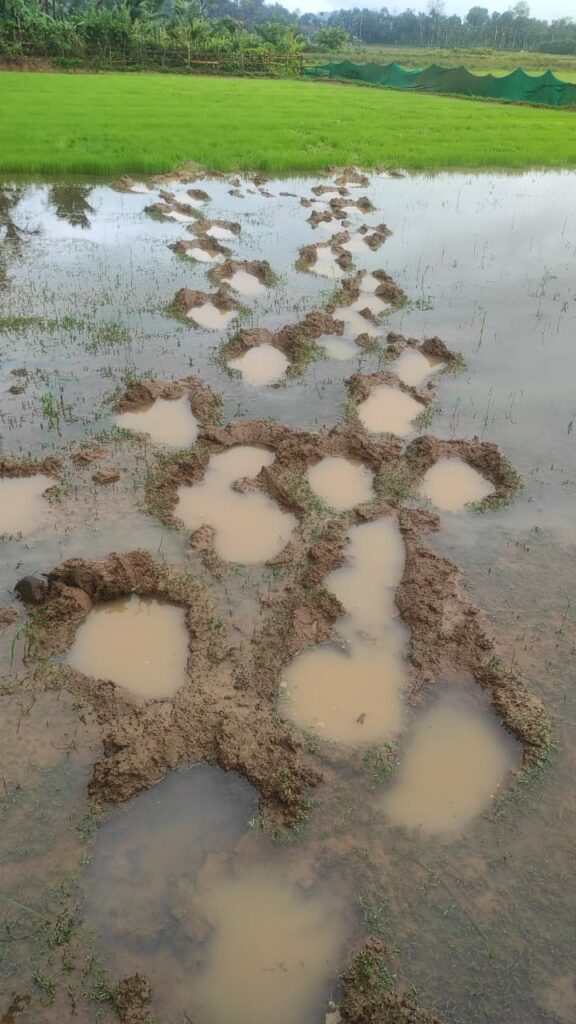
Because elephants are naturally migratory animals, the uninterrupted movement between these forests is essential for maintaining healthy populations. When these traditional pathways are obstructed, elephants are inevitably forced into agricultural lands and human settlements, increasing the likelihood of conflict.
The Kutta-Wayanad (Begur) Corridor
One of the most significant traditional corridors connected Brahmagiri, Kutta, Begur, and Wayanad. Over the years, this route has come under increasing pressure from expanding human settlements, agricultural activities, infrastructure development, and other forms of land-use change. The gradual narrowing of this corridor has considerably restricted the free movement of elephants across the landscape.
The Nanjarayapatna-Valnur (Maldare-Anekad) Bottleneck
Another critical corridor lies between Nanjarayapatna, Valnur, Maldare, and Anekad. This narrow passage has become one of the most heavily constrained movement routes in Kodagu. As development has intensified around this bottleneck, elephants are left with progressively fewer options, forcing them to navigate through fragmented spaces that frequently pass directly through coffee plantations and villages.
In an effort to reduce conflict, the Forest Department has introduced various mitigation measures, including elephant-proof trenches (EPTs), solar fencing, and rail barricades across several vulnerable locations. While these interventions have undoubtedly reduced elephant movement at certain points, they have also produced unintended consequences in others.
When long-established migratory routes are completely blocked, elephants do not simply abandon them. Instead, they begin searching for alternative passages, many of which pass through private plantations and human habitations.
Older matriarchs play a particularly important role in this process. They carry the collective memory of the herd, leading family groups along routes that have been used for generations. When these traditional pathways are obstructed by steel barricades, trenches, or other permanent structures, the herds continue attempting to follow their ancestral routes, often encountering human settlements in the process.
Whether this behaviour should be interpreted as an expression of persistence rooted in ancestral memory or simply as a survival response is open to scientific discussion. Regardless of the interpretation, the outcome remains the same: increased interaction between humans and elephants, resulting in greater risks for both.
The Nagarahole Challenge
One of the most complex dimensions of the human-elephant conflict is found along sections of the Nagarahole Tiger Reserve boundary, particularly around the Konnankatte region. This landscape includes approximately 450 acres adjoining tribal settlements such as KM Kolli, Airyasulli, and Chinni Hadlus and have been provided Hakku Patras (Title Deeds) issued by Revenue Department.
Settlements situated within or adjacent to important elephant corridors create complex management challenges. Balancing the rights and welfare of resident tribal communities while maintaining functional wildlife corridors remains one of the most difficult aspects of managing human-elephant conflict.
Problems tend to arise when forest settlements expand or are accompanied by roads, electricity, schools, markets, fencing, agriculture, and increased human activity. These features can fragment habitat and increase encounters between people and elephants. Several stretches of the settlement boundary continue to rely primarily on elephant-proof trenches and solar fencing rather than permanent rail barricades.
Elephant-proof trenches around these settlements gradually erode, accumulate silt, or require frequent maintenance. Solar fences may also become ineffective when damaged by fallen trees or other natural causes. Elephants, renowned for their intelligence and adaptability, are capable of learning how to exploit weaknesses in these systems over time.
Consequently, recurring breaches occur along sections of the reserve boundary, enabling elephants to establish new movement routes through adjoining plantations and villages. Areas such as Thithimathi, Konnankatte, Chennangolli near Pollibetta, Siddapur, Kutta, the surroundings of Irupu Falls, and several other settlements bordering the reserve continue to experience some of the highest levels of human-elephant conflict in Kodagu.
These recurring incidents illustrate that the challenge extends beyond preventing elephant movement. It is fundamentally a landscape-level issue requiring long-term ecological planning rather than relying solely on physical barriers.
In one survey across four protected areas, about 89% of surveyed households expressed willingness to relocate voluntarily, although researchers stressed that long-term rehabilitation and livelihood support are critical for success. Where settlements are located within core wildlife habitats or critical elephant corridors, voluntary, well-planned relocation with informed consent, fair compensation, and sustainable rehabilitation has the potential to benefit both wildlife conservation and the long-term welfare of the communities concerned. However, relocation alone cannot resolve human-elephant conflict unless it is accompanied by the restoration of wildlife corridors and landscape-level habitat connectivity.
Restoring the Landscape, Not Merely Containing the Conflict
If we are to resolve a crisis that has been unfolding for more than six decades, our approach must move beyond reactive measures and embrace long-term landscape restoration. While barriers such as elephant-proof trenches, solar fencing, and rail barricades have their place in conflict mitigation, they cannot serve as permanent solutions if the underlying ecological issues remain unaddressed.
The focus must shift from merely preventing elephant movement to restoring the ecological connectivity that once allowed elephants to move safely across the landscape.
One of the most important steps is to recognise that elephant habitats and elephant corridors are not the same. Protected forests provide elephants with areas to live, feed, breed, and raise their young. Corridors, however, serve a different purpose. They are narrow stretches of land that enable elephants to move safely between larger habitat blocks while maintaining natural migratory patterns.
As habitat fragmentation continues, the legal recognition, protection, and restoration of these corridors should become a conservation priority. Wherever scientifically and socially feasible, the placement of rail barricades and other permanent barriers should be periodically reviewed to ensure that they do not unintentionally obstruct traditional migratory routes. Maintaining carefully planned and designated passageways would enable elephants to move between forests while reducing the likelihood of them entering coffee plantations and human settlements.
Habitat restoration should form another important pillar of long-term management. Native vegetation, particularly bamboo and other traditional forage species that once flourished across these landscapes, should be restored within suitable forest buffers and degraded habitats. Re-establishing these natural feeding grounds would not only improve habitat quality but also reduce the need for elephants to forage within cultivated areas.
Equally important is the need for coordinated landscape planning that balances conservation objectives with the legitimate needs of local communities. Infrastructure development, land-use planning, and future commercial expansion must take wildlife movement into account so that the mistakes of the past are not repeated.
Moving Beyond the Blame Game
Elephants are, by nature, intelligent, social, and remarkably predictable animals. Their movements are guided by generations of accumulated knowledge, with herds relying heavily on ancestral migratory routes that have existed for centuries. The increasing presence of elephants in plantations and villages should therefore not be viewed simply as a behavioural change on the part of the animals, but as a consequence of profound changes to the landscape through which they have always travelled.
Over the past six decades, the cumulative impact of forest clearance, the loss of traditional feeding grounds, the construction of major infrastructure such as the Harangi Dam, expanding settlements, commercial development, and the fragmentation of wildlife corridors has steadily reduced the space available for elephants to move freely.
The resulting conflict is therefore not the product of a single event, nor can it be attributed solely to an increase in elephant numbers. Rather, it is the outcome of decades of landscape transformation that has compressed both humans and elephants into increasingly shared spaces.
If Kodagu is to restore a more peaceful coexistence between people and wildlife, the conversation must move beyond assigning blame. The emphasis should instead be on understanding the historical causes of the conflict, protecting and restoring ecological connectivity, and implementing science-based management strategies that safeguard both human lives and wildlife.
Only by addressing these root causes can we hope to reduce conflict in a meaningful and lasting manner. The objective should not be to prevent elephants from moving altogether, but to ensure that they have safe, designated routes through which they can continue the migrations that have shaped the ecology of the Western Ghats for centuries.
The facts, views and opinions expressed are solely those of the author and do not necessarily reflect the views of Coffeeland News.
Join our WhatsApp Group for News and Article Alerts



Once feared, chased, and hated the elephants of Assam’s Hatikhuli now walk peacefully through farms — thanks to a simple, extraordinary idea: feed, don’t fight. Learn how 90-year-old conservationist Pradip Kumar Bhuyan, Binod Dulu Bora, and the community turned fear into friendship, planting food for elephants, mapping migration routes, and creating safe corridors. Today, over 300 elephants pass through Hatikhuli every year, and villagers thrive alongside them.
Read the storty at: https://assamtribune.com/assam/how-farmers-of-this-assam-village-are-securing-crops-with-elephant-feeding-zones-1559066
Celebrations by doing Puja to the venerable pachyderm in captivity is somewhat sad in concept. It’s even worse to see them “perform” within the precincts of temples.
Sharing this thought provoking video on the state of India’s elephants on the occasion of World Elephant Day.
𝗚𝗶𝘃𝗲 𝘁𝗵𝗲𝗺 𝘀𝗽𝗮𝗰𝗲….. 🐘
𝗧𝗵𝗲𝘆 𝗱𝗲𝘀𝗲𝗿𝘃𝗲 𝗶𝘁 as 𝗺𝘂𝗰𝗵 as we 𝗵𝘂𝗺𝗮𝗻𝘀
There is a complete overlap or familiarity of the issues mentioned in the excellent article by Navin that affects us in the Nilgiris, where I have spent most of my working life. Have encountered every form of large “territorial” animals from elephants, tigers, leopards, gaurs, bears, Nilgiri tahr, Nilgai and so on. As earlier mentioned in the comments section, the Nilgiri is a single ecological unit. Elephants and tigers move across the three states irrespective of political boundaries. Conservation and conflict mitigation therefore have to be planned at the landscape level rather than through isolated state-level interventions.
However, of all the issues that affect these animals most it is the lack of “food” – poor forest management. Native grasslands have disappeared, reducing forage for herbivores and altering wildlife movement, which in turn contributes to conflict along the forest edge. It is here that it is worth asking – so many large corporates and other businesses benefit from operating plantations, resorts and other industries in these enchanting landscapes – can’t they contribute to maintaining the salubrious environment? It is heart rending to see wild animals eating from garbage dump yards created by municipalities and tourists alike. Where is the human conscience?
It is deeply painful to see elephants rummaging through and eating from garbage dumping yards. The lack of empathy and responsibility towards waste disposal is deeply disturbing. People keep the surroundings of their own homes clean, but once the waste crosses their property boundary, they seem to consider it someone else’s problem.
I have personally come across diapers, manure bags and various forms of plastic in elephant dung. This is not merely a waste-management failure; it is a serious threat to wildlife.
When garbage enters forest habitats and elephants begin feeding on it, the consequences can be devastating.
We cannot claim to care about wildlife while continuing to treat forests and their surroundings as dumping grounds. The responsibility lies with everyone, including residents, tourists, travellers, local bodies, businesses and the authorities responsible for managing these areas.
We had earlier attempted to conduct a plastic-free campaign in Nagarhole Tiger Reserve. Unfortunately, the initiative faced opposition from some individuals residing within the forest, and a atrocity case under the Scheduled Castes and Scheduled Tribes (Prevention of Atrocities) Act was also filed against me.
Travellers using roads passing through the forest, tourists visiting the elephant camp inside the reserve, and people residing within the protected forest – all contribute to the accumulation of plastic waste.
It is time for people to think beyond their own doorsteps. Environmentally sensitive regions such as Coorg, the Nilgiris and the Western Ghats must be kept free from single-use plastics. The Government and all stakeholders must take stock of the situation and launch a comprehensive, time-bound garbage-free campaign on a war footing. The present system of waste management clearly needs a major overhaul.
Gram Panchayats, which are the primary local bodies responsible for waste management in villages, have, in many instances, failed to deliver an effective and sustainable garbage-management system. Unless this institutional failure is addressed and clear accountability is fixed, efforts to keep the forests and surrounding areas free from plastic and other waste are unlikely to succeed.
Good to see CLN Online regularly carrying articles on the Environment, Climate Change, Wildlife, Human Animal Conflict and related topics. Credit to Navin for an exceptionally well documented article. The human animal conflict issue is as old as the hills. Elephants have roamed the forests for centuries and are great wanderers. I quote Dr C.K. Vishnudas, wildlife biology expert, “Wildlife populations have recovered because conservation has succeeded, but coexistence has not received the same attention. The next phase of conservation must focus on securing corridors, restoring degraded habitats, reducing invasive species, strengthening early warning systems and involving local communities in decision-making. Otherwise, both people and wildlife will continue to suffer”.
Ecological knowledge of tribal communities who have lived within these forests for centuries is crucial. None of the measures for managing (Human Elephant Conflict) “HEC” can succeed in isolation. They demand cooperation that goes beyond political boundaries. In the case of the Nilgiris Biosphere Reserve, it spans across three states – Karnataka, Tamil Nadu and Kerala – yet each state has their own policy and procedures for the same large territorial animals who move about without any consideration for State boundaries. The irony is that the concerned Forest Departments don’t seem to recognize this crucial fact.
I missed out on one more important point. When elephants are being driven back towards the Reserve, they do not necessarily return to the forest. They often circumvent the Reserve and make their way back into human habitations, or take refuge in large Devarkadus or neglected estates. This has, over time, habituated them to this cycle.
More importantly, from a humane and practical standpoint, it is simply not possible to drive such a huge animal out of a human dominated landscape easily. The operation involves considerable risks, both to the elephants and to people. These complexities are often very difficult to explain to those who casually question or criticise the Forest Department without understanding what is actually involved on the ground.
With regard to the tribal communities, as you rightly pointed out, their traditional knowledge and understanding of the forest are important and should be respected. However, it is also important to acknowledge the historical context. A large majority of the tribal communities currently living inside these forests were brought into the region around 150 years ago, particularly for timber related work during the British period, including in what is today the Nagarhole Tiger Reserve.
Earlier, many of these communities lived sustainably outside the forest and traversed the landscape largely on foot. Today, circumstances have changed considerably. Many who live inside Nagarhole, have Motor vehicles (bikes, cars and jeeps) and move through these areas day and night, with relatively unrestricted movement, while communities living just outside the forest often face much greater restrictions. Although there are provisions for using Forest Department vehicles and services, these facilities are not utilised.
Missionary activities relating to conversion have also, in some instances, influenced livelihoods and social dynamics, while votebank politics has become an important factor in shaping decisions and interventions concerning these communities.
There has also been a visible change in the way the forest is used. Earlier, people lived much more lightly on the landscape. Today, discarded alcohol bottles, sachets and other plastic waste can be found in the forest. A significant proportion of their livelihood is now outside the forest, with people working in estates and plantations, while the remaining time spent inside the forest continues to have an impact on the habitat.
The answer, therefore, should not be to simply displace or ignore these communities. They need greater support and viable opportunities to live and earn their livelihoods outside the forest, or, alternatively, there must be stricter, fair and consistently enforced rules governing activities within Nagarhole. The objective should be to find a balance where the communities can live with discipline, dignity and security, while the forest and its wildlife are also allowed to thrive.
Dear Mr. Bopaiah,
Yours is a well written synopsis of an often misunderstood conflict. The foundation of its merit rests your excellent research and extensive experience with nature and wildlife. It is a beacon to both layman and designated authorities, which should be followed to lead us and our wildlife out of this conflict which is sadly going to claim many more lives on both sides of the species divide in the years to come .
I look forward to more such informative articles from you.
Thank you Dr. Ravin. I agree. Without a sustained scientific approach this conflict won’t end. Many plans exist with the authorities, but the govt is holding them back due to financial constraints, legal hurdles and political interference.
An excellent article encompassing all aspects related to the case of the increase in the human animal conflict especially in Kodagu District. Do hope Forest and Wildlife department will take concrete steps to implement strategies to ensure safety for both humans and wildlife.