Constitutional protection for the Kodava community is essential to preserve its unique identity and safeguard India’s pluralistic character, Supreme Court advocate Vikram Hegde asserted while addressing a national symposium organised by the Kodava National Council (CNC.
The symposium, titled “Special Status for Kodavas: Constitutional Pathways and International Law,” was held at Capital Village, on the outskirts of Madikeri.
Speaking on the topic “Kodava Religious Practice – Kovi-Tok as an Essential Religious Practice under Articles 25 and 26,” Vikram Hegde said that the demand for constitutional protection for Kodavas is both legitimate and consistent with the framework of the Indian Constitution.
He observed that Kodagu, which once enjoyed distinct political status, has gradually been merged into larger political constituencies, resulting in diminished representation for the indigenous Kodava community.
Referring to the forthcoming delimitation exercise, Hegde said objective, data-based submissions should be placed before the Election Commission of India in support of creating a separate Lok Sabha constituency for Kodagu.
He noted that Kodagu had previously existed as a Part-C State with its own 24-member Legislative Assembly, but is now part of a much larger parliamentary constituency where, according to him, voters from Mysuru outnumber those from Kodagu by nearly three to one, making independent political representation increasingly difficult.
He said any proposal for a separate parliamentary constituency should be supported by detailed documentation highlighting Kodagu’s distinct geography, comprising the ecologically sensitive Western Ghats, its unique Jamma, Sagu and Bane land tenure systems, and its horticulture-based economy.
He also suggested that resolutions supporting the proposal should be adopted by Gram Panchayats and the Zilla Panchayat.
Speaking on the Kodava tradition of “Kovi Haak (Gun Rights),” Hegde said the practice represents an integral part of the community’s religious and cultural identity. He referred to the Karnataka High Court’s recognition of the exemption available under the Arms Act and argued that the practice should receive permanent constitutional protection as an essential religious practice under Articles 25 and 26 of the Constitution.
He stated that Kodava rituals associated with birth, death, KailPodh and Puttari are traditionally incomplete without the ceremonial use of firearms, adding that the status of Kovi Haak is comparable to certain constitutionally protected religious practices enjoyed by the Sikh community.
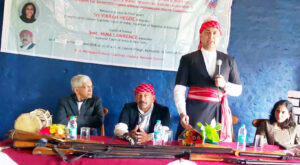
Another session was addressed by Supreme Court advocate Hima Lawrence Vikram Hegde, who spoke on “Codavaland: Geopolitical Autonomy, Self-Government and Ancestral Kodava Ethnic Identity under International Law”.
She said the constitutional response to protecting a small community with its own language, customs, sacred places and lineage should not be based on numerical strength but on preserving its unique identity.
“A community should not be denied protection because it is small. Rather, its distinct identity deserves greater constitutional safeguards,” he observed.
She further stated that Kodagu’s traditional landholding systems, sacred groves, agriculture and coffee cultivation are inseparable from the culture and identity of the Kodava people.
“Development cannot be measured solely through resorts and concrete structures. True development lies in preserving both the environment and the cultural heritage of the region,” She said.
She also emphasised the importance of promoting the Kodava language through education, digital documentation and greater use in public life to ensure its long-term survival.
Senior advocate K.P. Balasubrahmanya, who attended as the chief guest, described the Kodavas as a rare indigenous community and said extending constitutional protection to them was the need of the hour.
He commended the 36-year peaceful movement led by the Codava National Council (CNC) under the leadership of N.U. Nachappa and appealed to the community to continue supporting the movement.
Presiding over the symposium, CNC President N.U. Nachappa reiterated the organisation’s commitment to securing geopolitical autonomy and self-governance for Codavaland.
He said the peaceful struggle would continue until both the Union Government and the Karnataka Government provide constitutional safeguards to protect the identity, culture and rights of the Kodava community.
Nachappa also referred to parliamentary recognition accorded to the Kodava “Kovi”(Gun) tradition in 1949, the Karnataka High Court judgment of December 8, 2021, restoration of the Kodava identity, permanent exemption for Kovi-Tok, restoration of hereditary Jamma-Bane lands, and the need to distinguish indigenous ethnic farmers from ordinary revenue farmers under international law.
The symposium also proposed several constitutional measures, including special political representation for Kodavas in Parliament and the Karnataka Legislative Assembly on the model of Sikkim’s Sangha constituency, as well as the creation of a separate code and column for Kodavas in the 2027 Census of India and the proposed caste census.
Participants stated that the symposium reflected the long-standing aspirations of the Kodava community for constitutional recognition and special status.
A resolution moved by N.U. Nachappa, seeking geopolitical autonomy for Codavaland for the indigenous and nature-worshipping Kodava community, was unanimously adopted at the symposium.
A large number of community leaders, former civil servants, academicians, advocates and members of the Kodava community attended the event.
Join our WhatsApp Group for News and Article Alerts